24

amberBy Amber Cullen a member of Mission Year Team Member in Philadelphia.

I’m drivin’ down the highway at 65mph
And I’m lookin’ out on the plains, the beautiful Ohio plains
With trees standing solitary in the middle of the vastness
And the sky so blue like the most satisfying drink of water
And the tires are pounding the pavement and my hair is out and
All at once I’m laughing, tears flying, exhilarated to be—just be.
Not like the world is any less painful or that things are any less messed up
Or like somehow I’ve convinced myself that these plains are the escape from it all
Because it all is still here (right here) and everything is still hard
But for now Ima sit with the rhythm of the plains and just be. Continue reading “24”

Tangela Harris—Remembering a Fierce Midwife of Justice

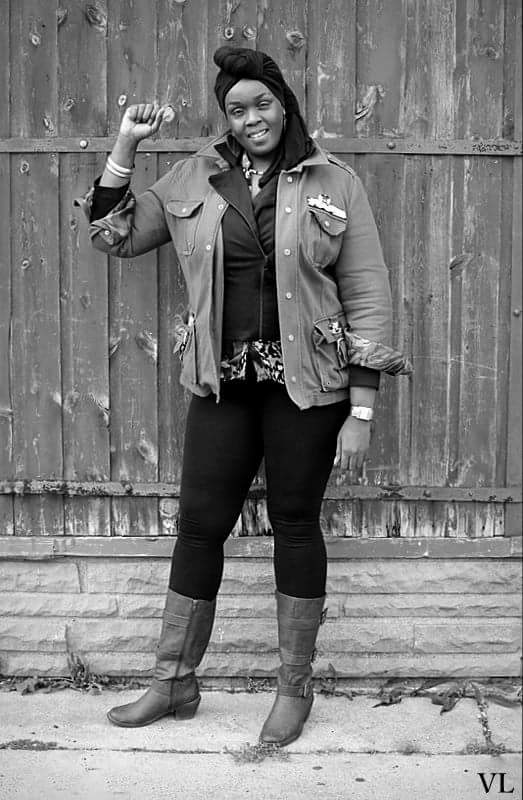
TangelaBy Lindsay Airey

The white fathers told us, I think therefore I am; and the black mothers in each of us—the poet—whispers in our dreams, I feel therefore I can be free.
Audre Lorde

Tangela. Dear, fierce and tender Tangela. I just heard the news. I don’t even know how you died. I just got word pouring in over social media. 40 years old. How can you be dead? How can it be true?

Mind racing with questions. And tears. Tears and tears and tears. How can it be so? You were so ALIVE! Oh, and the children. The babies who must be grieving your loss. You were so beloved. So depended upon. So ready to respond in the time of need. So true a human. Oh, and how great were the burdens you carried. Rest now, dear Sister. Though our tears and cries long to bring you back, to fill the great void you have left.
Continue reading “Tangela Harris—Remembering a Fierce Midwife of Justice”

Reflections on the Hebrew Midwives

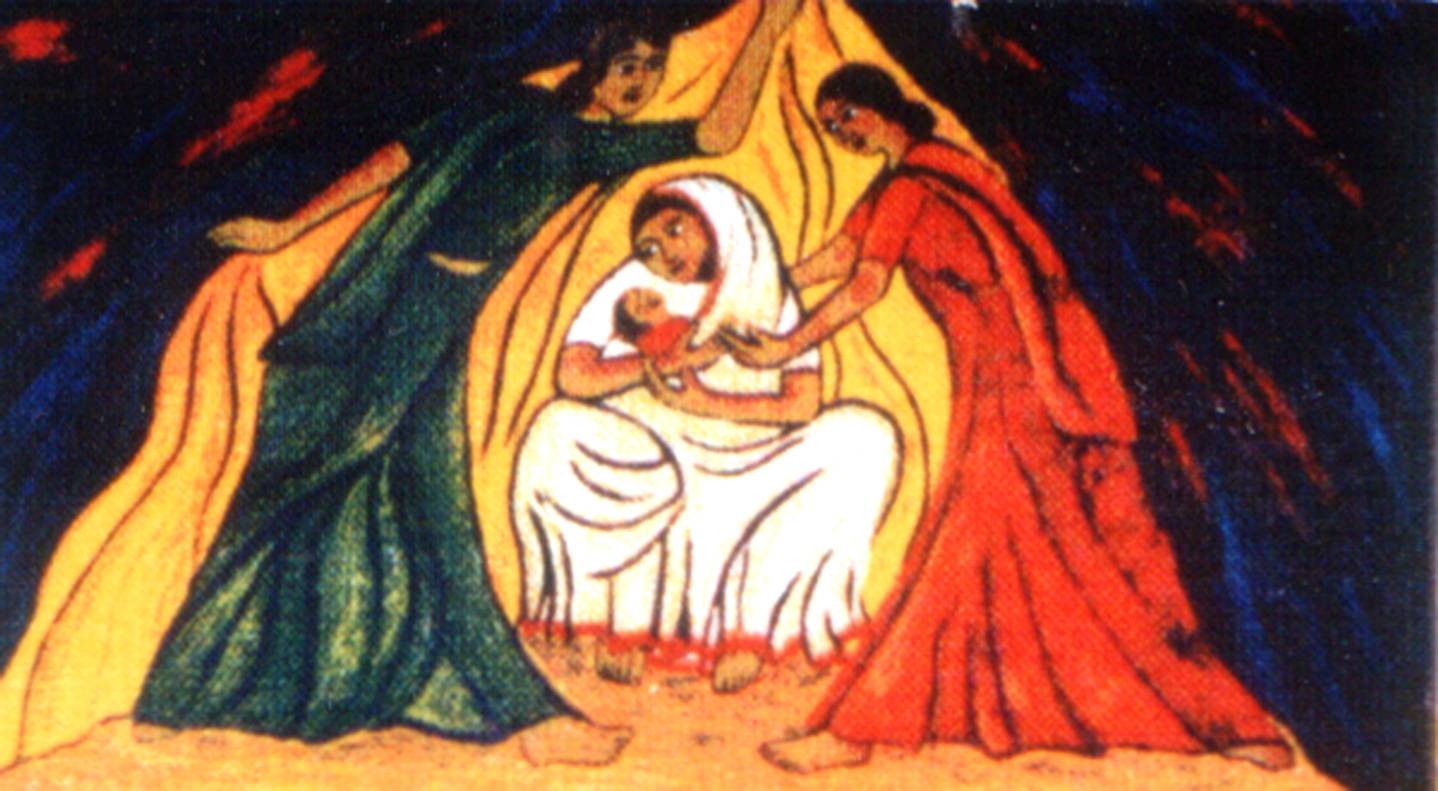
midwivesThird post in the series on radical biblical women. Written by Amanda Dalosio who lives in NYC with her family and is part of the New York Catholic Worker community.

Exodus 1:15 The king of Egypt said to the Hebrew midwives, one of whom was named Shiphrah and the other Puah, 16 “When you act as midwives to the Hebrew women, and see them on the birthstool, if it is a boy, kill him; but if it is a girl, she shall live.” 17 But the midwives feared God; they did not do as the king of Egypt commanded them, but they let the boys live. 18 So the king of Egypt summoned the midwives and said to them, “Why have you done this, and allowed the boys to live?” 19 The midwives said to Pharaoh, “Because the Hebrew women are not like the Egyptian women; for they are vigorous and give birth before the midwife comes to them.” 20 So God dealt well with the midwives; and the people multiplied and became very strong.

The account of the two midwives, Shiphrah and Puah, is set in a scene of overwhelming cruelty and oppression. The King of Egypt has enslaved the people of Israel having set taskmasters over them to oppress them with forced labor Ex1:11 who are ruthless in all the tasks that they imposed on them Ex 1:14. Yet out of this misery comes a moment of great courage. The women disregard the edict of death imposed by the empire and instead choose to remain faithful to life. And so is recounted the first biblical example of individual moral resistance to an empire.        Continue reading “Reflections on the Hebrew Midwives”

Remembering the Cloud of Witnesses

all saintsThis All Saints Day, we pause to remember those saints who have crossed over this year especially mindful of those who have filled these pages and gifted our movements. Here are those we have covered this year, we invite other to add names and stories and to cry out Presente!

Bill “Bix” Bichsell

Jerry Berrigan

Marcus Borg

Middle Passage

Grace Lee Boggs

We give thanks for their lives and rejoice that they are among us still. Presente!

Honoring St. James

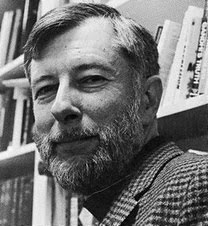
McClendonBy Tommy Airey

Whatever confusion there may be among Christians about redemption today, it must be small compared to that which accompanied the birth of the Christian movement in the first century…Yet we can be sure of the upshot: the disciples’ recognition that Jesus’ story that had engaged them was not ended by his death. For him and for them, there was a new beginning. Strangely but surely a new era had begun.
James McClendonDoctrine (1994)

Today, on the 15th anniversary of his passing, we honor James McClendon, one of the most underrated Christian theologians of the 20th century. McClendon, raised in Southern Baptist Louisiana, became the first Protestant theologian to ever be hired by a Catholic theology department (University of San Francisco). His contract was mysteriously not renewed at USF after he passed around a petition denouncing American military adventures in Vietnam. Later in the 70s, McClendon became a pioneer in postmodern theological endeavors after reading John Howard Yoder’s The Politics of Jesus and attending a conference in Manhattan with his wife (the philosopher and theologian Nancey Murphy) called “The Church in a Postmodern Age.” From there, McClendon did ground breaking work at Berkeley’s Graduate Theological Union and Fuller Theological Seminary in Pasadena.
Continue reading “Honoring St. James”

American Myths About Poverty

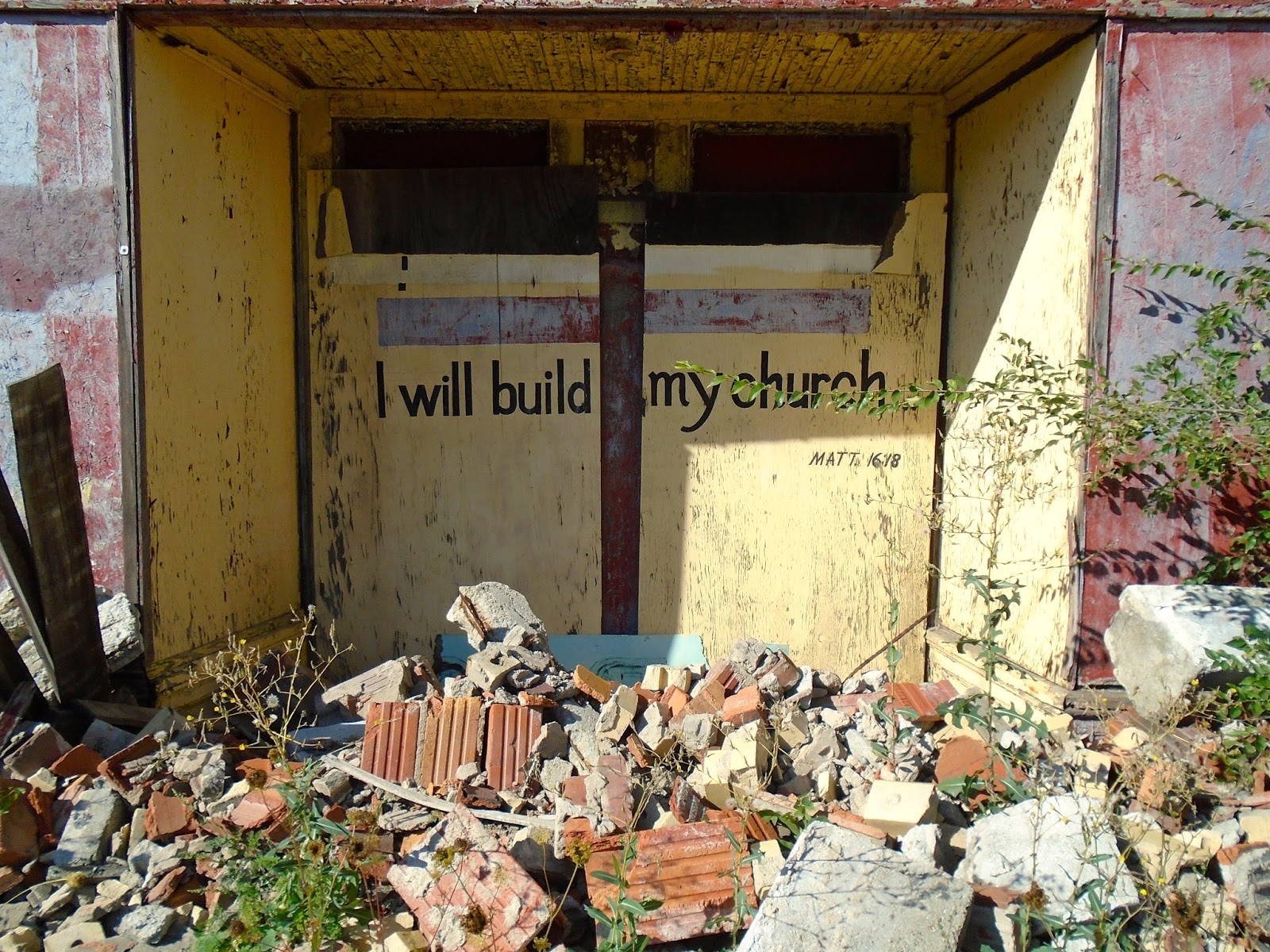
Photo: A Church in Northwest Detroit on Rosa Parks Blvd.
Northwest Detroit on Rosa Parks Blvd.
Some highlights from Eduardo Porter’s recent New York Times piece “The Myth of Welfare’s Corrupting Influence on the Poor“…just more evidence that social analysis must always trump “conventional wisdom.”
—————-

Today, almost 20 years after Mr. Clinton signed a law that stopped the federal entitlement to cash assistance for low-income families with children, the argument has solidified into a core tenet influencing social policy not only in the United States but also around the world.

And yet, to a significant degree, it is wrong. Actual experience, from the richest country in the world to some of the poorest places on the planet, suggests that cash assistance can be of enormous help for the poor. And freeing them from what President <a title="More articles about Ronald Wilson Reagan." Continue reading “American Myths About Poverty”

Wilderness School

TwoCoyotes2By Kate Foran. A second installment on her series on alternative education of her daughter Sylvie.

“When I show most people a rock I found, they say, ‘oh, nice.’ But when I show my teachers at Wilderness School, they say ‘Wow! It’s so beautiful! I love it!!” Sylvie, age 5.

The enthusiasm with which nature mentors and children regard rocks is a key piece in this patchwork quilt of my daughter’s education. On Mondays Sylvie spends the day at Two Coyotes Wilderness School, which meets in the woods surrounding Holcomb Farm in Granby, CT. She starts the morning with a gratitude circle, songs and games, and then it’s onto the woods for the day’s agenda (which might be building a fire with a bow drill or gathering wild edibles for October’s Ancestor Feast, or building a shelter out of sticks and branches.) Continue reading “Wilderness School”

Snowden

Snowden Meanwhile, the debate has become personal–about Snowden himself more than the issues to which he hoped to draw attention. It isn’t surprising that some Americans are suspicious of Snowdens’s motives. His story seems almost too good to be true: a young man of modest means, propelled by his brilliance to a position that gave him unusual access to the nation’s most closely guarded secrets…
Ted Rall, Snowden (2015)

We live in the heroic age of Assange, Manning and Snowden. Yet, what these men have uncovered for the world to see is so immense and overwhelming that, in order to just cope with our daily lives, we’ve put the issue on the back burner of the collective unconscious. This is one of the lamentations of political cartoonist Ted Rall, whose graphic biography of Snowden was released last month. Like virtually every sample of this genre, Snowden is an easy read. Unlike many, however, it is heavy, exposing the principalities and powers of an Orwellian collusion of government and corporation that watches our every move. It also implicates us: to resist the compulsion to sweep it all under The Carpet.
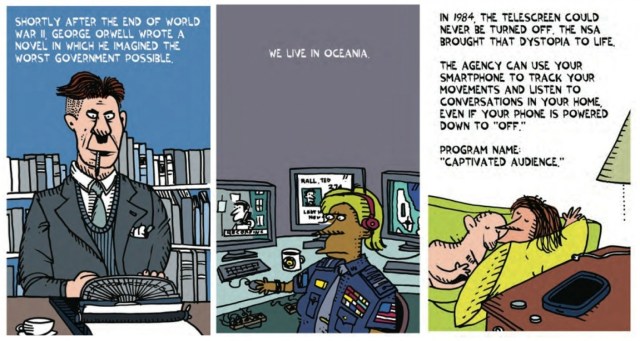
Rall excerpts

For radicals & progressives alike, militarism (abroad) and authoritarianism (at home) has been the most aggravating failure of the Obama presidency. It has, quite simply, been an escalation of what Bush started post-9/11. Rall both enlightens and entertains the reader, seeking to understand what it was in Snowden’s character or experience that led him to risk it all to break the law and to question why his actions were condemned so ubiquitously among the political elite. We recommend Snowden, as a nice companion to the work of Glenn Greenwald and Laura Poitras’ Oscar winning documentary CitizenFour.

And, coming up next for Rall, just in time for the primaries in January 2016…

Bernie