
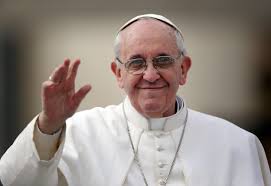
“I am with you. Let us together say from the heart: no family without lodging, no rural worker without land, no laborer without rights, no people without sovereignty, no individual without dignity, no child without childhood, no young person without a future, no elderly person without a venerable old age. Keep up your struggle and, please, take great care of Mother Earth. I pray for you and with you, and I ask God our Father to accompany you and to bless you, to fill you with his love and defend you on your way by granting you in abundance that strength which keeps us on our feet: that strength is hope, the hope which does not disappoint. Thank you and I ask you, please, to pray for me.” – Pope Francis
80 Years Later: War Is A Racket
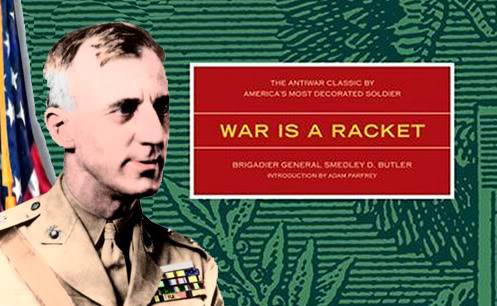 An excerpt from a speech given in the 30s by retired U.S. Marine Corps General Smedley D. Butler, published later in 1935. A classic:
War is a racket. It always has been. It is possibly the oldest, easily the most profitable, surely the most vicious. It is the only one international in scope. It is the only one in which the profits are reckoned in dollars and the losses in lives. A racket is best described, I believe, as something that is not what it seems to the majority of the people. Only a small ‘inside’ group knows what it is about. It is conducted for the benefit of the very few, at the expense of the very many. Out of war a few people make huge fortunes.
PROPHETIC GENEALOGIES AND THE COST OF DISCIPLESHIP
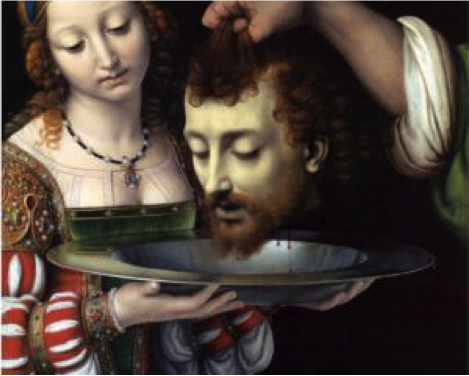 By Ched Myers, for the 7th Sunday after Pentecost (Mark 6:14-29)
Note: This is an ongoing series of Ched’s brief comments on the Markan gospel readings from the Revised Common Lectionary during year B, 2015.
This Sunday’s gospel is Mark’s account of John’s execution by Herod (that is, Herod Antipas, tetrarch of Galilea and Perea from 4 B.C.E.-39 C.E.) This “flashback” belatedly explains the circumstances surrounding John’s arrest, which was reported in passing at the outset of the story (1:14). Mark tells us that Herod believes that Jesus is John coming back to haunt him (6:14-16). Insofar as Jesus took up the Baptist’s mantle (preaching repentance and the Kingdom of God), Herod is not wrong. But the disturbing implication for the king is that this proclamation persists despite his having gotten rid of one of its messengers, suggesting that there was a more serious popular movement to be reckoned with. It is to the sordid tale of John’s demise that Mark now abruptly turns.
Continue reading “PROPHETIC GENEALOGIES AND THE COST OF DISCIPLESHIP”
White Supremacy: The Air We Breathe
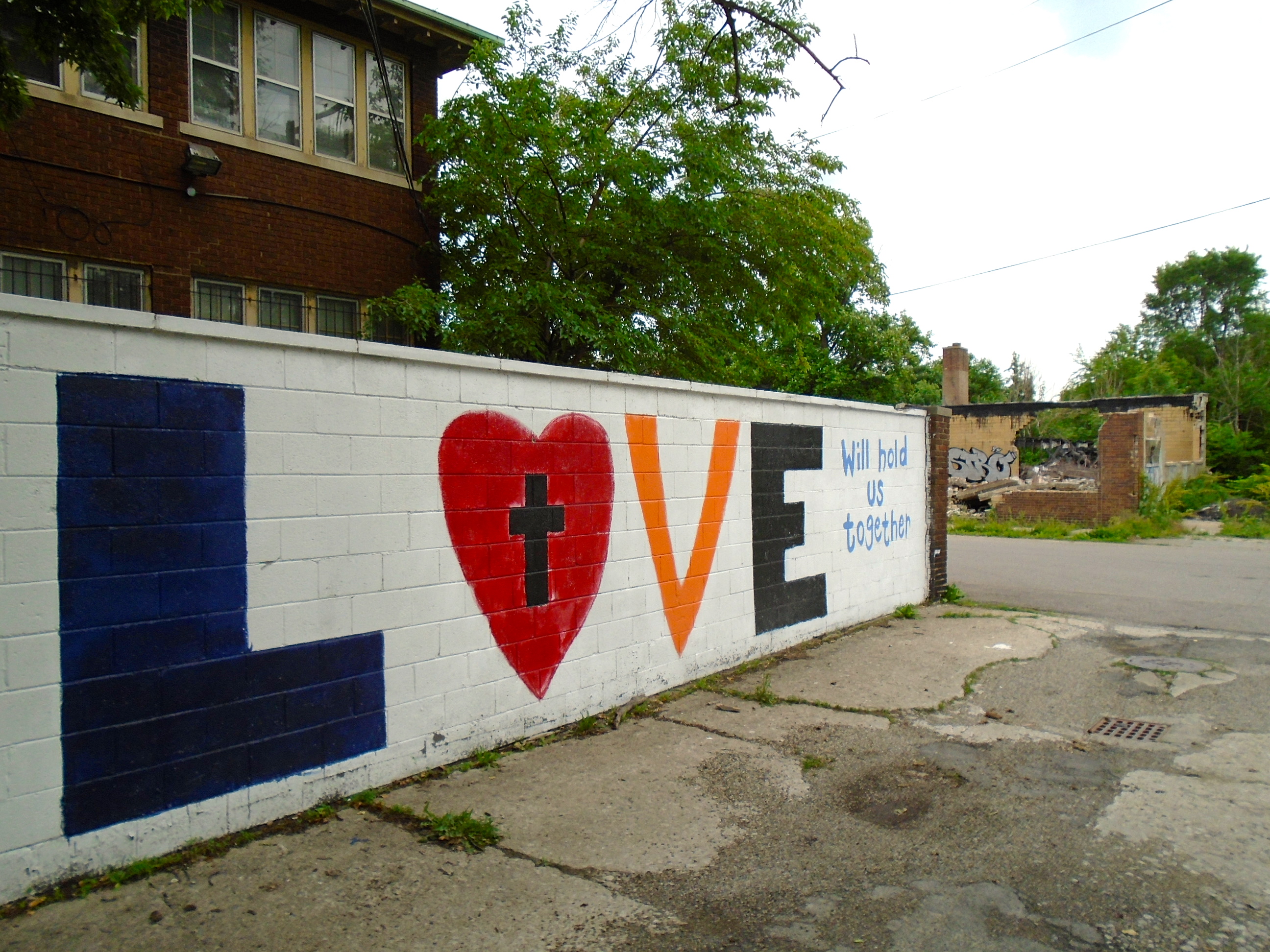
By Tommy Airey
—————–
The Confederacy is a southern thing, but white supremacy is not.
Bree Newsome
Economist Paul Krugman came out with a piece last week in The New York Times lambasting the South for its ongoing racist drama, while proclaiming “we really have become much less racist, and in general a much more tolerant society on many fronts.”
He scaffolded his arguments with two key economic studies: one that studied the massive white working class exodus away from the Democratic Party in the 70s and 80s (the Southern Strategy) and another that pegged the downsizing of the U.S. welfare state to racial discrimination. Krugman argues that, unfortunately, these forces are still very powerful in the U.S., beckoning readers to take a quick glance at the states that have denied Medicaid expansion to its residents. Surprise, surprise: almost of them are in the South.
Continue reading “White Supremacy: The Air We Breathe”
Learning from Laughter: Speaking Truth to Innocence
 By Lydia Wylie-Kellermann. First published on Geez’s blog.
The sun hits my face hard as I listen to the water from the fountain. As I look up and around, I am aware how little this downtown resembles the city I know anymore. The faces are all young and white (not unlike my own) playing beach ball, listening to live bands, sipping mid-day cocktails, and eating from food trucks. I look down at the 25 black bodies lying on the cement draped with signs and names of those killed at the hands of the police. On my lap sits the one-and-a-half year old who is my constant companion and teacher these days. He watches intently holding an air of seriousness in his body. Continue reading “Learning from Laughter: Speaking Truth to Innocence”
A Sign of Love
Thanks to CreativeResistance.Org for posting this photo of the Pride Parade in Turkey. The rainbow was “inadvertently” created from police water cannons trying to stop it.

To Take Up The Ancient Lesson
 From Pope Francis’ recent earth-loving encyclical:
Christian spirituality proposes an alternative understanding of the quality of life, and encourages a prophetic and contemplative lifestyle, one capable of deep enjoyment free of the obsession with consumption. We need to take up an ancient lesson, found in different religious traditions and also in the Bible. It is the conviction that ‘less is more’…Our goal is not to amass information or to satisfy curiosity, but rather to become painfully aware, to dare to turn what is happening to the world into our own personal suffering and thus to discover what each of us can do about it.
Dear White People
 By Melanie Morrison, Executive Director, Allies for Change
DEAR WHITE PEOPLE: Difficult as it may be, you and I MUST listen to and grapple with the words that Dylann Roof spoke as he began shooting the people who warmly, graciously welcomed him into that Bible study circle at Emmanuel AME Church: “You are raping our women and taking over the country. You have to go.” Those words are a mirror for us as a people – as white people. Those words are not only the isolated rantings of a tormented soul. We can’t simply scratch our heads and wonder how someone could be so hate-filled. We can’t only conclude that we need stricter gun control. We don’t need to interview his family and friends to understand where those words came from. The words Dylann Roof spoke are quite literally the white narrative that has undergirded and sustained systemic racism for centuries. That narrative continues unabated. Those words represent the fears and stereotypes that undergird present day racial profiling, state sanctioned violence, and mass incarceration. Those words feed anti-immigrant hysteria. Those words ring out in the chant, “Give us our country back.” Dylann Roof’s words are a mirror we must face as a people — as white people — if we are going to do the deep work required of us. None of us is exempt from this work. You and I and all of us must do this.
60 Years Later: Roberto Clemente’s Rookie Season
 Anytime you have an opportunity to make a difference in this world and you don’t, then you are wasting your time on earth.
Roberto Clemente (1934-1972)
It was six decades ago that Roberto Clemente–black and Puerto Rican–made his major league baseball debut. Throughout his career, he endured discrimination and hatred based on his skin color, ethnicity and nationality. It was so bad that, in 1960, Clemente led the Pirates to the World Series title and the MVP was given to Bobby Richardson, a white player from the losing Yankees.
After the ’72 season, a vicious earthquake devastated Managua, Nicaragua. Clemente immediately began organizing relief efforts, sending plane loads of basic necessities. When he discovered these goods were being diverted by the corrupt Somoza government, he chartered a jet and joined the mission. It plunged into the ocean almost immediately after takeover on New Year’s Eve.
WHAT IS EVANGELISM? STRANGER AT HOME, AT HOME AMONG STRANGERS
 By Ched Myers, the 6th Sunday of Pentecost (Mk 6:1-13)
Note: This is an ongoing series of Ched’s brief comments on the Markan gospel readings from the Revised Common Lectionary during year B, 2015.
At this point in Mark’s narrative we are given some background on each of the three major “protagonists” of this story: Jesus (6:1-6), the disciples (7-13) and John the Baptist (14-29, the gospel for 7 Pentecost). These three episodes each concern “rejected prophets,” which opens up a central theme of the second half of the gospel: the cost of discipleship.
This narrative sequence begins with Jesus’ return “to his own country” (6:1). For a third time, he teaches in a synagogue on the Sabbath (see 1:21ff; 3:1ff), and for a third time he encounters opposition. But this time it is not from the authorities, but from his neighbors and kinfolk. They are suspicious of this local boy’s notoriety, objecting that he has no distinguished lineage (6:3). Because of the domesticating constraints of nationality, kinship and household expectations (6:4), the “prophet without honor” is unable to effect change in his hometown, and returns to his itinerant mission (6:5f).
Continue reading “WHAT IS EVANGELISM? STRANGER AT HOME, AT HOME AMONG STRANGERS”
 Radical Discipleship