The Cross & The Lynching Tree

James ConeFrom James Cone in The Cross & The Lynching Tree (2011):

The lynching tree—so strikingly similar to the cross on Golgotha—should have a prominent place in American images of Jesus’ death. But it does not. In fact, the lynching tree has no place in American theological reflections about Jesus’ cross or in the proclamation of Christian churches about his Passion. The conspicuous absence of the lynching tree in American theological discourse and preaching is profoundly revealing…To reflect on this failure is to address a defect in the conscience of white Christians and to suggest why African-Americans have needed to trust and cultivate their own theological imagination.

*Click here for a free PDF of the Introduction and Chapter 1 of The Cross & The Lynching Tree.
Touch

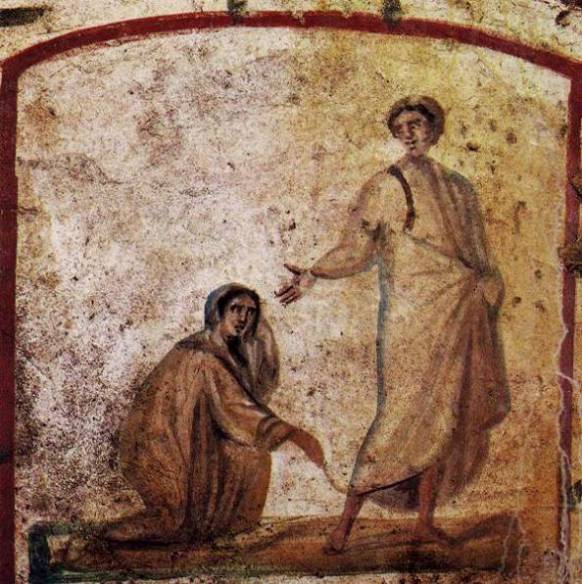
touchTouch, however, is always ‘touchy.’ It crosses boundaries. In U.S. culture, we have a presumption against touch. ‘Look, but don’t touch’ describes behavior toward objects, but is also used to describe relations between people…. Jesus … allowed himself to be touched by the bleeding woman who reached him through the crowd and the woman anointer at Bethany. He received Judas’ ambiguous kiss and the violent soldiers’ blows. After his death women touched him, washed him, rubbed oil into his skin, and wrapped his body in linens. Even resurrected Jesus said to Thomas, ‘Touch me and see. No ghost has flesh and bones like this. — Rose Marie Berger

Stations of the Cross through the Streets of Detroit

good fridaysI learned the liturgical year as a child by where we put our bodies. Mondays in Advent were spent at Williams International where they were making cruise missiles and Good Friday was spent walking the streets of Detroit. This walk has been happening since before I was born and I’ve walked it every year of my life. As a community, we spend Lent thinking about where we see the Cross today. Where is crucifixion happening today. Then together on Good Friday, we name it out loud by taking our bodies and a wooden cross to those places.

This year when we think about the Crucifixion we are thinking about the poor being pushed out to make way for gentrification. We are thinking about water shut offs and privitized education system. We are thinking about drones and black lives matter. Today, hundreds of us join together reading these words together. We invite you to join us in reading a couple of them here.

– Lydia Wylie-Kellermann Continue reading “Stations of the Cross through the Streets of Detroit”

“Who Will Roll Away the Stone? A Meditation on Mark’s Easter Story”

MyersTopBy Ched Myers

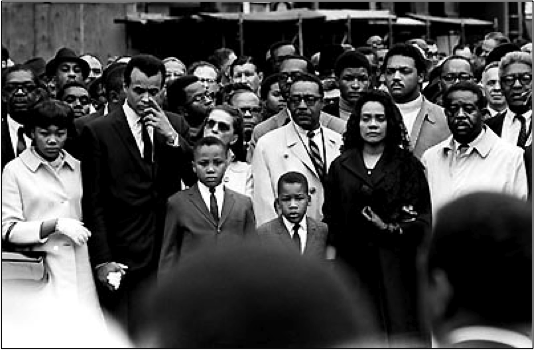
Note: This year Easter (Apr 5) falls close to the anniversary of Martin Luther King’s assassination (Apr 4). This is an abridged excerpt from the conclusion of Who Will Roll Away the Stone? Discipleship Queries for First World Christians (Orbis, 1994); it appeared in Sojourners (April 1994, Vol. 23, No. 3, pp. 20-23; King pictures added).
——————-
VERY early on the first day of the week, when the sun had risen, Mary, Mary, and Salome went to Jesus’ tomb (Mark 16:2).

Sooner or later, we who have tried to follow Jesus find ourselves weary and broken like the Galilean women, on our way to bury him. It is the morning we awake to that inconsolable, aching emptiness that comes only from hope crushed. This dawn does not bring a new day, only the numb duty of last respects. Continue reading ““Who Will Roll Away the Stone? A Meditation on Mark’s Easter Story””

The Crucified God

Micah IconBy Tommy Airey

God will again have compassion upon us;
God will tread our iniquities under foot.
You will cast all our sins
into the depths of the sea.
Micah 7:19

At the heart of the prophetic proclamation there stands the certainty that God is interested in the world to the point of suffering.
Jurgen Moltmann, The Crucified God (1972)

*This is the final installment in our series on Micah posted every Wednesday during Lent.
————-
In the midst of Holy Week, we pause to remember our 6-week Journey through Lent thus far. Our daily trek towards the Divine starts with stripping down so that we can vulnerably and transparently take inventory of our weaknesses, copings and inconsistencies. We summon the strength and focus to study the ways social, political, economic and religious systems enslave and devour humanity and the land. We ask ourselves how we are complicit and benefit from these arrangements. Then we expose oppression, injustice and greed while casting a vision and creatively constructing another Way.
Continue reading “The Crucified God”

The Palm Sunday Peace Parade: Pasadena, CA

Palm Sunday PeaceTriumphant and victorious is he,
humble and riding on a donkey.

Zechariah 9:9

By Bert Newton

Below is a history of what is now the 13th Annual Palm Sunday Peace Parade, sponsored by a coalition of communities: Church for Others, Crescenta Valley Methodist Church, Knox Presbyterian Church, Montrose Peace Vigil, Orange Grove Friends Meeting, Pasadena Mennonite Church, Peace & Justice Academy, Progressive Christians Uniting, Jill Shook & Anthony Manousos, Urban Village of Pasadena.
——————-
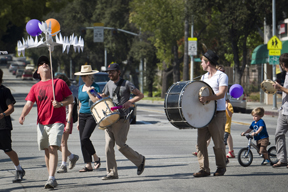
We now call it the Palm Sunday Peace Parade; this name not only has the advantage of alliteration, it also reflects the context in which the march actually began. We began the Palm Sunday Peace Parade in Pasadena in 2003 at the outbreak of the war with Iraq, so it was a peace march. Even though the context was war and the death that war brings, we made our event joyful and celebratory, much like the original Palm Sunday; the gospels tells that Jesus marched toward his death and yet entered Jerusalem in celebration of his victory over the forces of death. So we designed our event likewise to be festive and celebratory, a peace parade.
Continue reading “The Palm Sunday Peace Parade: Pasadena, CA”

Bread

ww2“I never expected much of the bishops, in all history, popes and bishops and abbots seem to have been blind and power-loving and greedy. I never expected leadership from them. It is the saints that keep appearing all through history who keep things going. What I do expect is the bread of life and down through the ages there is that continuity.”

– Dorothy Day

Two Weekend Reads

res schoolsTo what extent might unresolved trauma be impacting our settler Mennonite capacity to feel empathy with other traumatized groups? If we, as a community, can recognize this impact and guard against the egoism of victimization, wouldn’t it stand to reason that our hearts would be more open to the pain being carried by our indigenous neighbours and our hands more ready to work at “restorative solidarity”?
Elaine Enns

We recommend a dark brew to accompany two challenging and inspirational readings coming from two Canadian women doing unique work with truth and reconciliation. First, Elaine Enns, working within the North American Mennonite tradition, prods white settlers towards a “restorative solidarity” with our indigenous neighbors. Writing in Canadian Mennonite Magazine, she zeroes in on empathy in an article entitled “Facing History With Courage:” Continue reading “Two Weekend Reads”