Pride Sermon by Laurel Dykstra

The Eighth Sunday after Pentecost – Pride Daylaurel
August 3rd, 2014
Christ Church Cathedral, Vancouver

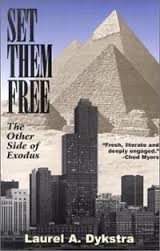
Laurel Dykstra is a community-based scholar with a long history in intentional communities and the radical discipleship movement. Her justice work focuses on issues of urban poverty; the activism of children, youth and families; challenging white privilege; and Queer and gender-Queer participation and resistance in churches. She is the author of Set Them Free: The Other Side of Exodus (Orbis, 2002), Uncle Aiden (Baby Bloc, 2005), editor of Bury the Dead (Cascade, 2013) and co-editor, with Ched Myers of Liberating Biblical Study (Cascade, 2011).
———————-
I have a lot of favorite bible passages, but today’s about Jacob, his 4 wives and 11 children beside the river Jabbok is one of them–it is complicated, human, and a surprisingly good fit for pride Sunday. Continue reading “Pride Sermon by Laurel Dykstra”

Child Poverty Is Not An Act Of God

From Marian Wright Edelman, President of the Children’s Defense Fund whose Leave No Child Behind® mission is to ensure every child a Healthy Start, a Head Start, a Fair Start, a Safe Start and a Moral Start in life and successful passage to adulthood with the help of caring families and communities:
———————–
Just released U.S. Census Bureau data reveal 45.3 million people were poor in America in 2013. One in three of those who are poor is a child. Children remain our poorest age group and children of color and those under five are the poorest. More than one in five infants, toddlers, and preschoolers were poor during their years of greatest brain development and vulnerability. Black children saw no decrease and continue to have the highest child poverty rates in the nation. In 20 states  more than 40 percent of Black children were poor and nearly one in five Black children were living in extreme poverty with an annual income of less than half of the poverty level or $33 a day for a family of four.

Continue reading “Child Poverty Is Not An Act Of God”

Acting Against the Spirit of Our Time

From Howard Thurman in Footprints of a Dream : The Story of the Church for the Fellowship of All Peoples (1959):

The movement of the Spirit of God in the hearts of men and women often calls them to act against the spirit of their times or causes them to anticipate a spirit which is yet in the making. In a moment of dedication they are given wisdom and courage to dare a deed that challenges and to kindle a hope that inspires.

Puddleglum on Faith

From C.S. Lewis’ The Silver Chair:Puddleglum

 “Suppose we have only dreamed, or made up, all those things- trees and grass and sun and moon and stars and Aslan himself. Suppose we have. Then all I can say is that, in that case, the made-up things seem a good deal more important than the real ones…I’m on Aslan’s side even if there isn’t any Aslan to lead it. I’m going to live as like a Narnian as I can even if there isn’t any Narnia.”

Coming This Weekend: A Wall Street Flood

The climate crisis is not just a narrow ‘environmental’ problem of resources or jobs in need of better management. It is the supreme symptom of a political and economic system that is bankrupt to its core.
Flood Wall Street organizer Sandra Nurse

Today we excerpt from an article by Yates McKee over at Waging Nonviolence, detailing the upcoming People’s Climate March & follow-up action, Flood Wall Street, in NYC this Saturday to Monday. Continue reading “Coming This Weekend: A Wall Street Flood”

Ray, Janay & Restorative Justice In A Culture of Violence?

The ultimate weakness of violence is that it is a descending spiral, begetting the very thing it seeks to destroy…Returning violence for violence multiplies violence, adding deeper darkness to a night already devoid of stars.
Martin Luther King, Where Do We Go from Here: Chaos or Community? (1967)
————————–
By Tom Airey, Co-Editor of RadicalDiscipleship.Net & Lindsay Airey, MFT

Mainstream media outlets have homed in on the subject of domestic abuse in the wake of the release of the video of pro football player Ray Rice literally knocking out his fiance (now wife) back in Febuary.   Continue reading “Ray, Janay & Restorative Justice In A Culture of Violence?”

Wes Howard-Brook on How Empire “Handles” Violence

Today, we share a Facebook Post (and highlights of an ongoing strand from Friday, Sept 12) from Dr. Wes Howard-Brook, former attorney and, currently, a professor of Theology & Scripture at Seattle University. Social media has all sorts of issues, but sometimes it can serve as a really helpful forum for “overhearing” conversations about vital issues. This strand focuses on the issue of ongoing violence in the Middle East, ISIS (and other “terrorist” groups) and, specifically, the role of the American Empire in the whole affair. Continue reading “Wes Howard-Brook on How Empire “Handles” Violence”

A Revaluation Of Everything

From now on, therefore, we regard no one from a human point of view; even though we once knew Christ from a human point of view, we know him no longer in that way. So if anyone is in Christ, there is a new creation: everything old has passed away; see, everything has become new!
II Corinthians 5:16-17

Below, we excerpt the work of Ched Myers & Elaine Enns, critically reflecting on II Corinthians 5:16-17 in Ambassadors of Reconciliation, Volume I: New Testament Reflections on Restorative Justice & Peacemaking (2009). Continue reading “A Revaluation Of Everything”

Are We Activists or Inactivists?

From Jeffrey Stout, Princeton Professor of Political Science in Blessed Are The Organized: Grassroots Democracy in America (2010)

To maintain a position of dominance, even the most powerful people in the world rely on the inaction of others and the resignation that lies beneath it. The powerful became powerful by organizing others to work for them and creating incentives for profitably cooperative activity. It appears to be against the interests of the rich and the lucky for everyone else to be similarly well organized. The rich and the lucky benefit from making large-scale democratic reform appear hopeless. Paradoxically, they also benefit from making large-scale change seem easily achievable, for example, by casting a vote every four years for a candidate who promises something called “change.”