There is Always Another Way to Read History

From Dana Mills, Resource Development Manager, +972 Magazine, sent to subscribers of The Landline, their weekly newsletter on Friday, December 8, 2023

It has been 63 days since the atrocities carried out by Hamas in southern Israel, and since Israel began its nightmarish assault on the Gaza Strip. October 7, the first day of the war, was also the Jewish holiday of Simchat Torah, which occurs on the last day of the holiday of Sukkot. Now, two months later, we find ourselves beginning the next Jewish holiday: Hanukkah. But this Hanukkah feels more complicated than any I can remember. 

A week before the start of Hanukkah, Israeli soldiers brought a huge hanukkiah — a nine-branched candelabrum lit by Jews around the world during the eight-day festival — into Gaza. The soldier holding the camera proudly smiles and announces that it is “the first hanukkiah in Gaza,” while the other soldiers around him cheer, the rubble of Palestinian homes and buildings visible in the background. A headline about the hanukkiah in the right-wing Israeli newspaper Israel Hayom proudly stated: “We will drive out the darkness with light.” But looking at soldiers assembling a hanukkiah on top of the ruins of Gaza, where the army has killed more than 17,000 Palestinians in the past two months, was a moment of deep darkness for me. 

This image brought to mind a Hanukkah photo from a very different place and time: one in which a hanukkiah sits on a windowsill while, in the background, a swastika flag hangs from a building. The photo, taken in 1931 in Kiel, Germany, strikingly captures the eve of Nazism’s ascension. That hanukkiah was lit by Rabbi Dr. Akiva Posner and his wife, Rachel — my great-uncle and great-aunt. 

The fact that this photo is part of my own family archive has always made me proud. Like any photo, it can be read in different ways. For me, it represents a legacy of defiance, the importance of celebrating one’s Jewishness as a subversive act, and the significance of holding on to ritual even in the face of grave danger. It symbolizes the power of resistance and moral courage, which are core to the kind of Jewishness I seek to embody.

The hanukkiah lit in Kiel against the backdrop of a swastika feels like the polar opposite of the hanukkiah standing on the ruins of Gaza. While the Kiel hanukkiah celebrates defiance in the face of oppression and the sanctity of ritual, the Gaza hanukkiah glorifies death and destruction. 

This death and destruction is not an accident or an unintended consequence of Israel’s military operation in Gaza: Israeli officials have called for a permanent forcible transfer of Palestinians in Gaza, and, as our recent investigation demonstrated, the army is fully aware of civilian casualties when choosing its targets. Among the Israeli public, too, there is increasing legitimacy for calls to “flatten Gaza” and decreasing concern for the collective punishment being carried out against civilians. 

In less than a century, we have moved from lighting candles against a backdrop of the genocide of Jews to a world in which there are Jews lighting candles to affirm, legitimize, and celebrate a genocide that they themselves are involved in committing. 

Reflecting on the brave acts of Jewish resistance and defiance throughout history, including my own family lighting that hanukkiah against the backdrop of the swastika, ought to push us in the Jewish community to consider more seriously how we can use our faith, tradition, and culture to bring about a more just world. Jewish history is rich with examples of how we have opposed fascism and resisted racism throughout history. Turning to those examples at this difficult time can help us in fighting the widespread hatred, fear, and vengeance that are currently so prevalent in Israeli society.  

Looking to our history for inspiration does not mean romanticizing those moments in which Jews were under horrific attacks and dealt with grave danger, bolstering an image of the Jew as constantly suffering and a pariah by disposition and destiny. But the violence and racism inflicted upon us as Jews should be a constant reminder to cherish humanity above all and resist racism enacted in our name. 

As I prepare to light my own hanukkiah, it feels unbelievable that the war is still raging, that the Israeli army is continuing its unchecked attacks on Gaza, and that Israeli hostages are still being held captive. This Hanukkah, may the Kiel hanukkiah serve as a call to celebrate and treasure life. 

Inspired by the defiance embodied in my family’s hannukiah, we must call to prioritize bringing home all of the hostages, to stop the immense death and suffering being inflicted on Palestinians, and to achieve a political resolution that ensures all human lives between the river and the sea are protected. We must demand that genocides are a thing of the past and work to bring light into our midst through resistance to racism and fascism — including when it comes from those who claim to speak in our name.

There is always another way to read history and to brush against its grain in support of the crucial value of humanism. In this horrific moment in Israel-Palestine, my great-aunt and great-uncle’s hanukkiah teaches us to not be afraid to dissent, and to fight to drive out the darkness and bring in the light.

Happy Hanukkah,
Dana Mills
Resource Development Manager, +972 Magazine

We Have Yet To Grow Up

An excerpt from Cornel West’s Democracy Matters (2010).

The American democratic experiment is unique in human history not because we are God’s chosen people to lead the world, nor because we are always a force for good in the world, but because of our refusal to acknowledge the deeply racist and imperial roots of our democratic project. We are exceptional because of our denial of the antidemocratic foundation stones of American democracy. No other democratic nation revels so blatantly in such self-deceptive innocence, such self-paralyzing reluctance to confront the night-side of its own history. This sentimental flight from history – or adolescent escape from painful truths about ourselves – means that even as we grow old, grow big, and grow powerful, we have yet to grow up.

Deep Dives

The 2024 Bartimaeus Kinsler Institute 2024 is coming. Registration is now open.

February 19-22 2024, in Ojai, California

Register HERE.

BKI 2024 will focus on two longstanding commitments of BCM:

Building capacity for Decolonizing Discipleship and

Sabbath Economics.

These four days offer an opportunity for deep dives into both themes for educator/practitioners.  Two tracks will unfold in parallel:

  • a Healing Haunted Histories track facilitated by Elaine and team (limit 12), and
  • a track examining the Gospel of Luke and contemporary problems of Affluenza and plutocracy facilitated by Ched and team (limit 25). 

Because these themes speak to each other deeply, we will weave them together in plenary sessions to open and close each day.

It’s As Simple As That

An excerpt from Ismat Mangla’s AnalystNews interview with Zachary Foster, a historian and Rutgers University senior fellow. The full interview is well worth reading multiple times. You can follow Foster on Twitter here. In this excerpt, Mangla asks Foster about what made him move away from the Zionist beliefs.

I grew up in a very “exotic” suburb of Detroit, went to Jewish schools, Jewish summer camps, Jewish youth groups — all of which were Zionist. I went to Israel as a study abroad student in undergrad. That was the beginning of my transition from Zionist to non-Zionist to anti-Zionist, getting exposed to what day-to-day life was like for Palestinians in Jerusalem.

You don’t go from a Zionist household to speaking out publicly, frequently advocating for Palestinian human rights, overnight. It’s a process. 

When I discovered that Palestinian Americans — who identify strongly with Palestine, whose parents and grandparents are from Palestine — are not allowed to go move to or visit Palestine, while I — an American Jew who may speak zero Arabic or Hebrew, who may have zero family in the country, who may literally not be able to identify it on a map or even ever heard of it — have a right to claim citizenship because I’m Jewish? Does that make any sense to you? That’s insane. That was a real lightbulb moment for me, meeting Palestinians and understanding the trauma of  ’48 — and understanding that while I have rights there, they don’t. 

The more you study Palestinian history and Israeli history, the more pro-Palestinian you become. You can’t study the history of Zionism and not be horrified. It’s as simple as that. 

First Advent: A Call to Insomniac Eco-Theology

By Ched Myers

Note:  I shared the comments below on the gospel reading for the First Sunday in Advent (Dec 3, 2023) as part of Creation Justice Ministries’ “Green Lectionary” podcast.  You can hear my whole conversation with Derrick Weston & Debra Rienstra here. (above image: “All the stars in the sky will be dissolved and the heavens rolled up like a scroll,” Elena Markova, U.S., 2022; image found here)

Apocalyptic texts tend to make churchgoers nervous. In every lectionary cycle, however, the penultimate Sunday of Ordinary Time and first Sunday of Advent turn to what I call the “apocalyptic season” that bridges the end and beginning of the liturgical year. The gospel reading for First Advent always comes from the “synoptic apocalypse” (Mt 24, Mk 13, or Lk 21), before turning to the ministry of John the Baptist in Second Advent. This Year B we have the second half of Mark’s “Little Apocalypse” (13:24-37); the first part occurs at the end of Ordinary time. The lectionary’s brief apocalyptic focus functions to help us look at the “end of the world” as we prepare for it to be “born anew” in Advent and Christmastide.  

Here are some brief thoughts (especially on the underlined phrases) on Sunday’s reading, with our ecological crisis in mind.

Mk 13:24-25:  “But in those days, after that suffering, the sun will be darkened, and the moon will not give its light, and the stars will be falling from heaven, and the powers in the heavens will be shaken

For us, apocalyptic images of the cosmos falling apart obviously correlate with the climate catastrophe that is upon us.  Interestingly, the root of our term “disaster” comes from aster, or stars in Greek; we are indeed amidst a disaster. But too often we still apprehend ecological disaster as something happening to us, rather than engineered by us. In fact, the biblical idea of nature in revolt does not actually originate with apocalyptic literature, but with the Exodus liberation story.  In that old wise tale, enslaved Hebrews are struggling for liberation against Pharaoh’s oppressive regime, an obvious mismatch. But the Creator has animated this movement, so Creation aligns against the empire in a series of escalating plagues that ultimately force the tyrant to relent (if you haven’t had a chance to look at my longer piece “Nature Against Empire: Exodus Plagues, Climate Crisis and Hard Heartedness,” go here). This profound framing lies in the background of Jesus’ vision here, and it’s not too difficult to see its relevance for our moment of imperial oppression of both people and Creation—in which we are each and all deeply implicated.    

Continue reading “First Advent: A Call to Insomniac Eco-Theology”

Black and Palestinian Christians in Solidarity

Check out this Sojourners Magazine conversation between Josiah R. Daniels and Azmera Hammouri-Davis.

Honestly, I never thought much about Israel before college. Then, during my sophomore year, a prominent New Testament studies scholar had been invited to speak on campus; after it came to light that they were openly critical of the state of Israel, they were summarily disinvited. A few other students and I were still able to meet with the scholar, and we were shocked by the language they were using to describe the conditions in Israel for the Palestinians: “Second-class citizens,” “genocide,” and “apartheid” were the terms that struck me most.

“It can’t be as bad as what Black people have faced in the United States or what they faced in South Africa,” I remember saying to the scholar. “Go and see,” they admonished. And so, one year later, that’s exactly what I did.

In 2012, three other students and I had been invited to attend a conference at Bethlehem Bible College called Christ at the Checkpoint. The mission of this conference, which will be convening for the seventh time in May 2024, was to invite evangelicals to think about Israel and Palestine in ways that prioritized “peace, justice, and reconciliation,” while also explicitly giving voice to Palestinian Christians. And while I’m grateful that I was introduced to authors, theologians, and activists like Munther Isaac, Jonathan Kuttab, and Salim Munayer, nothing was quite as transformational as experiencing a checkpoint for myself.

I’d been stopped at police checkpoints in the United States multiple times — either alone or with friends or my dad. During those stops, humiliation, pain, or death always seemed to be a likely outcome. So when I was preparing to pass through one of the checkpoints at Israel’s apartheid wall, I imagined the Israel Defense Forces soldiers would hassle me the same as the Chicago police. But there was no hassling. I handed them my blue U.S. passport and waltzed through the checkpoint. “I feel like the scholar exaggerated a bit,” I thought to myself. But as soon as that thought crossed my mind, I turned around to see a long line of Palestinians, each of them being hassled by an IDF soldier. When I looked into the eyes of those Palestinians, I saw that they, too, felt humiliation, pain, or death was a likely outcome.

To read the interview go to Sojourners Magazine here.

What is Christian Zionism?

Jewish Voice for Peace and Showing Up for Racial Justice are hosting a free webinar called Understanding Christian Zionism on Wednesday, November 29 at 8:00pmEST. You can register for it here.

What is Christian Zionism, how is it showing up in this moment, and why is understanding it important in our efforts to demand a ceasefire and an end to the violence in Gaza? Join SURJ and Jewish Voice for Peace for a mass teach-in about Christian Zionism. We’ll hear from an expert panel– Palestinian Christian activist Jonathan Brenneman, Jewish researcher and writer Aiden Orly, and scholar of pentecostalism and the Christian far right Elle Hardy– who will share their analysis of how we got here and how our strategies to demand a ceasefire and fight for Palestinian liberation can be aided by a deeper understanding of the forces we’re up against. Live ASL interpretation will be available on the call. If the Zoom reaches capacity, we will be livestreaming on SURJ and JVP’s Facebook pages. Register to receive the recording if you’re unable to make the call.

How Do We Celebrate Christmas While Bombs Drop in Gaza?

Another compelling offering from The Alternative Seminary.

How Do We Celebrate Christmas While Bombs Drop in Gaza?

Jesus was born in a context of occupation, political violence, and militant resistance. As much as we try to wrap the “Christmas story” in innocent, Hallmark-card imagery, the biblical texts describing the coming of Jesus are making powerful assertions about the politics of the Bible that speak very much to our contemporary global crises – including the current violence in Israel and Palestine.

Once again this year, the Alternative Seminary is offering their annual Advent gathering “Peace on Earth and the Politics of Christmas.” In this virtual program, we will explore the “nativity narratives” in the Gospels of Matthew and Luke to see how they express core biblical themes of justice and liberation. We will “un-domesticate” these stories and reflect on how they are truly challenging us to a revolutionary discipleship – an especially urgent need as we witness more violence in Jesus’ homeland. This program will be facilitated by Will O’Brien, coordinator of The Alternative Seminary and contributor to Radical Discipleship.

Continue reading “How Do We Celebrate Christmas While Bombs Drop in Gaza?”

Only Two Things

An excerpt from Mosab Abu Toha’s November 6 essay in The New Yorker. Toha is a renowned Palestinian author who was kidnapped by Israeli forces, just a few days ago, at a military checkpoint along with about 200 other Palestinian men.

My brother-in-law Ahmad suggests that we set out on our bikes to find my father. After only three hundred metres, we see him, his head tilted downward while he pedals.

My father tells me later that debris covered every inch of the street that led to our house. He did not feed his fifteen ducks, thirty hens, five rabbits, and six pigeons. “Maybe some are alive and stuck under the rubble,” he says. But, after he saw the bombed house and heard the frightening whirring of drones, he headed back to the camp.

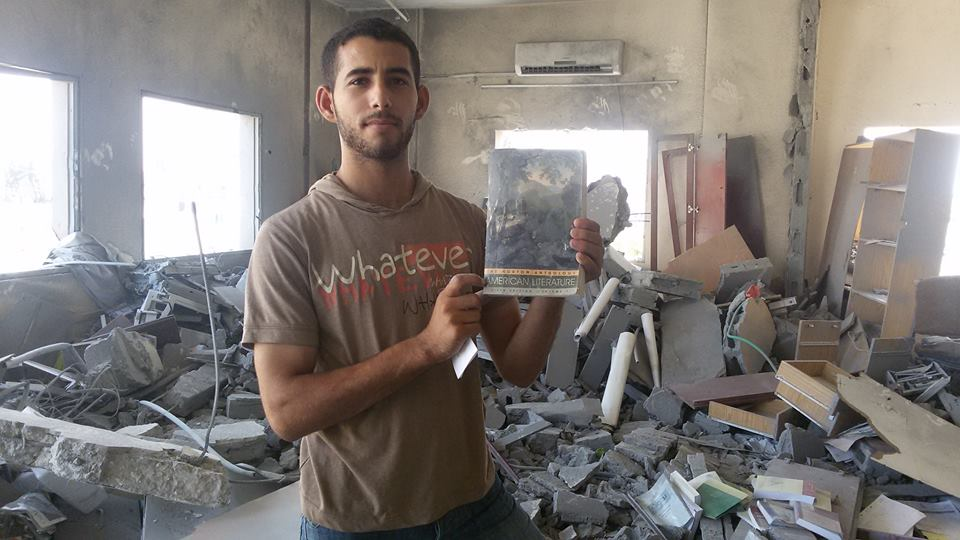
When we get “home,” we all sit on the floor. It’s not until later that I start to realize: I lost not only my house and its rooms but also my new clothes and shoes and watches. My books, too.

Continue reading “Only Two Things”