Today: The 24-Hour Covid Vigil

vigilA Message from Naming The Lost.

As we approach Memorial Day, Americans are mourning the 80,000+ of our loved ones and neighbors whose lives have been lost to COVID-19 (and the hundreds of thousands more worldwide). They are our siblings, our parents, our children, our nurses and grocery clerks, our first responders and teachers, they are the working people who do the essential work of keeping our families and communities safe. Continue reading “Today: The 24-Hour Covid Vigil”

A Spiritual Pandemic

Lansing, April 30
Lansing, Michigan (April 30, 2020)

By Tommy Airey

*Note: I submitted this op-ed to The New York Times, Washington Post, Los Angeles Times and The Oregonian. None of them printed it. So I submit it to you.

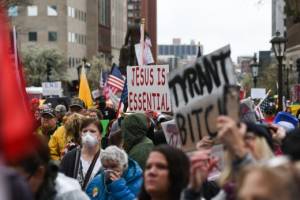
The white Christians marching with their flags and firearms on state capitals and main streets make it clear: they have neither a care nor a clue about how COVID-19 is disproportionately killing non-white populations. While they protest, Black residents in Detroit shelter-in with water taps shut-off, Indigenous peoples attempt to contain outbreaks on reservations with limited access to health care and Immigrants around the country work the front-lines at unsafe meat processing plants mandated to stay open by an executive order. Unfortunately, the spectacle of the fascist few takes the focus off the rest of us white folk—the silent, enabling masses—also careless and clueless. The coronavirus may be novel, but the overwhelming disregard for Black and Brown life is not. Continue reading “A Spiritual Pandemic”

Racism is a Demonic Possession

billFrom yesterday’s Interfaith Council for Peace and Justice press conference (Detroit, MI) in response to the white Christian “protest” at the Capitol in Lansing.

My name is Bill Wylie-Kellermann. I’m a United Methodist pastor in Detroit, recently retired from St Peter’s Episcopal Church, and a member of Michigan Poor Peoples Campaign: A National Call for Moral Revival.

I speak as a white male Christian outraged at the public display of white supremacy in these demonstrations against the health requirements of Michigan under COVID 19. Continue reading “Racism is a Demonic Possession”

Teaching Eco-Ministry

RicBy Ric Hudgens (right)

I just finished teaching a class in Eco-Ministry at Garrett Seminary. My initial (and still favorite) title for the course was a play on John Wesley’s quote, “the world is my parish.” I wanted to call it The Earth is Our Parish. However, the formal title became “CL-621 Earth Ministry for Ecological Renewal.” CL-621 is one of the core courses in the Ecological Regeneration Concentration of Garrett’s new Masters in Public Ministry program.

I’m writing about it here not primarily to promote Garrett Seminary, but because this Eco-Ministry is a growing edge in contemporary ministry. It often has interfaith and eco-spiritual aspects, which are essential. But its placement in Garrett’s new Public Ministry degree gave it a distinctive social and political slant that is sometimes missing. Garrett’s version also featured radical discipleship resources that gave it a particular focused and practical impact. Continue reading “Teaching Eco-Ministry”

A God Who Adores Our Freedom

Alice-Walker-112931058x1-56aa24d75f9b58b7d000fc00From Alice Walker’s autobiography Anything We Loved Can Be Saved. Happy Belated Mother’s Day.

All people deserve to worship a God who also worships them.  A God that made them, and likes them.  That is why Nature, Mother Earth, is such a good choice.  Never will Nature require that you cut off some part of your body to please It; never will Mother Earth find anything wrong with your natural way.  She made it, and She made it however it is so that you will be more comfortable as part of Her Creation, rather than less.  Everyone deserves a God who adores our freedom: Nature would never advise us to do anything but be ourselves.  Mother Earth will do all that She can to support our choices.  Whatever they are.  For they are of Her, and inherent in our creation is Her trust.

Let Us Imagine

ZinnFrom Chapter 24 of Howard Zinn’s A People’s History of the United States (2000).

Let us imagine the prospect-for the first time in the nation’s history–of a population united for fundamental change. Would the elite turn as so often before, to its ultimate weapon–foreign intervention–to unite the people with the Establishment, in war? It tried to do that in 1991, with the war against Iraq. But, as June Jordan said, it was “a hit the same way that crack is, and it doesn’t last long.” Continue reading “Let Us Imagine”

A Lynching that Cuts to the Heart

5c11c24dc4ab2.image
Source: https://www.dailysentinel.com/news/local/article_776357e2-4dae-5c90-b9c8-6b7b96adb1c4.html

This sermon was delivered by Rev. Luke Hansen, S.J. on May 3, 2020, the Fourth Sunday of Easter, at Bellarmine Chapel, Cincinnati. The liturgy was livestream and is available here.

Lectionary readings: Acts 2:14a, 36-41; Psalm 23; 1 Peter 2:20b-25; John 10:1-10

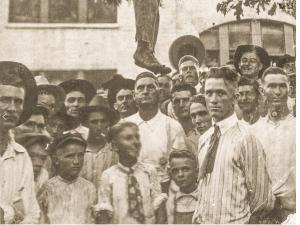
In early March, before the world changed, I traveled to Alabama with a group of Xavier University students. We were on a “civil rights immersion,” visiting Selma, Birmingham and Montgomery.

In Montgomery, the Equal Justice Initiative has built a memorial for the victims of lynching and a legacy museum that tells the story of racial violence, from slavery to mass incarceration. Continue reading “A Lynching that Cuts to the Heart”

Interrogation of Everything

D18_185_015Sheldon C. Good, executive director of The Mennonite, Inc., interviewed Ibram X. Kendi about antiracism and the church by email Sept. 3. The interview, edited for clarity, appears below. The editorial in the October issue of The Mennoniteavailable here, includes part of the interview.

Kendi is author of How to Be an Antiracist. He won the 2016 National Book Award for Nonfiction for his book Stamped from the Beginning. He is the founding director of the Antiracist Research and Policy Center at American University in Washington, D.C.

1. You make the case in How to Be an Antiracist that the word “racist” has been removed from its proper usage. How did that happen?

The most virulent racists define racist as anyone who uses the r-words, race or racism. They say, racist is a pejorative term, it is the equivalent of saying I don’t like you, as Richard Spencer once said. Anyone who categorizes people by race, who calls someone racist, is the real racist, they say. Obviously, they are deeply defensive, and deeply in denial. As such, they don’t want to be called racist. They shut down and close up when they do. Some racial reformers have agreed and view “racist” as an attack. So they don’t use the term either. But racist is a descriptive term, not an attack. It describes when a person is saying there is something wrong or right with a racial group. It describes when a person is supporting racist policy with their action or inaction. Continue reading “Interrogation of Everything”

Emmaus Road Litany

Farm Church
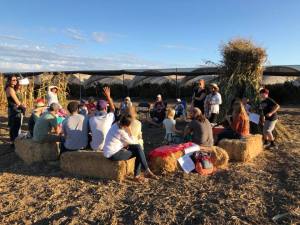
A Farm Church gathering in pre-pandemic times.

Inspired by Ched’s “Easter Faith and Empire” article, Katerina Friesen wrote the following litany for Farm Church (Ventura River Watershed in California) on Sunday, April 26 for an adapted “Bread of Life” communion time.

El Peregrino camina con nosotr@s (The Sojourner walks with us)
When we are confused, disillusioned after hopes of revolution,
Disappointed by loss after loss, Jesus opens our minds. Continue reading “Emmaus Road Litany”