The Radical Power of the Poetic Word

By Rev. Bill Wylie-Kellermann

Walter Brueggemann: A Remembrance (March 11, 1933 – June 5, 2025)

When I was a student at Union Seminary in New York, Abraham Heschel taught at Jewish Theological Seminary across the street. Though he died within my first year, the author of The Prophets, was notorious, it was said, for being the professor who actually believed in God. Something related might be said about Walter Brueggemann who crossed over to the ancestors and saints June 5.

He was an eminent scholar, among those like Norman Gottwald who altered the landscape of biblical studies by bringing sociological analysis to interpretation, and for such reason presided for years in the biblical guild. Yet, as a discipline, he was eminently readable and accessible to movement and church for whom the work was ultimately intended.

Once in a footnote to Israel’s Praise, he cited a 1985 order of the Pretoria regime prohibiting Blacks from singing Christmas carols in the townships because they generated such revolutionary energy. The newspaper report quoted a South African police agent: “Carols are too emotional to be sung in a time of unrest…Candles have become revolutionary symbols.” Which is to say, he could write an analysis of the world-shaking and world-making power of Israel’s liturgy and psalms, but then put out a book of prayers for our own moment. He prayed. He imagined a new world with all his heart. He invited us likewise.

Continue reading “The Radical Power of the Poetic Word”
Rubble and Resurrection

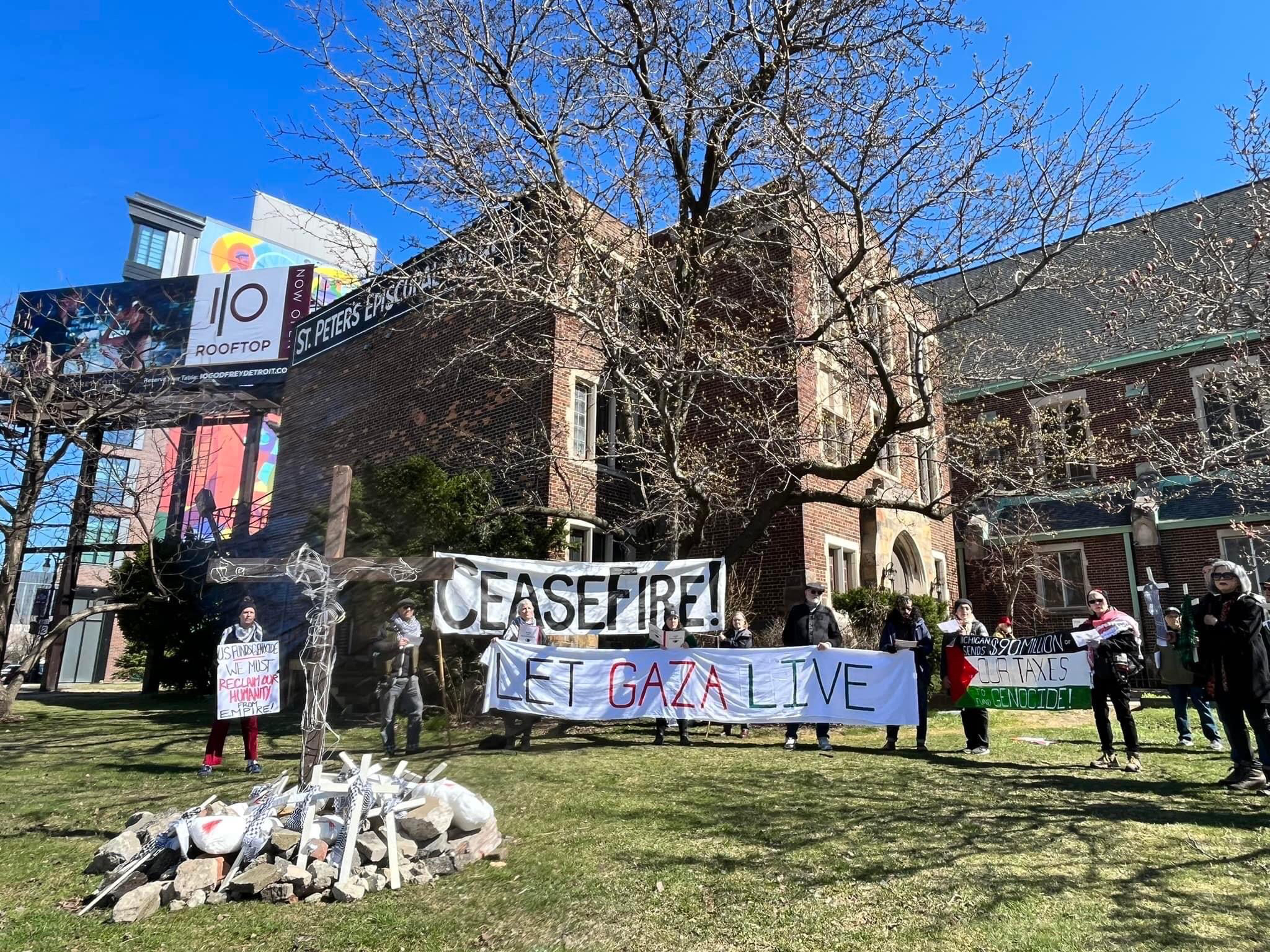
By Bill Wylie-Kellermann, an Easter vigil homily from Detroit

So good to be in this service, in this hour and house – thanks to all who have returned or stepped up to make it happen. I speak the thanks of many hearts.

Two memories always wash over me when I come to this service.

One, is of 1983 when at the inspiration of Tom Lumpkin, seven of us including Maria West and Gordon Judd, walked the easter vigil onto Wurtsmith AFB when first-strike cruise missiles were then being loaded on B52s. We cut the fence, breaking the seal on death, walked down the 3 ½ mile runway, pausing at a small building to spray paint “Christ Lives! Disarm” and there renewed our baptismal vows – renouncing Death and all its works – finally partaking eucharist on our knees at the open gate to the high security area of loaded bombers. Our Easter declaration, that we were free to unmake these weapons, changed then and there my understanding of resurrection.

The other is during the service in this sanctuary, in 2001 – as we gathered in a circle to receive eucharist, just as Jeanie Wylie was passing the bread to her daughter, she went into a seizure. The circle were all people who had loved and supported her through her brain-tumored illness, so folks beside her instinctively lowered her to the floor and the loaf and cup continued round. Before it was complete she was sitting up and insisted on receiving. By the time we sang Jesus Christ is Risen Today, her voice was back and almost full throated. She herself lived a resurrected life. Today when we invoke the ancestors and saints, join our voices with them, she, like others we name, will be present to us. Holy Holy Holy – Hosannah in the Highest.

Continue reading “Rubble and Resurrection”

The Resurrection is Against the Law

BillAn excerpt from Bill Wylie-Kellermann’s classic Seasons of Faith and Conscience (1991).

The sealing of the tomb is, I believe, notoriously misunderstood. I grew up with a Sunday School notion that to seal the tomb was a matter of hefting the big stone and cementing it tight. The seal, in my mind’s eye, was something like first-century caulking–puttying up the cracks to keep the stink in. Not so. This is a legal seal. Cords would be strung across the rock and anchored at each end with clay. To move the stone would break the seal and indicate tampering. Continue reading “The Resurrection is Against the Law”

A Lexicon of Stringfellow’s Theology

By Bill Wylie-Kellermann, the author of William Stringfellow: Essential Writings (2013)

*See below for a chronological list of Stringfellow’s works (corresponding to initials & page numbers at the end of each entry).

Babel…means the means the inversion of language, verbal inflation, libel, rumor, euphemism and coded phrases, rhetorical wantonness, redundancy, hyperbole, such profusion in speech and sound that comprehension is impaired, nonsense, sophistry, jargon, noise, incoherence, a chaos of voices and tongues, falsehood, blasphemy. And, in all of this, babel means violence…By the 1970s in America, successive regimes had been so captivated by babel that babel had become the means of ruling the nation, the principal form of coercion employed by the governing authorities against human beings. EC, p.106-7.

Baptism …is often profoundly misunderstood. It is widely thought to be the sacrament of the unity of the Church. But that is not what baptism is; just as it is not mere membership or initiation ritual. Baptism is the assurance – accepted, enacted, verified, and represented by Christians – of the unity of all humanity in Christ… The oneness of the Church is the example and guarantee of the reconciliation of all humankind to God and of the unity of all humanity and all creation in the life of God. The Church, the baptized society is asked to be the image of all humanity, the one and intimate community of God. ID, p.111.

Blasphemy. In Revelation it denotes wanton and contemptuous usurpation of the very vocation of God, vilification of the Word of God and persecution of life as life originates in the Word of God, preemptive attempt against the sovereignty of the Word of God in this world, brute aggression against human life which confesses or appeals to the Word of God. CO, p. 69.

Continue reading “A Lexicon of Stringfellow’s Theology”

A Prayer of Freedom

An excerpt from Bill Wylie-Kellermann’s classic Seasons of Faith and Conscience (1991), on the first temptation of Jesus in the wilderness: If you are the Son of God, command these stones to become loaves of bread.

To undertake a lenten discipline, to fast or deny an appetite, is not to inflict some perverse self-punishment or to be justified by a religious act. It is a prayer of freedom: to loosen the bonds and to restore a right relation to the created order. It is so politically loaded because it breaks with the culture precisely at its main method of control.

If in his own fast Jesus is exercising a similar kind of freedom, the tempter manages to come back at a more subtle level. The temptation is to power because more than Jesus’ own needs are at issue. Can there be any doubt that in his aching need he intercedes for all those who are hungry? He bears all who suffer poverty and want. Can there be doubt that he wants justice so bad he can taste it? He hungers after righteousness.

The sharing of bread is intimately entangled with the ministry of Jesus. It is the great sign and metaphor of the kingdom. I have a friend who says if you can read the gospels without getting hungry then you’re not paying attention. The ministry reads like a gigantic floating potluck. From the opening wedding feast to to the feeding of the multitudes, by way of banquet parables or eating with tax collectors and sinners, through the last supper and the resurrection meals. Jesus can be seen with bread in his hands – blessing, breaking, offering, partaking.

Summer Reading Subverting Supremacy Stories

By Tommy Airey, exclusively for RadicalDiscipleship.Net

This summer, Lindsay and I maneuvered a ministry of migration. We pivoted between and beyond the Kirkridge Retreat Center in the Poconos of northeast Pennsylvania, a studio apartment two blocks from the Deschutes River in Central Oregon and a wide stretch of beach on the Pacific Ocean on Acjachemen land in Southern California. I spent some of this time working on a book that lays out a biblical spirituality for white folks and middle-class people breaking rank from the default narratives of dominant culture. Those of us navigating the wilderness that borders both fundamentalism and liberalism need a spiritual training program for the ultra-marathon race of recognizing and resisting the supremacy stories scripted by whiteness, hetero-patriarchy, the profit motive, the penal system and patriotism.

My friend Sarah Nahar says this kind of inner work is like shedding colonial codes of conduct. Rev. Lynice Pinkard compares it to learning another language: speaking treason fluently. I like breaking rank because it sounds so subversive—what spirituality should be. Break rank with supremacy stories and you’ll gain your soul—and lose your social respectability. Try calling out capitalism at your church potluck. It sounds like a conspiracy, which in Latin means “to breathe with.” To grow our souls, us middle-class folk need mouth-to-mouth resuscitation. Because our hearts have stopped. But here’s the rub: we can only get CPR from those chronically oppressed by supremacy stories. So we start breathing with those who are Black and Brown, Indigenous and Immigrant, women and working poor.  

Continue reading “Summer Reading Subverting Supremacy Stories”

Lent: A Confusion Before the Cross: Confronted by the Powers in Prayer

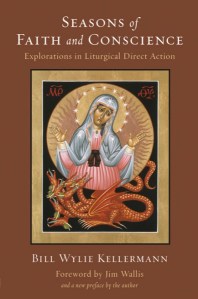
seasonsExcerpt and reflection from Bill Wylie-Kellermann’s Seasons of Faith and Conscience: Explorations in Liturgical Direct Action (1991):

It can be fairly said that discipleship is the topic of Lent. The liturgical road from Ash Wednesday leads straight to Passion-week Jerusalem. To enter wholeheartedly into the season costs more than tag along admiration from the margins of a multitude. A call and a choice are put point blank: take up your cross and follow.

Lent was first and still remains a season of baptismal preparation. Before the church year took shape there was only the unitive feast of Easter which went on for fifty days until Pentecost. But for some (those initiates to be baptized into the death and life of Christ on Easter) it was the culmination of a three year period of instruction and discipline. In the underground rigors of pre-Constantinian faith the scrutiny was serious, the preparation prolonged, and the prayer intense. Those demanding final days before baptism were marked with a fast. In part, by a simple act of solidarity and intercession, other members even whole congregations, were drawn instinctively to join the fast and renew their own sacramental vows come Easter sunrise.

Continue reading “Lent: A Confusion Before the Cross: Confronted by the Powers in Prayer”

Prayer for Mr. Trump, the human being.

By Bill-Wylie-Kellermann

O Wind of Spirit who moved across the face of chaos,
breathing life into creation and humanity.
Heal this man, afflicted in his presidency,
from the very illness he has unleashed in mockery.
Defend him from the Power of Death by which he is so enthralled
and so embraced, as to set it upon countless others
whom we pray you protect as well.
For the time and sake of mercy,
withhold the wrath of your judgement and bring him instead
            into the fullness of his humanity, painful though it be.
When his breath comes easy and he wakes, may truth dawn upon him like a bolt.

Continue reading “Prayer for Mr. Trump, the human being.”

Racism, Exorcism + Baptism

PIPFrom the conclusion of Rev. Bill Wylie-Kellermann’s chapter on racism (“Exorcising an American Demon: Racism is a Principality”) in Principalities in Particular: A Practical Theology of the Powers That Be (2017):

William Stringfellow’s source of authority and hope at the Chicago
conference was tied to baptism:

[Racism] is the power with which Jesus Christ was confronted and which, at great and sufficient cost, he overcame. In other words, the issue here is not equality among human beings, but unity among human beings…The issue is baptism. The issue is the unity of all humanity wrought by God in the life and work of Christ. Baptism is the sacrament of that unity.

As the Ephesians letter (which itself may be read as a baptismal meditation) puts it: the new humanity in Christ’s body breaks down the wall of hostility (2:14–16). In this new humanity which baptism seals and affirms, our relationship to every other human being, every human community, indeed to every creature, is renewed. The wall has no
claim upon us. The powers do not rule in our lives and community. We
have died, with Christ, out from under their spirit and dominion (Eph
2:1–8). Continue reading “Racism, Exorcism + Baptism”

Blessing Liz McAlister

LizMcalisterArrest2001This morning at 9am Elizabeth McAlister will be the first to be sentenced for her action as part of the Kings Bay Plowshares.

The sentencing itself will take place with a video conference at 9am tomorrow. An audio link is provided by the court for public to listen. Dial 1-888-684-8852, enter the call access code 2296092 and enter the security code 1234.

Last night community gathered over zoom to hold a blessing and liturgy in preparation. Here is the closing blessing for Liz by Bill Wylie-Kellermann.

In the name of the One who creator and sustainer of life; the One who is Lord and servant of all creation; and the Spirit that calls us together as one, let this blessing be. Continue reading “Blessing Liz McAlister”