An excerpt from Ched Myers’ commentary on this week’s Gospel text in Luke. The entire post is well worth reading, as it is every week. Check out Ched’s blog for his weekly comments and subscribe to his emails here.Also, check out his recent release (above) Healing Affluenza and Resisting Plutocracy.
There are three main problems with how church folk have been socialized to encounter scripture:
We handle texts as fragments, rarely grasping the narrative whole and flow;
Our habits of “fast food Bible study” allow only limited time and attention to “get to the point,” which fosters either overdependence upon an authority figure to tell us what the text means, and/or a settling for vast simplifications;
The focus of interpretation is almost always “personal application,” quite apart from social and historical context (ours and the text’s)—treating the Bible as an “answer book” or doctrinal rulebook.
The problem is, ancient storytelling was not simplistic, but a sophisticated art form using a variety of techniques to educate, preserve culture, and explore the human experience.
From Ched Myers, posted to social media last week in eager anticipation for the Second Festival of Radical Discipleship in Bangor, PA over this so-called “Memorial Day Weekend.”
I want to offer the edited and abbreviated version below of a “rant” I gave at the 2015 BKI Festival for Radical Discipleship here in Oak View, as a paean to this work and to the vision of radical discipleship that animates our mission at BCM, which will be celebrated this weekend at the Second Festival at Kirkridge Retreat Center. May this tradition carry on!
What is Radical Discipleship?
The etymology of the term radical (from the Latin radix, “root”) is the best reason not to concede it to nostalgia. To get to the root of anything we must be radical. No wonder the word has been demonized by the elite and co-opted by marketing hucksters, and that no one in conventional politics dares use the word favorably–much less track any problem to its root. It is also curious and revealing that the notion of discipleship is so marginal in our churches. Curious, because discipleship is unarguably the central theme of the gospels. Revealing, because it shows how wide the gulf between seminary, sanctuary and streets has become in North America.
The prevailing expressions of faith among Protestant churches—evangelical decisionism, mainline denominationalism and fundamentalist dogmatism—are each problematic in a society that is mired in dysfunctional politics, delusional economics and a distractive culture. Faith as discipleship remains the “road rarely taken” here at the heart of empire. We have yet truly to reckon with Dietrich Bonhoeffer’s famous warning, delivered under the shadow of fascism, that “cheap grace is grace without discipleship.” Radical Discipleship thus calls us to a double commitment: to reveal the roots of personal and political pathologies that continue to shape our imperial society, and to recover the roots of our biblical tradition: the messianic movement of rebellion and restoration, of repentance and renewal, and of a “Way out of no way” that has been going on since the dawn of resistance to the dusk of empire…
By Ched Myers, a few comments about the Gospel texts for the 2nd and 3rd Sundays of Lent, re-posted from Bartimaeus Cooperative Ministries. If you are in Southern California in early April, register to attend the official launch of Ched’s new book here.
In a sequence that runs from Luke 12:35–13:9, Jesus names five examples of brutality endured by poor and working classes who labor and live in the world of wealthy “lords”:
household servants enduring sleeplessness (12:37) and beatings (12:47);
debtor’s prison (12:58–59);
Galileans suffering violence at the hands of Roman authorities (13:1–3);
pedestrians killed by dangerous urban construction (13:4–5); and
oppressive demands on peasants for agricultural production by absentee landlords (13:6–9).
Jesus’s warning to “settle out of court” (2) refers to a judicial system controlled by the landlord class that routinely imprisoned the poor for indebtedness.” Pilate’s massacre of Galileans (3)—perhaps during a Passover pilgrimage, hence the reference to “their sacrifices” (13:1)—could refer to any number of skirmishes between Roman authorities and Judean dissidents during the first century CE, many of which were documented by the Jewish historian Josephus. Urban construction accidents (4) were common, given the notorious working conditions and “code violations” that characterized ambitious and hasty Herodian building projects. Those two incidents might be connected if the Tower of Siloam was part of Roman aqueduct construction, since Josephus reports that Pilate killed a group of Jews who were protesting his seizure of Temple funds to pay for imperial waterworks projects in Jerusalem. . Jesus’s emphatic refrain—“I tell you, unless you repent, you will all perish as they did” (13:3, 5)—implies that unless his people defect from this system, they too would be killed by its oppressions (Luke uses apollumi far more frequently than any other N.T. writer). These are some of many reasons that Jesus repudiates the “peace” of an imperial system that routinely generates such violations (12:51).
By Ched Myers, a reflection on Luke 6:17-26, re-posted from Bartimaeus Cooperative Ministries. We are eagerly awaiting the release of Ched’s newest book on Luke’s Gospel Healing Affluenza and Resisting Plutocracy (above) in early April. Pre-Order it here.
In the gospel text for the Sixth Sunday in Epiphany, Luke brings Matthew’s Sermon on the Mount down to “level ground.” Its rhetorical fire “raises up” the poor and “brings down” the rich, just as the Magnificat promised.
David King’s 2022 Reclaiming the Radical Economic Message of Luke is one of the few other contemporary studies of Luke’s radical economics out there. He points out that Jesus’ opening lines to the Sermon on the Plain contains curses which parallel the beatitudes in the Sermon on the Plain. “Damn you rich! You already have your consolation. Damn you who are well-fed now! You will know hunger”… It is part of the standard theme of reversal, but it is also an acknowledgement of God’s disdain for wealth.
As such, it is truly a text of terror for contemporary middle class readers. (For a recent sermon that faces squarely the “discomfort” this text brings to middle class ears, see here).
If we are going to talk about how undocumented immigrants impact our society, we ought to first address how our national policies have disrupted their lives. Above all, solidarity with the immigrant poor should seek to know them not as statistics, but as human beings who endure extraordinary hardship and trauma in their struggle just to survive–especially since the structural causes of their impoverishment lie on our side of the border.
By Ched Myers, For the Second Sunday in Lent (Mk 8:31-38), re-posted from Lent 2015
Note: An ongoing series of Ched’s brief comments on the Markan gospel readings from the Revised Common Lectionary.
————–
The midpoint of Mark’s narrative poses two questions, aimed both at the disciples in, and the readers of, the story:
“Do you not yet understand?” (Mk 8:21).
“Who do you say that I am?” (8:29a).
The latter provokes what I call the “confessional crisis” (8:30-33), which this Sunday’s reading inexplicably jumps into the middle of (we get the whole text on the 16th Sunday after Pentecost, Sept 13th). This is followed by Jesus’ second call to discipleship (8:34ff), deepening the journey begun in 1:16-20. Continue reading “Jesus’ “Second Call” to Discipleship”→
Note: I shared the comments below on the gospel reading for the First Sunday in Advent (Dec 3, 2023) as part of Creation Justice Ministries’ “Green Lectionary” podcast. You can hear my whole conversation with Derrick Weston & Debra Rienstra here.(above image: “All the stars in the sky will be dissolved and the heavens rolled up like a scroll,” Elena Markova, U.S., 2022; image found here)
Apocalyptic texts tend to make churchgoers nervous. In every lectionary cycle, however, the penultimate Sunday of Ordinary Time and first Sunday of Advent turn to what I call the “apocalyptic season” that bridges the end and beginning of the liturgical year. The gospel reading for First Advent always comes from the “synoptic apocalypse” (Mt 24, Mk 13, or Lk 21), before turning to the ministry of John the Baptist in Second Advent. This Year B we have the second half of Mark’s “Little Apocalypse” (13:24-37); the first part occurs at the end of Ordinary time. The lectionary’s brief apocalyptic focus functions to help us look at the “end of the world” as we prepare for it to be “born anew” in Advent and Christmastide.
Here are some brief thoughts (especially on the underlined phrases) on Sunday’s reading, with our ecological crisis in mind.
Mk 13:24-25: “But in those days, after that suffering, the sun will be darkened, and the moon will not give its light, and the stars will be falling from heaven, and the powers in the heavens will be shaken.
For us, apocalyptic images of the cosmos falling apart obviously correlate with the climate catastrophe that is upon us. Interestingly, the root of our term “disaster” comes from aster, or stars in Greek; we are indeed amidst a disaster. But too often we still apprehend ecological disaster as something happening to us, rather than engineered by us. In fact, the biblical idea of nature in revolt does not actually originate with apocalyptic literature, but with the Exodus liberation story. In that old wise tale, enslaved Hebrews are struggling for liberation against Pharaoh’s oppressive regime, an obvious mismatch. But the Creator has animated this movement, so Creation aligns against the empire in a series of escalating plagues that ultimately force the tyrant to relent (if you haven’t had a chance to look at my longer piece “Nature Against Empire: Exodus Plagues, Climate Crisis and Hard Heartedness,” go here). This profound framing lies in the background of Jesus’ vision here, and it’s not too difficult to see its relevance for our moment of imperial oppression of both people and Creation—in which we are each and all deeply implicated.
By Ched Myers, a brilliant Bush-era article on Luke’s Road to Emmaus story (this weekend’s Gospel text). It is more relevant than ever.
In the first-century Pax Romana, Christians had the difficult and demanding task of discerning how to cling to a radical ethos of life – symbolized preeminently by their stubborn belief in the Resurrection of Jesus – while living under the chilling shadow of an imperial culture of domination and death. Today, in the twenty-first-century Pax Americana, U.S. Christians are faced with the same challenge: to celebrate Easter faith in the teeth of empire and its discontents.
“The words empire and imperialism enjoy no easy hospitality in the minds and hearts of most contemporary Americans,” wrote the great historian William Appleman Williams a quarter century ago in his brilliant rereading of U.S. history. Yet today, because of the ascendancy of the New Right’s ideological project (whose intellectual architecture is typified by the Project for a New American Century), the words are increasingly used approvingly in regard to U.S. policy. We are indeed well down the road of imperial unilateralism, and are seeing clearly that this means a world held hostage to wars and rumors of war. The conquest and occupation of Afghanistan and Iraq have had an enormous human and political cost. Meanwhile, the Unites States has military bases on every continent and some form of military presence in almost two-thirds of the 189 member states in the United Nations.
By Ched Myers, a commentary on last Sunday’s Gospel
Today’s gospel text for the 23rd Sunday after Pentecost culminates Year C’s journey through Luke (next week’s “Reign of Christ Sunday” is a special feast day to close the liturgical year). It narrates the first half of the third gospel’s version of the “Synoptic Apocalypse” (Lk 21), which begins by portraying Jesus’ disciples, many of whom were up-country Galileans, as dazzled pilgrims encountering the grandeur of the “Holy” metropolis of Jerusalem for the first time (21:5).
Like rural folk visiting Washington DC for the first time, they were impressed (or perhaps just overwhelmed) by the imposing monuments and edifices of their nation, which conjured a visceral patriotism they assumed Jesus shared. We, too, inevitably experience moments of existential awe by our civilization, especially as powerfully represented by its built environment—whether civic, religious, industrial or military. We all dwell under the shadow cast by the self-congratulatory narrative of empire; it is so heroic and compelling that we become enamored with (or paralyzed by) the systems that rule over us, despite ourselves. “Wow!” they/we intone, “God bless America!”—then turn to Jesus to add plaintively, “right??”
By Ched Myers, on Luke 19:1-10, re-posted from October 2016
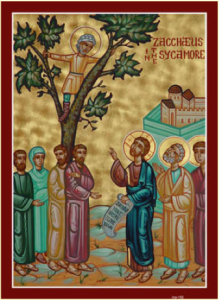
First, as always, let’s put this Sunday’s gospel reading in its broader narrative context. The story of Zacchaeus represents the culmination of one of Luke’s important subplots: Jesus’ challenge to rich men (Gk plousios) to “turn their lives (and assets) around.” As pointed out in previous posts, this narrative strand forms the backbone of Luke’s “Special Section” (Lk 11-19), a pattern worth reiterating here (with links to my comments earlier this year):






 By Ched Myers, on Luke 19:1-10, re-posted from October 2016
 Radical Discipleship