The Prophetic Script

bartBy Ched Myers, for the 2nd Sunday of Lent (Luke 13: 31-35

Note: This is part of a series of Ched’s occasional comments on the Lukan gospel readings from the Revised Common Lectionary during year C, 2016.

More than any other gospel writer, Luke portrays Jesus as using Israel’s prophets for his own interpretive lens. This theme stretches across the whole arc of Luke’s story, from its beginning where the coming promise of redemption comes “through the mouth of God’s holy prophets from of old” (1:70) to the Emmaus road epilogue, which stresses this traditions as a hermeneutic key to the problem of suffering: “Then beginning with Moses and all the prophets he interpreted to them the scriptures” (24:25-7; 44f). Continue reading “The Prophetic Script”

Jesus on a Wilderness Vision Quest

JesusTemptationBy Ched Myers, 1st Sunday in Lent (Luke 4:1-13)

Note: This is part of a series of Ched’s occasional comments on the Lukan gospel readings from the Revised Common Lectionary during year C, 2016. For a longer version of this reflection and a close look at each of the temptations, see http://www.chedmyers.org/sites/default/files/02-4-Pb%2C%20Jesus%20Wilderness%20Temptations%20as%20Vision%20Quest.pdf.

The church traditionally inaugurates Lent by reflecting on the “wilderness temptations” of Jesus. In preparation for his mission, Jesus follows a mysterious yet compelling calling to radical wilderness solitude. He fasts. He lives in the wild. He wrestles with spirits. (Above: Ivan Nikolaevich Kramskoy, “Christ in the Wilderness,” 1873.) Continue reading “Jesus on a Wilderness Vision Quest”

A Double Stance

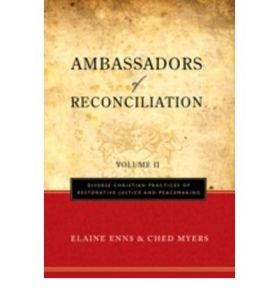
AORFrom Elaine Enns & Ched Myers in their 2nd Volume of Ambassadors of Reconciliation (2009).  Enns & Myers direct Bartimaeus Cooperative Ministries, hosting their annual February Kinsler Institute from February 15-19–this year’s theme is Landscapes of Trauma, Stories of Healing: Women in Luke’s GospelONLY 2 MORE DAYS to register:

To secure peace with justice, whether locally or globally, requires that peacemakers assume a double stance. On one hand, we must be close enough to a given conflict that we can identify the particularities of each party and situation, which calls for the approach of community organizers, social workers and pastors. On the other hand, we also need to step back enough to see the influence of larger historical, social and ideological forces, requiring the skills of social analysis and advocacy. Holistic peacemaking cannot ignore any of these competences or perspectives if it is to be transformative. And if we do not experiment with alternatives, we are left with the retributive solutions of sheriffs and the prison system, which merely manage the inevitable conflicts generated by a dysfunctional society.

Risky Midrash: The Jubilee Pertains to Our Enemies Too

NaamanBy Ched Myers, for the 3rd Sunday of  Epiphany (Jan 24, 2016: Luke 4:22-30)

Note: This is part of a series of Ched’s occasional comments on the Lukan gospel readings from the Revised Common Lectionary during year C, 2016.

The audience reaction to Jesus’ inaugural sermon in Nazareth is somewhat ambiguous (4:22). Though they “witness to him” (the Gk emarturoun with the dative is usually positive), they also “wonder” about him (ethaumazon, which can connote surprise in a negative sense; see Lk 11:38), no doubt skeptical about how such eloquence can come from a humble construction worker’s son. This explains Jesus’ immediate move to the defensive, then quickly to the offensive. Continue reading “Risky Midrash: The Jubilee Pertains to Our Enemies Too”

Magnificat: Poor Women’s Voices Liberated

MyersMagnificatBy Ched Myers, for the 4th Sunday in Advent (Luke 1:39-55)

Note: This is part of a series of Ched’s occasional comments on the Lukan gospel readings from the Revised Common Lectionary during year C, 2015-16.

Luke 1 is the prolegomenon to the nativity story, and is structured around the stories of two women who, for radically different reasons, cannot conceive. In a nutshell, Elizabeth is too old, and Mary is too young. Their stories are narrated in staggered parallel:

  • Annunciation to Elizabeth (1:5-25) Annunciation to Mary (1:26-38)
  • Elizabeth’s Response (1:41-45) Mary’s Response (1:46-55)
  • John’s birth (1:57-66) Jesus’ birth (2:1-20)

Continue reading “Magnificat: Poor Women’s Voices Liberated”

The Baptist’s Radical Critique of Entitlement: Repentance as Radical Discontinuity

LentzJohntheBaptistBy Ched Myers, the 3rd Sunday in Advent (Luke 3:7-18)

Note: This is one of Ched’s occasional comments on the Lukan gospel readings from the Revised Common Lectionary during year C, 2015-16.

The third week in Advent lingers on Luke’s portrait of John the Baptist, in which we get our most substantive glimpse into this wilderness prophet’s message (right, icon by Robert Lentz, 1984). This reading cuts sharply against the grain of the holiday season, so often defined in corporate-sponsored Christmas culture by commercialization and commodification of all things religious. But the Lectionary’s wisdom seeks to restrain the manic rush into what a young Jewish friend calls “the days of craze,” insisting rather on a sober look at the travails of empire.
Continue reading “The Baptist’s Radical Critique of Entitlement: Repentance as Radical Discontinuity”

The “Confessional Crisis”

PeterBy Ched Myers, for the 16th Sunday of Pentecost (Mk 8:27-9:1)

Note: This is an ongoing series of Ched’s brief comments on the Markan gospel readings from the Revised Common Lectionary during year B, 2015.

Roughly midway through the season of Ordinary Time, and a week before the Fall Equinox, our lectionary series in Mark’s gospel arrives at the midpoint of the story.

The first half of the narrative began by heralding a “Way” (1:2), and closed with a question addressed to the disciples and the reader: “Do you not yet understand?” (8:21) The second half opens “on the Way” (8:27), with yet another query: “Who do you say that I am?” (8:29a). Do we really know who Jesus is, and what he is about?

It is a shock to discover in this Sunday’s reading that Peter’s “correct” answer (8:29b) is silenced (8:30). This issues in what I call a “confessional crisis” (8:30-33), followed by Jesus’ second call to discipleship (8:34ff). This sequence represent the fulcrum upon which the entire gospel balances. Mark’s thesis is most clearly revealed here: discipleship is not about theological orthodoxy, but about the Way of the cross.

This Way will be explained by three object lessons, both positive and negative. The architecture of the ensuing narrative section consists of three “portents” about Jesus’ impending arrest, which the disciples fail to comprehend, and three teaching cycles. This structure has a catechetical character, representing a “school of the road,” as Jesus and his disciples journey from the far north of Palestine to the outskirts of Jerusalem:

         Geography                   Portent      Incomprehension       Teaching

1) Caesarea-Philippi      8:31                     8:32f                    8:34ff

2) Galilee to Judea        9:31                     9:32-34                9:35ff

3) to Jerusalem             10:32-34              10:35-37              10:39ff

This catechism is neatly framed by two stories in which the blind receive sight: in Bethsaida (8:22-26) and in Jericho (10:45-52). Here we see master story telling indeed.

Since Mark’s first storm episode (4:41), the issue of Jesus’ identity has been lingering in the background; now Mark turns to address it directly (8:27). The public’s perception of Jesus parallels the three misinterpretations reported earlier concerning John (8:28; see 6:14-16). But when the disciples are asked for their opinion, Peter hails Jesus as “Messiah” (8:29).

We meet this politically-loaded term for the first time since the story’s title (1:1). Messiah was understood by many Jews in first century Palestine to be a royal figure who would someday restore the political fortunes of Israel. Based upon Mark’s title and the centrality of this confession in the church, we are likely to approve of Peter’s identification. But to our chagrin, Peter is immediately silenced by Jesus (8:30), as if he were just another demon trying to “name” Jesus (see 1:25; 3:12)!

Since this lection has already come up this year (on the Second Sunday in Lent), I refer to my comments there concerning the crisis of expectation that punctuates Jesus’ exchange with Peter, and the meaning of his teaching on denial and the “Coming of the Human One.”


Open Borders!

bordersBy Ched Myers, for the 14th Sunday of PENTECOST (MK 7:1-23)

Note: This is an ongoing series of Ched’s brief comments on the Markan gospel readings from the Revised Common Lectionary during year B, 2015.

After a lengthy hiatus in John, the RCL gospel returns to Mark, though it piecemeals this Sunday’s text (I’ll read it whole, and suggest you do as well).
Continue reading “Open Borders!”

PROPHETIC GENEALOGIES AND THE COST OF DISCIPLESHIP

JtheBBy Ched Myers, for the 7th Sunday after Pentecost (Mark 6:14-29)

Note: This is an ongoing series of Ched’s brief comments on the Markan gospel readings from the Revised Common Lectionary during year B, 2015.

This Sunday’s gospel is Mark’s account of John’s execution by Herod (that is, Herod Antipas, tetrarch of Galilea and Perea from 4 B.C.E.-39 C.E.) This “flashback” belatedly explains the circumstances surrounding John’s arrest, which was reported in passing at the outset of the story (1:14). Mark tells us that Herod believes that Jesus is John coming back to haunt him (6:14-16). Insofar as Jesus took up the Baptist’s mantle (preaching repentance and the Kingdom of God), Herod is not wrong. But the disturbing implication for the king is that this proclamation persists despite his having gotten rid of one of its messengers, suggesting that there was a more serious popular movement to be reckoned with. It is to the sordid tale of John’s demise that Mark now abruptly turns.
Continue reading “PROPHETIC GENEALOGIES AND THE COST OF DISCIPLESHIP”

WHAT IS EVANGELISM? STRANGER AT HOME, AT HOME AMONG STRANGERS

LessonsBy Ched Myers, the 6th Sunday of Pentecost (Mk 6:1-13) 

Note: This is an ongoing series of Ched’s brief comments on the Markan gospel readings from the Revised Common Lectionary during year B, 2015.

At this point in Mark’s narrative we are given some background on each of the three major “protagonists” of this story: Jesus (6:1-6), the disciples (7-13) and John the Baptist (14-29, the gospel for 7 Pentecost). These three episodes each concern “rejected prophets,” which opens up a central theme of the second half of the gospel: the cost of discipleship.

This narrative sequence begins with Jesus’ return “to his own country” (6:1). For a third time, he teaches in a synagogue on the Sabbath (see 1:21ff; 3:1ff), and for a third time he encounters opposition. But this time it is not from the authorities, but from his neighbors and kinfolk. They are suspicious of this local boy’s notoriety, objecting that he has no distinguished lineage (6:3). Because of the domesticating constraints of nationality, kinship and household expectations (6:4), the “prophet without honor” is unable to effect change in his hometown, and returns to his itinerant mission (6:5f).
Continue reading “WHAT IS EVANGELISM? STRANGER AT HOME, AT HOME AMONG STRANGERS”