Jesus On A Vision Quest

temptationBy Ched Myers, First Sunday in Lent (Mark 1:9-15)

Note: This is an ongoing occasional series of Ched’s brief comments on the Markan gospel readings from the Revised Common Lectionary during year B.
———————
In Mark’s account of Jesus’ baptism, the narrative is suddenly invaded by dramatic imagery. Jesus rises from Jordan’s waters to a vision of the “heavens rent asunder” (1:10). This is an allusion to Isaiah 64:1f:
Continue reading “Jesus On A Vision Quest”

“God is Like a Mountain” (Mk 9:2-9)

By Ched Myers, for Transfiguration Sunday (6. Epiphany)

Note: This is an ongoing occasional series of Ched’s brief comments on the Markan gospel readings from the Revised Common Lectionary during year B.
——————
Without wildness, civilization could not survive. The converse does not hold.
Evan Eisenberg, The Ecology of Eden

The Feast of the Transfiguration probably dates back to the late Roman period. A major feast in the Eastern Church, it was not widely practiced until the 9th century by the Western Church. August 6th was designated as Feast of the Transfiguration for the whole church in 1456. The Roman Catholic Church today also commemorates the Transfiguration on the second Sunday in Lent, but the Revised Common Lectionary puts the story at the last Sunday of Epiphany, just before Lent. This is done in order to recognize the Transfiguration’s close relationship in the synoptic gospel narratives to Jesus’ journey toward Jerusalem and the Cross.
Continue reading ““God is Like a Mountain” (Mk 9:2-9)”

What Would Happen if Jesus Came to Your Home?

ChedBy Ched Myers, Fifth Sunday in Epiphany (Mk 1:29-39)

Note: This is an ongoing occasional series of Ched’s brief comments on the Markan gospel readings from the Revised Common Lectionary during year B.
———————
In Mark 1:28, Jesus retreats to a home from his confrontation with the “Powers” occupying the synagogue, having created space for change. In Mark’s story, the home seems to be a safe site (5:38; 7:17, 24; 9:33; 10:10; 14:3), in contrast to the synagogue and Temple as places of conflict. Such “politics of space” no doubt reflected the experience of the earliest church—or of any social renewal movement’s relationship with established institutions of control. In this case, we should note that Jesus avails the hospitality of a peasant fisherman, setting the pattern that will continue throughout this story: Jesus abides with the marginalized.
Continue reading “What Would Happen if Jesus Came to Your Home?”

The Movement For God’s Beloved Community

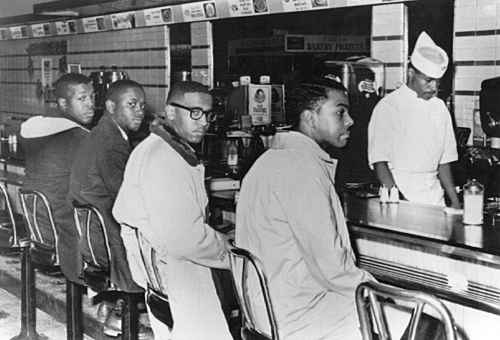
greensboro1Today, we honor those nonviolent freedom fighters who sparked the sit-in movement at lunch counters exactly 55 years ago. It is also the 50th anniversary of the first mass arrests in Selma–Dr. King and more than a thousand demonstrators, including more than 500 children were jailed on February 1, 1965 (many these same children prayed for Sheriff Clark’s speedy recovery from exhaustion outside a hospital days later). Lastly, we celebrate the 60th birthday of Ched Myers, a man who has committed his life to the legacy of Jesus & Martin Luther King. This is an excerpt from an article he published 10 years ago in Transmission (U.K) titled “Was Jesus a Practitioner of Nonviolence? Reading through Mark 1:21-3:19 and Martin Luther King”, an appropriate piece of vision-casting for all of us who dare to resist like it’s 1960 Greensboro & 1965 Selma:

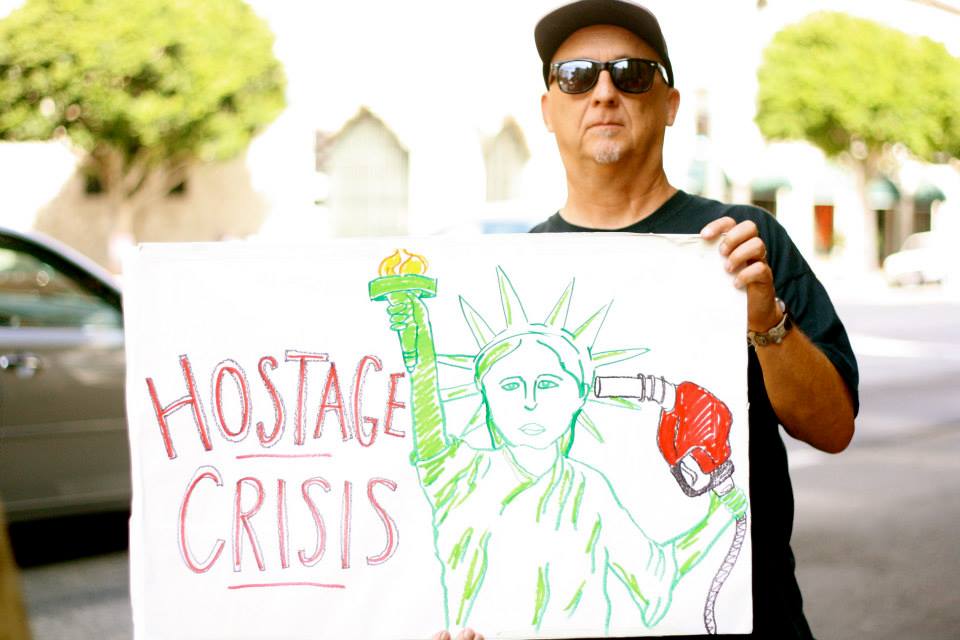
At the end of their lives, Jesus and King were each hemmed in by all the factions of their respective political terrains. They had to navigate death threats from without, dissent from within their own movements, and had as colleagues only a relatively tiny group of feckless companions. But that is how it always is struggling for the Kingdom of God in a world held hostage by tyrants, terrorists, militarists, and kingpins, unaided by ambivalent religious leaders and insular academics and utterly distracted young folks. Despite all this, however, both Jesus and King chose nonviolent love without compromising their insistence upon justice. They believed that the movement for God’s Beloved Community was worth giving their lives to—and they invite us to do the same.

Challenging the Status Quo: Jesus Contests Scribal Authority

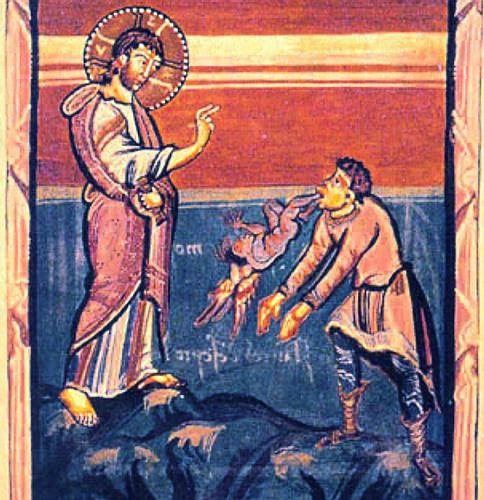
Healing_of_the_demon-possessedBy Ched Myers, Fourth Sunday in Epiphany (Mk 1:21-28)

This is an ongoing occasional series of Ched’s brief comments on the Markan gospel readings from the Revised Common Lectionary during year B.

The first major narrative section of Mark’s gospel begins (1:16) and ends (4:36) by the shores of the Sea of Galilee. In it Mark paints a portrait of Jesus’ public ministry in and around the Galilean city of Capernaum. This series of episodes exhibits the three essential characteristics of Jesus’ mission: the healing and exorcism of marginalized people, the proclamation of God’s sovereignty and the call to discipleship. These practices result in escalating confrontations with the local authorities, culminating with open conflict in 3:1ff.
Continue reading “Challenging the Status Quo: Jesus Contests Scribal Authority”

“Let’s Catch Some Big Fish!” Jesus’ Call to Discipleship in a World of Injustice

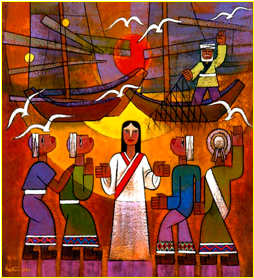
FishermenBy Ched Myers, Third Sunday in Epiphany (Mk 1:14-20)

This is an ongoing occasional series of Ched’s brief comments on the Markan gospel readings from the Revised Common Lectionary during year B.
——————-
The Sea of Galilee is the ecological and social setting of the first half of the gospel of Mark. A large freshwater lake about seven miles wide and 13 miles long, its shore is dotted with villages connected with the local fishing industry, the most prosperous segment of Galilee’s economy. The lake (also called Sea of Genneseret, Lake Kinneret or Lake Tiberius) is fed by the Jordan River, which flows in from the north and out to the south. Some 209 meters below sea level, it is the lowest freshwater lake on Earth. Due to this low-lying position in a rift valley, the sea is prone to sudden violent storms, as attested in the gospel stories.
Continue reading ““Let’s Catch Some Big Fish!” Jesus’ Call to Discipleship in a World of Injustice”

Baptized Into Our Bioregion

the-Baptism-of-JesusBy Ched Myers of Bartimaeus Cooperative Ministries, hosting the Festival of Radical Discipleship in mid-February in Oak View, CA:

Yesterday, the First Sunday after Epiphany, was the Feast of Jesus’ Baptism. In the gospel reading, a particular preposition is used in refrain in Mark 1:9-12. Everyone else is baptized by John in the Jordan, but Jesus is baptized into the river (Gk, eis ton Iordanēn). Then that wild bird descends onto or into Jesus (eis auton). And right after this, Jesus journeys deep into the wilderness (eis tēn ‘eremon), on his “vision quest.”
Continue reading “Baptized Into Our Bioregion”

Ecological Hermeneutics: “The Bible and Climate Change”

mckibben.4In a very short order we got very, very big. Human beings have always been in Job’s position–small. Our job is to figure out how to get smaller again. And I think it is essentially a theological task.
Bill McKibben

Ched Myers is always up for the challenge of making the Society of Biblical Literature’s annual gathering of “Bible geeks” accountable to the sanctuary, the street and the soil. He’s been chipping away at the ivory tower for decades now. Here are a few highlights from a paper Myers read at the Society of Biblical Literature, a couple of weeks ago, participating on a panel assessing the 20th anniversary of Bill McKibbon’s The Comforting Whirlwind: God, Job and the Scale of Creation (1994):

On McKibben’s Legacy:

Whether or not we are aware of it, every one of us owes you a huge debt of gratitude for a life’s work of truth telling, movement building and relentless advocacy. Like many of us in the room (I hope), I’ve been following and occasionally participating in 350.org since its inception, especially around the Keystone XL work. You and your colleagues have animated a truly grass roots initiative that uniquely translates the complexities of climate catastrophe into mobilizing soundbytes.
——————-
Indeed, to exhume scripture’s radical critique of imperial culture is to endure diffident dismissal by the secular left, shrill hostility from the religious right, and studied ambivalence from the ecclesial center. Yet your work on Job stands in the noble minority tradition of engaged readers of Word and World such as Jacques Ellul, Martin Luther King, Jr., William Stringfellow, Dorothy Soelle, Ernesto Cardenal, Cornell West, and Elizabeth McAlister—none of whom, let it be carefully noted, were or are professional biblical scholars.

From Job to Jesus, homing in on Jesus’ teaching in Luke 12, “that awkward moment in Luke’s gospel where Jesus, in the middle of a strongly worded diatribe about the economic delusions and entitlements of the rich, whirls around and exhorts his disciples to ‘pay attention’ to the birds and wildflowers (Lk 12:24-28)”:

But what if Jesus is simply summarizing the argument from Job’s whirlwind, a teaching meant to be taken with utter seriousness? What if this paean to birds actually demands that we confront the three pathological characteristics of modern capitalist culture—addiction, anxiety and alienation—as life and death issues? It then becomes for us truly a “text of terror”—but also a key to our liberation.
——————–
Jesus is invoking a cosmology shared by indigenous and traditional peoples the world over and throughout history, which was translated into economic lifeways characterized by symbiosis with nature, sustainable and local production and consumption, and cooperative and equitable work patterns…

Prodding McKibben: A Transition from “petitioning around policy issues” to “nurturing place-based politics” (aka, Watershed Discipleship):

I think we will see in the coming years that it is those who are rooted on particular land who will be most able to say no to the carbon juggernaut, and to say yes to more sustainable lifeways. To me, Bill, this suggests that our movement ought to be spending at least as much effort nurturing place-based politics as we do petitioning around policy issues and organizing big marches, as important as the latter are.

The approach of watershed discipleship is, in the tradition of Job’s whirlwind and Jesus’ ode to birds, blessedly geocentric, and firmly straddles the dialectic of healing the earth and delighting in it. It is my strong conviction that it can animate communities of faith to engage in contextual and constructive witness as they awaken to the realities of climate catastrophe—for which awakening we are greatly indebted to Bill McKibben.

Who Will Roll Away The Stone? 20 Years Later.

ChedA theology of reclamation is about redemption–the healing of our individual, but more importantly our collective, humanity. It is thus, in the North American context, fundamentally concerned with the struggle to become a non imperial people, neither grandiose nor ashamed. It is about practicing discernment, honesty, dignity, community, and simplicity.
Ched Myers, Who Will Roll Away The Stone (1994)
—————
By Tom Airey

20 years ago, Ched Myers penned Who Will Roll Away The Stone: Discipleship Queries For First World Christianshis promised sequel to Binding The Strong Man (1988), the critically-acclaimed 560-page socio-political reading of Mark’s Gospel. Who Will Roll  was an inter-disciplinary bombshell for making sense of how followers of Jesus might live in the wake of “the 1st Gulf War” and the Los Angeles uprisin Continue reading “Who Will Roll Away The Stone? 20 Years Later.”

Ray, Janay & Restorative Justice In A Culture of Violence?

The ultimate weakness of violence is that it is a descending spiral, begetting the very thing it seeks to destroy…Returning violence for violence multiplies violence, adding deeper darkness to a night already devoid of stars.
Martin Luther King, Where Do We Go from Here: Chaos or Community? (1967)
————————–
By Tom Airey, Co-Editor of RadicalDiscipleship.Net & Lindsay Airey, MFT

Mainstream media outlets have homed in on the subject of domestic abuse in the wake of the release of the video of pro football player Ray Rice literally knocking out his fiance (now wife) back in Febuary.   Continue reading “Ray, Janay & Restorative Justice In A Culture of Violence?”