Impoverished By Her Obligations

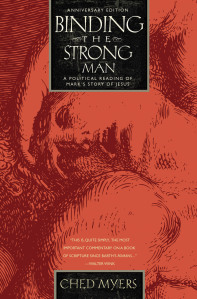
BindingComments on this week’s Gospel text (Mark 12:38-44) from Binding the Strong Man: A Political Reading of Mark’s Story of Jesus (1988), the commentary from Ched Myers, celebrating 30 years of prophetic utterance. 

The last episode in the temple is a story of a widow being impoverished by her obligations to the temple cultus (12:41-44). Long mishandled as a quaint vignette about the superior piety of the poor, Wright has shown that Jesus’ words should be seen “as a downright disapproval and not as an approbation”:

The story does not provide a pious contrast to the conduct of the scribes in the preceding section (as is the customary view); rather it provides a further illustration of the ills of official devotion. Jesus’ saying is not a penetrating insight on the measuring of gifts; it is a lament….Jesus condemns the value system that motivates her action, and he condemns the people who conditioned her to do it.

Continue reading “Impoverished By Her Obligations”

Orthodoxy is not Enough

Binding30 years in and Ched Myers’ Binding the Strong Man: A Political Reading of Mark’s Story of Jesus (1988) is more relevant than ever. We’ve got four more Sundays to celebrate it! This week’s commentary homes in on Mark 12:28-34.

The man’s question concerning the “first of all the commandments” is a common topic of rabbinic discussion, but could also be interpreted as yet another attempt to get Jesus to reveal his own political commitments. Jesus’ answer at first glance seems cautious in its orthodoxy: he quotes from the Shema (Dt 6:4f), with minor changes to the LXX text. Suddenly, however, he adds a citation of Leviticus 19:18 about obligation to neighbor, and concludes that “No other command is greater than these.”  Continue reading “Orthodoxy is not Enough”

Seeking True Vision


Binding30 years in and Ched Myers’ Binding the Strong Man: A Political Reading of Mark’s Story of Jesus (1988) is more relevant than ever. We’ve got five more Sundays to celebrate it! This week’s commentary homes in on Mark 10:46-52.

The community now approaches the suburbs of Jerusalem. Mark opens this second story of a blind man as he did the first: “And they came into” (kai erchontai; see 8:22) Jericho. Mark sets a scene for this episode, which was no doubt familiar to anyone who had gone to Jerusalem on pilgrimage. Jericho was the last stop en route to the city of David; the road out of town, representing the final, fifteen-mile leg of the pilgrim’s journey, would have been the standard beat for much of that city’s beggar population. The odds were good that pilgrims would have the mood and means to give alms. There Jesus, the disciples, and a great crowd meet Bartimaeus, the destitute blind man. Continue reading “Seeking True Vision”

On the Right and the Left

Binding30 years in and Ched Myers’ Binding the Strong Man: A Political Reading of Mark’s Story of Jesus (1988) is more relevant than ever. This week’s commentary homes in on Mark 10:35-45.

The petition by James and John shows that the disciples are still “deaf” to Jesus’ portents, continuing to understand his talk of the manifestation of the Human One’s “glory” (en te doxe sou) to mean some kind of messianic coup. Convinced their leader will prevail, they are already considering the administration of the new regime; they lobby for “first and second cabinet position.” The image of “sitting on the right and left” could be an allusion to Psalm 110:1, or to places at the messianic victory banquet, or subordinate thrones. In either case, it is an overtly political euphemism. Continue reading “On the Right and the Left”

The Eye of the Needle

Binding30 years in and Ched Myers’ Binding the Strong Man: A Political Reading of Mark’s Story of Jesus (1988) is more relevant than ever. This week’s commentary homes in on Mark 10:17-31.

Mark’s wry joke about the camel and the needle in particular has received ingenious “manipulation at the hands of bourgeois conscience-tranquilizing exegetes” (Jose Miranda). The famous medieval assertion that the “eye of the needle” referred to a certain small gate in ancient Jerusalem through which camels could enter only on their knees (!) is only one of the more obvious ways devised to rob this metaphor of its class-critical power. The proposition is plainly an impossible one. Bailey points out that the Babylonian Talmud records a similar hyperbole–an elephant going through the eye of a needle–and comments that “the elephant was the largest animal in Mesopotamia and the camel the largest in Palestine.” Mark’s stinging sarcasm is perhaps more recognizable in Frederick Buechner’s contemporary paraphrase: for wealthy North Americans it is harder to enter the kingdom “than for Nelson Rockefeller to get through the night deposit slot of the First National City Bank!”  Continue reading “The Eye of the Needle”

The Wedge of Patriarchal Practice

Binding

30 years in and Ched Myers’ Binding the Strong Man: A Political Reading of Mark’s Story of Jesus (1988) is more relevant than ever. This week’s commentary homes in on Mark 10:2-16.

Jesus refuses to enlist in the legal debate over the divorce statute itself. Instead he questions the way in which Pharisaic casuistry simply legitimates the already established social practice of divorce. The problem, as Elizabeth Schussler Fiorenza sees it, is that the legal issue is “totally adrocentric,” and “presupposes patriarchal marriage as a given.” Jesus argues:

Divorce is necessary because of the male’s hardness of heart, that is, because of men’s patriarchal mind-set and reality…However, Jesus insists, God did not intend patriarchy but created persons as male and female human beings. It is not woman who is given into the power of man in order to continue “his” house and family line, but it is man who shall sever connections with his own patriarchal family and “the two persons shall become one sarx“….The [Genesis] passage is best translated as “the two persons–man and woman–enter into a common human life and social relationship because they are created as equals.”

Jesus’ conclusion (10:9), then, is not meant as an absolute prohibition upon “divorce,” which would both overturn the Mosaic statute and return to a legalistic solution. Indeed, it drops the term for divorce (apoluse) in favor of a different term (to “separate,” chorizeto). Rather it protests the way in which patriarchal practice drives a wedge into the unity and equality originally articulated in the marriage covenant. Understood in the true sense, this famous phrase rightly belongs in the Christian marriage liturgy.

The principled critique of patriarchy having been stated “publicly,” the internal understanding of the community on this issue is once again given in a private explanation to the disciples in the safe narrative site of the home (10:10; 7:17f). Jesus here accepts the reality of divorce but prohibits remarriage–as does the similar catechetical tradition in I Corinthians 7:10 (though, there, “separation,” chorizo). The reciprocal formulation of the prohibition in 10:11f, however, reveals that the principle of equality has been maintained. The first clause–a man cannot divorce a woman and marry another without committing adultery against her–already went beyond Jewish law, “in which a man can commit adultery against another married man but not against his own wife” (Taylor, 1963). Bu the second clause, in which the rights of the female partner are expanded to include her right to divorce (or “leave”), directly contradicted Jewish law, which stipulated that only men could initiate and administer such proceedings (Kee, 1977).

This teaching recognizes the fact that divorce is a profound spiritual and social tragedy…The teaching also acknowledges, however, that divorce is a reality, within which the fundamental issue of justice must not be lost. Both parties must have the right to take initiative, and both must accept the responsibilities and limitations involved in the death of marriage.

Practice, Not “The Right Name”

Binding30 years in and Ched Myers’ Binding the Strong Man: A Political Reading of Mark’s Story of Jesus(1988) is more relevant than ever. This week’s commentary homes in on Mark 9:38-50.

The arrogance in John’s objection lies in its attempt to erect boundaries around the exercise of compassionate ministry “in Jesus’ name.” He equates exorcism with the accrual of status and power, and wishes to maintain a monopoly over it. This is especially ludicrous in light of the disciples’ lack of exorcism power, which we have just witnessed (9:14-29). But more importantly, it cuts directly against the grain of “receiving” in 9:37, an exhortation to inclusion, not exclusivity. On top of all this, John’s censure is based on the fact that the stranger “was not following us.” The disciples want to be followed, not followers. Never was a “royal we” less appropriate! Continue reading “Practice, Not “The Right Name””

Radical Status-Reversal

Binding30 years in and Ched Myers’ Binding the Strong Man: A Political Reading of Mark’s Story of Jesus(1988) is more relevant than ever. This week’s commentary homes in on Mark 9:30-37.

They next reach the home in Capernaum. That the community would stop in here on its way south, specifically for instruction on internal matters of power and discipline, is significant, for Capernaum was the center of gravity for the first part of the Gospel (Mk 1:21; 2:1). It is here that Jesus really begins to unmask his disciples’ true aspirations to power. Not only do they not understand where Jesus is trying to lead them; they are headed full speed in the opposite direction. Mark contrives the episode for maximal irony: the disciples are caught debating who was greatest among them “on the way” (twice, 9:33b, 34a)! For Jesus’ response, Mark sets a familiar stage: the twelve are called (3:14; 4:10; 6:7; 10:32; 14:17) and Jesus takes his seat (4:1; 12:41; 13:3). The narrative signals: Pay attention to the teaching that follows! Continue reading “Radical Status-Reversal”

Inevitability

Binding30 years in and Ched Myers’ Binding the Strong Man: A Political Reading of Mark’s Story of Jesus (1988) is more relevant than ever. This week’s commentary homes in on Mark 8:27-38.

Mark will tell us that it was “necessary” for John/Elijah (Mk 9:12:f) to challenge the highest powers and be executed by them; so too with Jesus, for that is the “script” Yahweh has given to the servant/prophets, as Mark will make clear through his parable of the tenants. Continue reading “Inevitability”

The Cornerstone to the New Social Order

BindingWe continue our every-Sunday-celebration of the 30th anniversary of Binding The Strong Man, Ched Myers’ political reading of Mark’s Gospel. 

The story of the Syrophoenician woman bears certain affinities with its counterparts in the Jewish cycle. She, like the hemorrhaging woman, demonstrates inappropriately assertive female behavior that is vindicated. The parallel with the Jairus story goes beyond the common petition on behalf of ailing daughters at home. Both these episodes articulate feeding-symbolics that are carefully correlated to Jesus’ feedings of the masses in the wilderness. Jesus’ somewhat anticlimactic instructions in the aftermath of his dramatic raising of Jairus’s daughter were for those present to “give her something to eat” (Mk 5:43). In like fashion, Jesus instructs his disciples in the first feeding to “give the crowd something to eat” (Mk 6:37). Similarly, Jesus tell the gentile woman that “the children must first be satisfied” (Mk 7:27 chortastenai)–which satisfaction has indeed already been reported in Mk 6:42 (“they all ate and were satisfied,” ephagon pantes kai echortastesan)! This is how Mark prepares the way for the fulfillment of the Syrophoenician woman’s request–the feeding and satisfaction of the gentiles–which will indeed shortly take place (same verb, Mk 8:4,8). Continue reading “The Cornerstone to the New Social Order”