

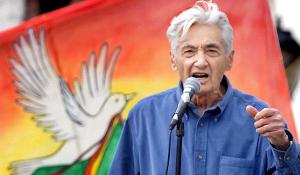
An timely excerpt from the last chapter of Howard Zinn’s A People’s History of the United States of America (1980).
History which keeps alive the memory of people’s resistance suggests new definitions of power. By traditional definitions, whoever possesses military strength, wealth, command of official ideology, cultural control, has power. Measured by these standards, popular rebellion never looks strong enough to survive.
However, the unexpected victories – even temporary ones – of insurgents show the vulnerability of the supposedly powerful. In a highly developed society, the Establishment cannot survive without the obedience and loyalty of millions of people who are given small rewards to keep the system going: the soldiers and police, teachers and ministers, administrators and social workers, technicians and production workers, doctors, lawyers, nurses, transport and communications workers, garbage men and firemen. These people – the employed, the somewhat privileged – are drawn into alliance with the elite. They become the guards of the system, buffers between the upper and lower classes. If they stop obeying, the system falls.
That will happen, I think, only when all of us who are slightly privileged and slightly uneasy begin to see that we are like the guards in the prison uprising at Attica – expendable; that the Establishment, whatever rewards it gives us, will also, if necessary to maintain its control, kill us.
Certain new facts may, in our time, emerge so clearly as to lead to general withdrawal of loyalty from the system. The new conditions of technology, economics, and war, in the atomic age, make it less and less possible for the guards of the system – the intellectuals, the home owners, the taxpayers, the skilled workers, the professionals, the servants of government – to remain immune from the violence (physical and psychic) inflicted on the black, the poor, the criminal, the enemy overseas. The internationalization of the economy, the movement of refugees and illegal immigrants [sic] across borders, both make it more difficult for the people of the industrial countries to be oblivious to hunger and disease in the poor countries of the world.
All of us have become hostages in the new conditions of doomsday technology, runaway economics, global poisoning, uncontainable war. The atomic weapons, the invisible radiations, the economic anarchy, do not distinguish prisoners from guards, and those in charge will not be scrupulous in making distinctions. There is the unforgettable response of the U.S. high command to the news that American prisoners of war might be near Nagasaki: “Targets previously assigned for Centerboard remain unchanged.”
There is evidence of growing dissatisfaction among the guards. We have known for some time that the poor and ignored were the nonvoters, alienated from a political system they felt didn’t care about them, and about which they could do little. Now alienation has spread upward into families above the poverty line. These are white workers, neither rich nor poor, but angry over economic insecurity, unhappy with their work, worried about their neighborhoods, hostile to government – combining elements of racism with elements of class consciousness, contempt for the lower classes along with distrust for the elite, and thus open to solutions from any direction, right or left…
…With the Establishment’s inability either to solve severe economic problems at home or to manufacture abroad a safety valve for domestic discontent, Americans might be ready to demand not just more tinkering, more reform laws, another reshuffling of the same deck, another New Deal, but radical change. Let us be Utopian for a moment so that when we get realistic again it is not that “realism” so useful to the Establishment in its discouragement of action, that “realism” anchored to a certain kind of history empty of surprise. Let us imagine what radical change would require of us all.
 From
From  An excerpt from
  From the conclusion of “
 An excerpt from chapter one of Howard Zinn’s
  Give people what they need: food, medicine, clean air, pure water, trees and grass, pleasant homes to live in, some hours of work, more hours of leisure. Don’t ask who deserves it. Every human being deserves it.
 From Howard Zinn’s The People’s History of the United States (1980):
 From Howard Zinn’s
  Radical Discipleship