Observe a holy Lent—the prayerbook enjoins, then spells it out with this austere prescription: self-examination, penitence, prayer, fasting, almsgiving, and reading and meditating on the word of God.
I am someone with a Lenten disposition. My own natural reserve, saying “no” for its own sake, and avoiding extravagance, were honed by my family and by my participation in certain discipleship traditions. Whatever the liturgical season, I engage in above average quantities of penitence, fasting, almsgiving, and no shortage of (critical) self-examination. But there are places where rigor can’t take you, and the 40 Birds of Lent is one of those places. Continue reading “The 40 Birds of Lent: Observe”→
Several years ago I participated in the Wilderness Way Community’s Lenten challenge: to spend 10 minutes each day outdoors in prayer or meditation. Due both to my own inclination and the fact that Lent falls where I live during spring migration, mating and nesting season, this experience, which I described to others as “going outside and paying attention,” quickly turned into going outside and paying attention to birds. Continue reading “The 40 Birds of Lent”→
The first Sunday after Christmas with the annual reading of Psalm 148, marks Wild Lectionary’s first anniversary: 51 blog posts, from diverse watersheds, reflecting on land, creation and indigenous justice themes from the readings of the Revised Common Lectionary. Continue reading “Wild Lectionary: Let All Creation Praise”→
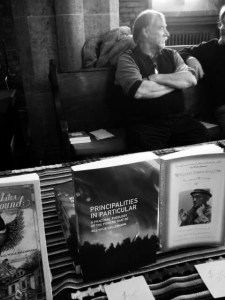
Rev. Bill Wylie-Kellermann and his recent releases
Because Christmas has become so central to the American economy and American consumption is so central to global capitalism, this festival of ‘Holy Days’ has become a central expression and embodiment of American imperial domination, an imperial religion. Richard Horsley, Religion and Empire (2003)
Truly, this Season signals a major tension for North American radical disciples. We resist and reclaim. Whether it is our love language our not, we give. But some forms of giving are far more redemptive than others.
It is in this Spirit that we offer gift ideas from more out-of-the-way, up-and-coming, long-suffering and open-hearted thinkers and artists. Links to their work are provided here and will eventually be added to our now-pemanent “STORE” tab up top. We hope this list is an Advent-instigator: please add your recommendations to the comments below or email us so we can add them to the store!!!
A beautiful 2016 publication from Philly-based pastor-parent-activist about using the difficult and challenging parts of life as a way to deepen your spiritual path and become more authentic.
Truly, it is a time of exile for those of us on the left. Let’s set the clock back to the early Bush years with this re-examination of the Exodus from a Vancouver-based pastor-activist.
From the foot of Tiger Mountain in Washington State comes a vital perspective on early church history (aka, “the roots of why Christians want to make America great again.”).
And lest we think gift-giving is only for adults, the executive director of the Center for Prophetic Imagination in Minneapolis tells this St. Francis-inspired tale for our young ones.
This year, Charlottesville exposed us all to some of the most vicious forms of American white supremacy. But far less known, C’Ville is home to some radical experimentation, including sweet sounds from a young singer-songwriter. Perfect for people defined by death-and-resurrection.
And this! From a Minneapolis-based artist and PhD candidate releasing her first album, a powerfully rich blend bursting with beauty, grief, creativity and prophetic wisdom.
Probably the most unique musical contribution of the movement is from Philly-based Holy Fool Arts, a voice of and for the wilderness that combines poetry, theatrical masks, ancient rhythms, traditional and modern dance forms, with a heavy side of the blues.
Lastly, a recommendation from author-activist Wes Howard-Brook fair-trade, organic chocolate from Mama Ganache. From WHB:
They are THE BEST! As we all know, corporate chocolate production is both a human and environmental horror show. The folks at MG use their profits to support farmers in West Africa in many ways, as explained on their website. I’ve been ordering from them for years!
In today’s Gospel when asked about the greatest of all the commandments, Jesus’ reply is simple, “love God, love your neighbor.” In Luke, this same exchange is followed by the question, “who is my neighbor?” which Jesus answers with the parable of the Good Samaritan. The story of upstanding citizens who fail to respond to suffering after an assault has obvious parallels for first world Christians confronted by climate crisis, species extinctions, and environmental racism. Continue reading “Wild Lectionary: Who Is My Neighbor?”→
Proper 24(29)
20th Sunday after Pentecost
Psalm 96
by Calvin Redekop
I love to return again to the Scriptures, to those visions seen by the prophets and apostles and singers of Israel about the “peaceful reign of God.” There is a strange concatenation of judgment and celebration in some of the Psalms, especially Psalms 96 to 99 and 104. Psalm 99 beings, “The Lord is king; let the people tremble!” In many Christian circles it is today politically incorrect to speak about God as king, as reigning, as judging, and instead God is portrayed as a morally nondiscrimination, indulgent Santa. Such and attitude represents the deliberate denial of a theme that runs through the Bible from beginning to end. “The Lord is king,” and one of the functions of a king was to be a judge, to dispense justice.
Now you know and I know, that lice, mice, roaches, bed-bugs, and rats are no respecters of persons. They invade the house of Pharaoh, the houses of his officials, and of all his people (Exod 8:21, 10:6); they infest the luxury hotels and the welfare hotels. But when the special shampoo costs eight dollars a bottle, and a visit from the exterminator $125, those that can—pay, and those that can’t, or whose landlord won’t—scratch.
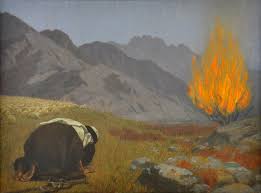
“There the angel of the Lord appeared to him in flames of fire from within a bush. Moses saw that though the bush was on fire it was not consumed… “Do not come any closer,” God said. “Take off your shoes, for the place you are standing is holy ground.”
And we know, when Moses was told,
in the way he was told,
“Take off your shoes!” He grew pale from that simple
reminder of fire in the dusty earth.
He never recovered
his complicated way of loving again
and was free to love in the same way
he felt the fire licking at his heels loved him.
As if the lion earth could roar
and take him in one movement…
-all poetry excerpts from David Whyte, Fire in the Earth
As I read the opening piece of the text from Exodus, it feels like I am reading a script from the white men who marched on Charlottesville two weeks ago.
It begins with the Pharaoh naming his fear that the Israelites are becoming too numerous and powerful. He is scared they will out-number and over-take him. He orders that they be forced into labor and when that doesn’t work, he orders murder.
It echoes of the treacherous low-wage labor forced on undocumented folks living in constant fear.
A decade or so ago, we spent two years of our monthly Saturday teaching/retreat series with the book of Genesis. Folks eagerly engaged Genesis’ anti-city perspective and its all-too-human characters. But when we got to the Joseph story, several rebelled angrily against our starting characterization of Joseph, son of Jacob, as a self-absorbed, manipulative power seeker, who “succeeded” by teaching Pharaoh how to manage famine for personal profit. What is it about Joseph that leads so many to want to see him as a heroic expression of faith? Continue reading “Wild Lectionary: Joseph—God’s Agent or Agent of Empire?”→

 By Laurel Dykstra


 Proper 18(23)
 Thirteenth Sunday after Pentecost
 Eleventh Sunday after Pentecost
 Radical Discipleship