To think again of dangerous and noble things

By Ric Hudgens, part three of a series (Part one is here and part two is here.)

Living otherwise means living according to the Great Economy.

Wendell Berry’s notion of the Great Economy contrasts with what he terms the Little Economy. The Little Economy is the industrial, globalized economic system that prioritizes profit and exploitation of resources over sustainability and community well-being. Berry’s discussion of the Great Economy is a central theme in his critique of contemporary society and his vision for a more sustainable and harmonious way of living.

The Little Economy has had detrimental effects on our environment, local community, and the human spirit. The Great Economy reveals the interconnectedness of economy, ecology, and culture. In some places, Berry literally equates the Great Economy with what Jesus called the kingdom of God. (See the essay “Two Economies” in The Art of the Commonplace: Agrarian Essays, 2003).

Continue reading “To think again of dangerous and noble things”

Enobling, Prophetic Faith

By Ric Hudgens, a pastor and author rooted in Northern Illinois

*Note: Three years ago as the covid pandemic was just picking up speed we observed the funeral of John Lewis. I wrote this essay that week. The lessons abide.

The funeral of John Lewis at Ebenezer Baptist Church last week was like an event from another world. Lewis was literally on the frontlines of some of the most remarkable years in our nation’s history. He not only lived a long life (“longevity has its place” said Dr. King, who was killed at 39), but remained engaged, relevant, and prophetic to the end. Case in point perhaps, the editorial Lewis wrote for publication on the day of his funeral (“Together We Can Redeem the Soul of America,” New York Times, July 30, 2020).

Everyone gathered in that historic church where King, Jr, and King, Sr were once ministers (and Rev. Raphael Warnock so ably serves today). I watched the entire service remotely, yet savoring the familiar contours of Black Baptist funerals. Despite the pandemic, everyone was masked, and microphones were switched after each speaker. It was a funeral, much like many others I’ve attended—unique perhaps only by the guests’ notoriety and the length of the service.

Continue reading “Enobling, Prophetic Faith”

Re-tired.

By Ric Hudgens, re-posted with permission from social media

Sometimes we choose transition. Sometimes it’s thrust upon us. Either way it’s disorienting. But, as the great Walter Brueggemann reminds us, disorientation is one stage on the way to re-orientation. I’m feeling that on-the-way-in-betweenness.

Divorce, a stroke, a resulting move to a new place, and then of course the pandemic left me a bit traumatized. It’s not dramatic (not like some), but it’s substantial. I find unfamiliar fears and anxiety showing up in unfamiliar places.

I’ve also known “post-traumatic growth” which was the subject and the fruit of a recently completed doctoral project. So I’m still “growing” and have much to be thankful for, and I’m also disoriented – like when I was a teenager and every year outgrew my clothes.

I need God/Spirit/Meaning in new ways. The old pathways bore me. Familiar methods leave me feeling confused, curious, cautious, and a bit cranky. I’m walking like someone with new shoes that are not yet broken in. I think my heels are blistering a bit.

Continue reading “Re-tired.”

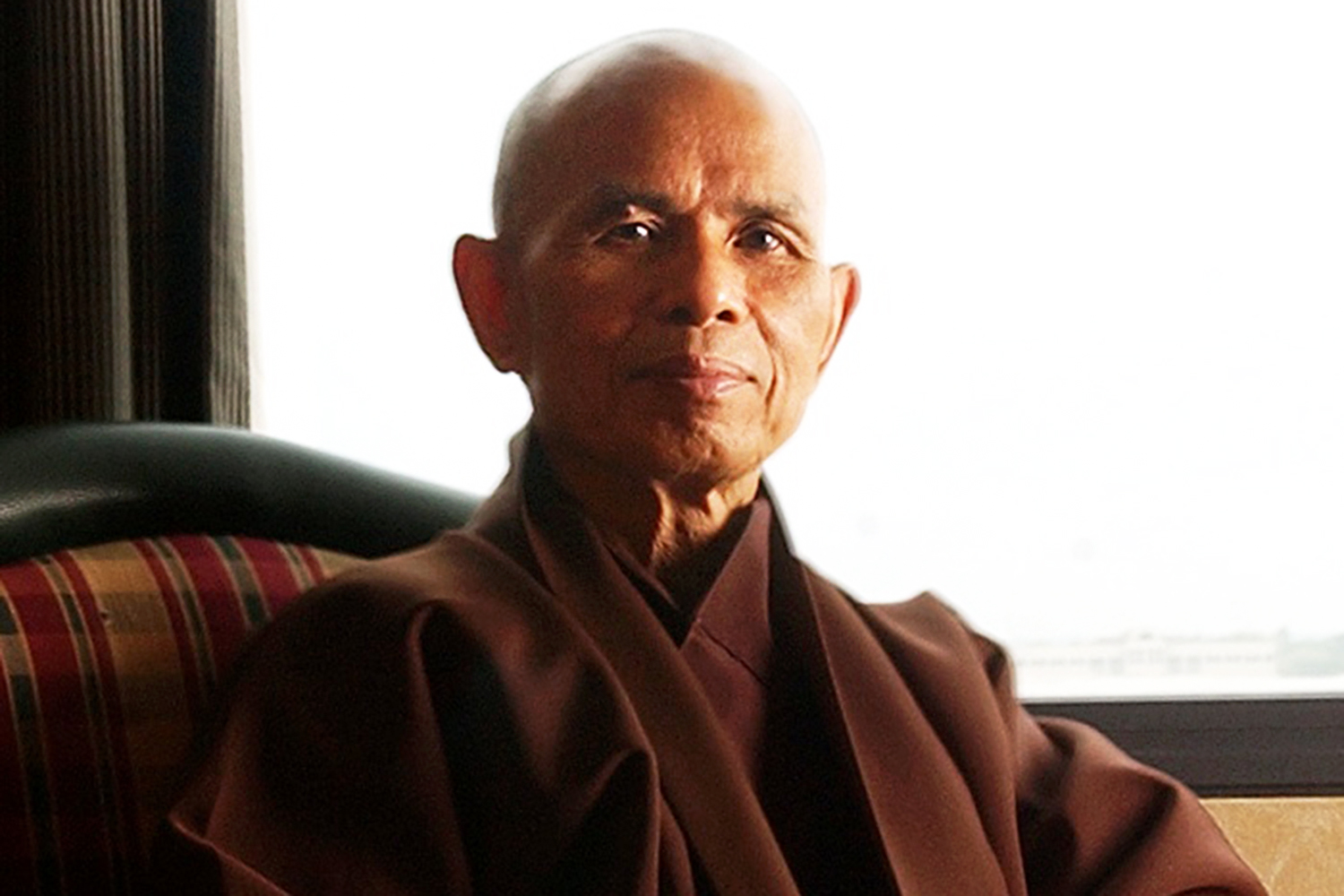
Thich Nhat Hanh and Radical Discipleship

By Ric Hudgens

In the past six weeks, our community has lost bell hooks (December 15) and Jim Forest (Jan 13). Then earlier this week, on January 22, the great teacher of engaged Buddhism, Thich Nhat Hanh, passed. All three were linked. bell hooks wrote a foreword to The Raft Is Not the Shore, which are the transcribed dialogues between Thich Nhat Hanh and Daniel Berrigan. The final book that Jim Forest published was entitled Eyes of Compassion: Living with Thich Nhat Hanh.

Thich Nhat Hanh also had a connection with Dr. Martin Luther King and Thomas Merton. This places him as a surprisingly central figure in the history of our community. Because I already was finding these intersections fascinating, I was and was not surprised to discover an encounter between Thich Nhat Hanh and the writings of Dietrich Bonhoeffer.

Continue reading “Thich Nhat Hanh and Radical Discipleship”

In Spite Of

By Ric Hudgens, a sermon for North Suburban Mennonite Church in Libertyville, Illinois

During this quarantine, I’ve been listening to music from an earlier period of my life. I’ve been going through my music collection and replaying songs from a time that was not bound by seclusion, confinement, vulnerability. My daughter observed that it’s been good medicine for me.

Last night I was listening to an old album by the Canadian folk singer Bruce Cockburn with the line “got to kick at the darkness till it bleeds daylight.” This is an image of Easter “in spite of.”

When a martial artist wants to break a board, they envision punching through the board. The target is not the board itself but a spot just past the board. If you target the board you will pull your punch. To break the board, you have to punch through the board.

Continue reading “In Spite Of”

We Are Seeds

By Ric Hudgens

I am thinking about people who live their lives as if they were seed.

The Greek poet Dinos Christianopoulos (1931-2020) wrote in 1978: “what didn’t you do to bury me / but you forgot that I was a seed.” (translated by Nicholas Kostis).

Young Mexican activists started a movement using a similar phrase in 2013 after 43 students disappeared in Iguala, Mexico: “They tried to bury us, they didn’t know we were seeds.” (see the blog entry with the same title, An Xio, Hyperallergic, July 3, 2018).

Even Jesus of Nazareth had said something similar 2,000 years ago: “unless a grain of wheat falls into the earth and dies, it remains alone; but if it dies, it bears much fruit.” (John 12:24).

We often think in metaphors about human life and the living of our own lives. Kirstie Pursie offers seven that are common: climbing a mountain, taking a journey, tending a garden, building a house, a race, a battle, a prison. (Kirstie Pursie, “7 Metaphors for Life: Which One Better Describes You and What Does It Mean”, Learning Mind, March 20, 2019). All of these are illuminating. There is probably a metaphor (or several) hidden in your life.

Continue reading “We Are Seeds”