Wild Lectionary: Leafy Branches Sunday – Domingo de Ramos

imagejpeg_0-5Palm Sunday, Year B
Mark 11:1-11

By Carmen Retzlaff

The Palm Sunday story in the Gospel of Mark says that

Many people spread their cloaks on the road, and others spread leafy branches that they had cut in the fields. (Mark 11:8)

The Greek (from Thayer’s Greek Dictionary) is:

stiba¿ß; stibas, stibados; a. a spread or layer of leaves, reeds, rushes, soft leafy twigs, straw, etc., serving for a bed; b. that which is used in making a bed of this sort, a branch full of leaves, soft faliage Continue reading “Wild Lectionary: Leafy Branches Sunday – Domingo de Ramos”
Wild Lectionary: Purge Me with Hyssop

Screen Shot 2018-03-04 at 8.43.44 PMLent 5B
Psalm 51:7b

By Laurel Dykstra

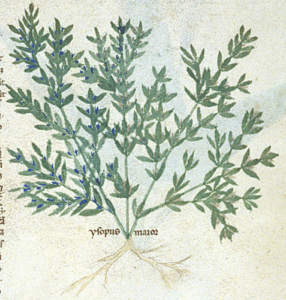
The psalmist says “purge me with hyssop” –clean me with a scrubby aromatic plant.

Mediterranean Hyssop— Hyssopus officinalis is a pungent-leafed bush with blue flowers that is used medicinally, mostly in teas as an expectorant, antiseptic and for cough relief. But the qualities that the bible ascribes to Hyssop: it grows in walls, can hold moisture, has a long, stiff stalk, has a purgative effect, appear in no one plant. Other suggested candidates for biblical Hyssop include caper, Syrian oregano, and za’atar a word which Palestinians use for a family of aromatic herbs (and the ubiquitous condiment made from their dried leaves). Continue reading “Wild Lectionary: Purge Me with Hyssop”

Wild Lectionary: God’s Gonna Trouble the Waters

IMG_7545.JPGLent 1B
Genesis 9:8-15
Mark 1:9-15

By Lydia Wylie-Kellermann

Water flows through our ancient Judeo-Christian texts. Righteousness pours down like a mighty stream (Amos 5:24), and Jesus offers relief to those who thirst (John 4:13–15). Before whales or eagles or humans did, God dwelt among the waters (Gen 1). The creation of heaven and earth commenced through a parting of the seas. Rains fell, destroying all creatures except those aboard an ark, awaiting a rainbow covenant that promised an end to the waters of judgment (Gen 9:11–17). The Israelites flee from their oppressors to freedom through the miracle of a parting sea that offered safe passage from empire into the wilderness (Exod 14). In the Gospels, Jesus was baptized into the wildness of the river Jordan (Mark 1:9f), became living water at the well (John 4), and shed tears over Jerusalem (Luke 19:41). From the beginning, water has offered a call to discipleship. Continue reading “Wild Lectionary: God’s Gonna Trouble the Waters”

Wild Lectionary: Transfiguration

27847750_10154970804366567_1328436879_n
Fresh buds on Tiger Mountain

Transfiguration B
Mark 9:2-9

By Sue Ferguson Johnson and Wes Howard-Brook

“Six days later, Jesus took with him Peter and James and John, and led them up a high mountain apart, by themselves.” (Mk 9.2)

It has been a long, wet, grey, dark winter so far here in the Issaquah Creek watershed. While we have been spared the intense cold and massive snowfalls visited upon our sisters and brothers to the east, the relentless “parade of storms” from the Pacific Ocean (as local weatherfolk like to call it) can wear away at even the most committed pluviophile. Continue reading “Wild Lectionary: Transfiguration”

Wild Lectionary: Awe

westlake1_0
Photo credit: NASA

Epiphany 5B
Isaiah 40:21-31

By Camen Retzlaff

Sometimes I am asked why the Bible, especially the Hebrew Bible, says that we should “fear” God, who is love. Psalm 111:10 The fear of the Lord is the beginning of wisdom; all those who practice it have a good understanding.

Have you not known, have you not heard?” says God in Isaiah this week. It is God who sits above the circle of the earth. We, the inhabitants of this planet, are like grasshoppers. God stretches a curtain of heaven for us, as a tent. God is reassuring here: this defeat, this moment in history, this war is not the big story. The story is so much bigger. God brings princes to naught and makes rulers of the earth like dead plants blown in the wind. Continue reading “Wild Lectionary: Awe”

Wild Lectionary: What We Do with Our Bodies

227350_659624815131_692849_nEpiphany 4B
1 Corinthians 8:4-6, 8

As to the eating of food offered to idols, we know that “no idol in the world really exists,” and that “there is no God but one.” Indeed, even though there may be so-called gods in heaven or on earth–as in fact there are many gods and many lords– yet for us there is one God, the Father, from whom are all things and for whom we exist, and one Lord, Jesus Christ, through whom are all things and through whom we exist.

 “Food will not bring us close to God.” We are no worse off if we do not eat, and no better off if we do.

By David Pritchett

Fireflies and Feathers: Two Kinds of Farming

The summer of 2012 was hot in the Midwest. By the fourth week of temperatures over 90 degrees, and over two months without rain, the grass was brown and our crops in Northeastern Indiana were not faring any better. Continue reading “Wild Lectionary: What We Do with Our Bodies”

Wild Lectionary: For They Were Fishermen

014
PC: Arthur Black

Epiphany 3B

As Jesus passed along the Sea of Galilee, he saw Simon and his brother Andrew casting a net into the sea–for they were fishermen. And Jesus said to them, “Follow me and I will make you fish for people.” And immediately they left their nets and followed him.
Mark 1:16-17 

As this week’s lectionary readings tell about the fishing families of Galilee, Wild Lectionary talked to ‘Nagmis fisherman Arthur Black. The ‘Namgis First Nation take their name from a halibut-like sea creature who saved a lone human during a flood when water covered the whole world. We asked Arthur to talk to people of faith about fishing on the West Coast of British Columbia and the threats to wild salmon which have been a staple food and source of wealth and culture for indigenous people in this region for millennia.

Wild Lectionary: Can you talk about fishing in your family?

Arthur Black: I am a fourth generation commercial native fisherman, my kids and grandchildren fish commercially with me on our vessel. Growing up I fished on my grandfather’s boat; when I started skippering boats my great-grandfather Harry Brown came out of retirement and fished with us till his passing in1987. Continue reading “Wild Lectionary: For They Were Fishermen”

Wild Lectionary: Fishing On Our Ancestral Territory

pic 2
My late father, on our traditional Nisga’a fishing territory. Photo credit Tanya Stanley, summer 2011.

Epiphany 3B
Mark 1: 16-18

By: Jeffery Stanley

May the words of my mouth, and the meditation of my heart, be acceptable unto you, Oh God our rock and Redeemer.

“As Jesus passed along the sea of Galilee, he saw Simon and his brother Andrew casting a net into the lake – for they were fishermen. And Jesus said to them ‘follow me and I will make you fish for people.’ And immediately, they left their nets and followed him.”

In the days of Jesus of Nazareth it was the custom for teachers to gather their students from the people of any community and lead them as a company from place to place as they taught. He (a teacher) would from time to time, talk to people and share truths with them. Certain students would be attracted to him and would come to listen to him from time to time. Sometimes they would linger at some favorable spot for awhile and persons would join them to listen and often respond to the message. Gutzke, Manford George. “Plain talk on Mark” pp. 18 Continue reading “Wild Lectionary: Fishing On Our Ancestral Territory”

Wild Lectionary: Woven in the Depths

Womb_2_Kovil_BG
Womb 2 Kovil BG Photo Credit: Fillipov Ivo, Creative Commons

Epiphany, Year B
Psalm 139:1-6, 13-18

By Ragan Sutterfield

E. Stanley Jones once wrote that if there is an instinct in the human heart to conceal there is also a deeper instict to reveal” (Victory Through Surrender). And yet, our culture keeps from authentic disclosure. We are invited, instead, to a kind of performative exposure, a way of revealing that also hides. We want to be known and seen but we do not trust those who might see us. We are afraid of what might happen if we are known, fully, authentically. So we manufacture disclosure on Facebook, hoping that in the commiseration of comments or praise of likes we will achieve what we are afraid to risk through a real openness. It is disclosure at the surface rather than at the depths.

Continue reading “Wild Lectionary: Woven in the Depths”

Wild Lectionary: Metanoia and John – Transformation in Wilderness

Jan 7 photo.jpgBy Valarie Luna Serrels

Epiphany 1B
Mark 1:4-11

There’s a story in Greek mythology about Kairos, the young, swift god of opportunity, with wings on his feet. When he passes by you, it’s too late to grab hold of said opportunity. However, in the wake of Kairos’ fleeting journey, stands the sorrowful goddess Metanoia. She invites those passed by with opportunity for reflection, mourning, and space to make a decision. An urgent decision. Metanoia literally means change. A changed mind, heart, behavior, life. Continue reading “Wild Lectionary: Metanoia and John – Transformation in Wilderness”