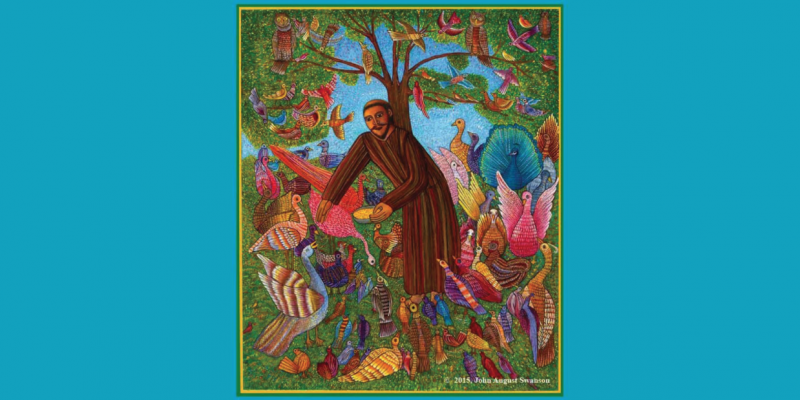
Image credit: “Francis and the Birds”, Giclee, 17.5” x 14.75”, Copyright 2015 by John August Swanson.
By M. Ashe Van Steenwyk. This article first appeared in Geez 64: The Holy Fool. Within Christianity there is a strange subset of the prophet called the “holy fool.”
Holy fools defy social convention in both word and action – sometimes in bizarre ways – out of their religious devotion.
In the West, Saint Francis is our typical holy fool. Born in the late 12th century, Francis was known for famously renouncing his inheritance by stripping naked, kissing lepers, preaching to forest creatures, and living a life of such stark simplicity and deep generosity that it sparked a movement that continues to today.
Written in response to a friend’s agonizing note reporting on the harrowing violence unfolding in Ukraine
We, from this distance and in our negligent comfort and delinquent affluence, lack the ability to stretch our hands to yours to feel your shivers; to enlarge our hearts so that they beat in rhythm with your sobs; to train our eyes so that they rise above the frivolous, paltry distractions, immune to grief, comforted in our colonized minds, asking only what more is there to drink? what more, to eat? what more, to abduct our attention from the brutal fate of distant, disposable victims of imperial lust and bloated arrogance?
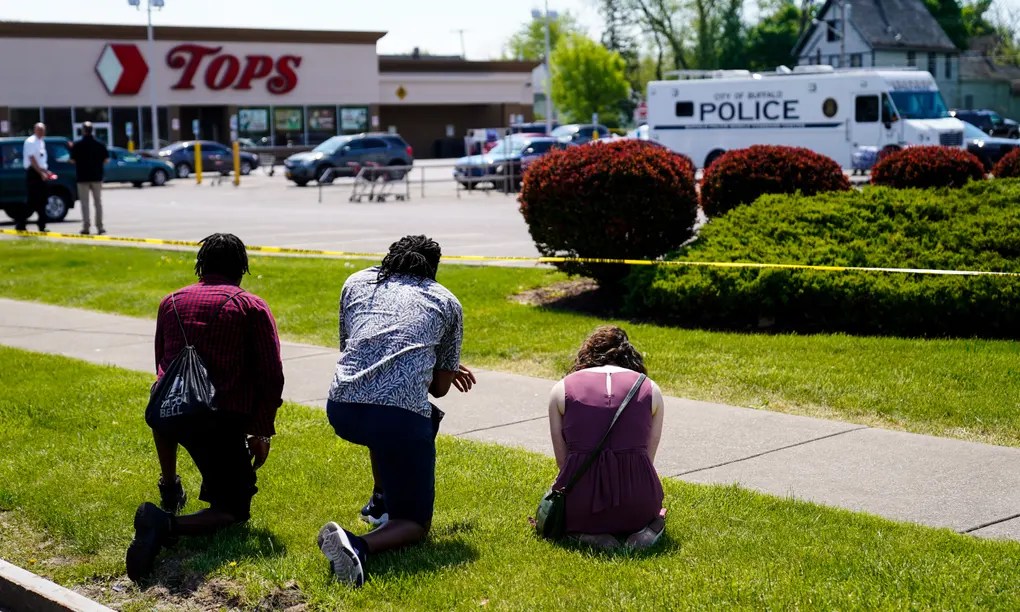
White folks, how will we drain the poison from our communities?
Repent?
Take the assault on Black Life personally, be mobilized to grief and rage that takes action?
Get at least as passionate & dedicated to rooting out the cancer of white supremacy as many of us get devoted to fighting the biological cancers that take our loved ones?
Protect & fight for the rights & dignity of our siblings being unaccountably targeted, imprisoned, displaced & massacred like we fight for our own families, our own children?
…this is a very emotional experience for a lot of Indigenous people in this country. And it should be an emotional experience for non-Indigenous people in this country. This is quite a historic moment in time. Although it’s not new news to Indigenous people, it might be new news to those who are hearing this horrific genocidal process that has taken place.
I think, you know, there’s a reason why the forcibly transferring of children from one group to another group is an international legal definition of genocide. That’s what we’re talking about, because taking children, or the process of Indian child removal, has been one strategy for terrorizing Native families for centuries, from the mass removal of Native children from their communities into boarding schools, as this new report lays out, from their communities into their widespread adoption and fostering out to mostly white families, which happened primarily in the 20th century.
As I work with younger First Nation and First Alaskan, my hope and prayer is for them to know they are wonderfully made as they are. I think of a young First Alaskan who asked me with tears rolling down her face, “You mean it is okay to follow God and speak my language, live my culture?” To help them understand that the community where they come from is more important than the idea of “conformed individuality.”
To think of the next generation of you Indigenous leaders that will be free from; you are invisible, you are nothing more than a merciless savage, to you are my daughter or son who I created…. How freeing and empowering could that be for them, for the generations to come? How do we, can we help free them from the bondage that we have carried?
“Keep these words that I am commanding you today in your heart. Recite them to your children and talk about them when you are at home and when you are away, when you lie down and when you rise.” (Deuteronomy 6.6-7)
What “words” do we keep in our hearts this day? What stories do we tell our children to give them hope and joy amid a world overflowing with violence and suffering?
Winter quarter was my final time teaching the Bible to college students at Seattle University after two decades. One might imagine that folks enrolled at a Jesuit Catholic university might start with some basic biblical literacy, or at least perhaps some curiosity about the stories that are supposed to be foundational for all Christian traditions. Yet I found almost the opposite to be true: most students were not Catholic or Christian in anything more than inherited label, and few had the slightest interest in engaging biblical narratives. I found my experience was common in many places.
By Ched Myers, comments on John 21 for May 1, 2022
I’ve long been fascinated with today’s gospel reading. The story is roughly parallel to Luke 5:1-11, and notably Luke places his version at the beginning of his narrative of Jesus’ ministry (in place of Mark’s call of the fishermen), while John puts it at the end of his gospel. This tradition must have been strong in the early church, and seems to signal a restoration of divine abundance in place of the scarcity of the exploited fishery in defiance of official regulations.
John brackets this story (21:1,14) with assertions that this was a “revelation /manifestation” (phaneroō, 6 times in John, e.g. 3:21); this is the final revelation. John places it at the “Sea of Tiberias,” a name only he uses in the N.T. for the Sea of Galilee” (see 6:1), which seems to emphasize the imperial renaming of the lake. In C.E. 14, Caesar Augustus died and Tiberius eventually became Emperor. To cultivate the new emperor’s favor, in C.E. 19 Herod Antipas began building a new capital city, which he named Tiberias in a bald demonstration of fealty. Right on the Sea of Galilee, this city was part of a new wave of Roman economic colonization. Its primary function was to regulate the fishing industry around the Sea, the most prosperous segment of ancient Galilee’s economy, putting it firmly under the control of Roman and Herodian elites, who endeavored to control the industry for export markets.
In the days after my conversation with my cousin, I woke to people in the streets. I woke to Minneapolis burning. I woke to protests in America’s heartland, Black people blocking the highways. I woke to people doing the haka in New Zealand. I woke to hoodie-wearing teens, to John Boyega raising a fist in the air in London, even as he was afraid he would sink his career, but still, he raised his fist. I woke to droves of people, masses of people in Paris, sidewalk to sidewalk, moving like a river down the boulevards. I knew the Mississippi. I knew the plantations on its shores, the movement of enslaved and cotton up and down its eddies. The people marched, and I had never known that there could be rivers such as this, and as protesters chanted and stomped, as they grimaced and shouted and groaned, tears burned my eyes. They glazed my face.







 Radical Discipleship