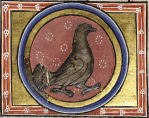
I was beyond excited to discover that the Aberdeen Bestiary (right) has been digitized and is available online. In recent years there has been, among a certain set, a revival of Herbals—illustrated volumes for the identification and medicinal use of plants, with an emphasis on women’s and Indigenous knowledge traditions. But the faunal analog, the Bestiary has seen no parallel resurgence. Composed in medieval monasteries, these often anecdotal sometimes allegorical, encyclopedias of animals were the height of scientific
Rock Dove
learning. Perhaps such “facts” as weasels giving birth through the mouth, deer eating poisonous snakes as a restorative, and the dove’s eye color indicating their maturity and discernment, dissuade modern would-be champions of the genera. Continue reading “40 Birds of Lent: A Siege of Herons”→
From Joanna Shenk, the author of the newly released The Movement Makes Us Human and the co-curator of Jesus Radicals:
In a time when the inhumanity of racism and greed are publicly normalized by the powerful, Jesus Radicals want to share stories of resistance, love, and transformation. The Movement Makes Us Human, the title of a newly released book on the life and thought of social movement veteran Dr. Vincent Harding authored by co-organizer Joanna Shenk, is also the theme of the first issue of the Jesus Radicals’ online journal, Rock! Paper! Scissors! Tools for anarchist + Christian thought .
We believe that involvement in movements for justice — like #metoo and Black Lives Matter and the resistance at Camp Makwa — invites us to embody our deepest humanity. This way of being human connects us across lines of difference and normalizes solidarity in the face of alienation and hate. Continue reading “Call for Content: 2 More Days!”→
I was born in the congo
I walked to the fertile crescent and built
the sphinx
I designed a pyramid so tough that a star
that only glows every one hundred years falls
into the center giving divine perfect light
I am bad Continue reading “Ego-Tripping (there may be a reason)”→
Observe a holy Lent—the prayerbook enjoins, then spells it out with this austere prescription: self-examination, penitence, prayer, fasting, almsgiving, and reading and meditating on the word of God.
I am someone with a Lenten disposition. My own natural reserve, saying “no” for its own sake, and avoiding extravagance, were honed by my family and by my participation in certain discipleship traditions. Whatever the liturgical season, I engage in above average quantities of penitence, fasting, almsgiving, and no shortage of (critical) self-examination. But there are places where rigor can’t take you, and the 40 Birds of Lent is one of those places. Continue reading “The 40 Birds of Lent: Observe”→
Today we honor the Lorde with “A Litany for Survival.”
For those of us who live at the shoreline
standing upon the constant edges of decision
crucial and alone
for those of us who cannot indulge
the passing dreams of choice
who love in doorways coming and going
in the hours between dawns
looking inward and outward
at once before and after
seeking a now that can breed
futures
like bread in our children’s mouths
so their dreams will not reflect
the death of ours: Continue reading “Happy Birthday, Audre!”→
Several years ago I participated in the Wilderness Way Community’s Lenten challenge: to spend 10 minutes each day outdoors in prayer or meditation. Due both to my own inclination and the fact that Lent falls where I live during spring migration, mating and nesting season, this experience, which I described to others as “going outside and paying attention,” quickly turned into going outside and paying attention to birds. Continue reading “The 40 Birds of Lent”→
“You will seek me and find me when you seek me with all your heart. I will be found by you,” declares the LORD, “and will bring you back from captivity.] I will gather you from all the nations and places where I have banished you, and will bring you back to the place from which I carried you into exile.”
-Jeremiah 29:13-14
Into my daughter’s pocket,
I slip two dollars to buy milk on her way home after school,
kiss her, and say a blessing over her.
This is our custom. Continue reading “Prayer in my Pocket”→
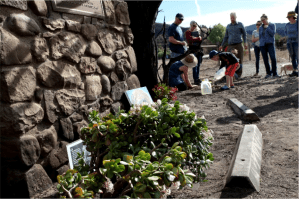
Note: This reflection was given at a Farm Church gathering at the Asistencia memorial site in California’s Ventura River Watershed on Sunday, Jan 14, 2018 (right; young Wesley Lehman waters a newly planted sycamore seedling; all photos of the gathering by Chris Wight). You can also find it on Ched’s blog.
This weekend we as a nation rightly commemorate the life and work of Dr. Martin Luther King, Jr. So a good place to start our circle this Sunday morning before the national holiday is with this passage from King’s 1963 book Why We Can’t Wait:
Our nation was born in genocide when it embraced the doctrine that the original American, the Indian, was an inferior race. Even before there were large numbers of Negroes on our shores, the scar of racial hatred had already disfigured colonial society. From the sixteenth century forward, blood flowed in battles of racial supremacy. We are perhaps the only nation which tried as a matter of national policy to wipe out its Indigenous population. Moreover, we elevated that tragic experience into a noble crusade. Indeed, even today we have not permitted ourselves to reject or feel remorse for this shameful episode. Our literature, our films, our drama, our folklore all exalt it.
PC: Bill Wingell/National Museum of African American History and Culture/Smithsonian.
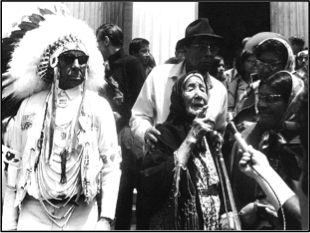
Dr. King summarizes why we are gathered as Farm Church at this unusual venue and time, for a special commemoration of a history that lingers in this very spot. [Right: Mattie Grinnell, a 101-year-old Mandan tribeswoman, speaks to the press outside the Supreme Court during the 1968 Poor People’s Campaign in Washington, D.C.]
Mohecan activist Jim Bear Jacobs taught us that westerners tend to steward our narratives through texts, while indigenous cultures understand their sacred history to be embedded in the land. The land holds the stories. And this Asistencia Santa Gertrudis memorial site is just one small, indeed hidden, chapter in the long and sordid history of Settler displacement of indigenous peoples that marks every single square mile of Turtle Island. Continue reading “Re-membering the Asistencia Santa Gertrudis”→

 By Laurel Dykstra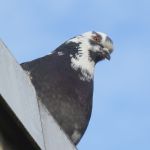

 From Joanna Shenk, the author of the newly released The Movement Makes Us Human and the co-curator of
  By Nikki Giovanni
 By Ric Hudgens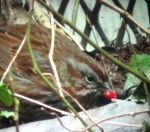
 Today we honor the Lorde with “A Litany for Survival.”
 By Laurel Dykstra
 “You will seek me and find me when you seek me with all your heart. I will be found by you,” declares the LORD, “and will bring you back from captivity.] I will gather you from all the nations and places where I have banished you, and will bring you back to the place from which I carried you into exile.”
 By Ched Myers