A poem by Assata Shakur. From the first page of her autobiography.
I believe in living. I believe in the spectrum of Beta days and Gamma people. I believe in sunshine. In windmills and waterfalls, tricycles and rocking chairs. And i believe that seeds grow into sprouts. And sprouts grow into trees. I believe in the magic of the hands. And in the wisdom of the eyes. I believe in rain and tears. And in the blood of infinity.
I believe in life. And i have seen the death parade march through the torso of the earth, sculpting mud bodies in its path. I have seen the destruction of the daylight, and seen bloodthirsty maggots prayed to and saluted.
I have seen the kind become the blind and the blind become the bind in one easy lesson. I have walked on cut glass. I have eaten crow and blunder bread and breathed the stench of indifference.
Another compelling offering from Alternative Seminary.
Whose Liturgy Is It Anyway? Reclaiming Christian Liturgy as the People’s Work
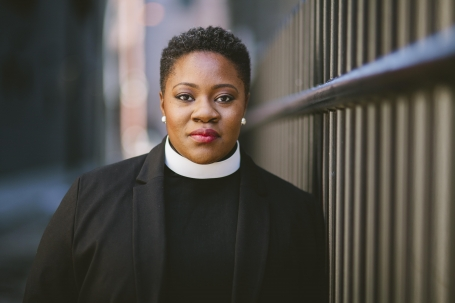
A Three-Part Series Led by Rev. Naomi Washington-Leapheart (above)
Saturdays, March 9, 16, 23. 10:00 am- 12:00 noon EST. $100
Familiar and traditional liturgy in Christian worship can be a source of comfort. But liturgies left unexamined can do harm. In this series, we’ll explore various liturgical forms and ask – whose liturgy is this and what “work” is this liturgy doing?
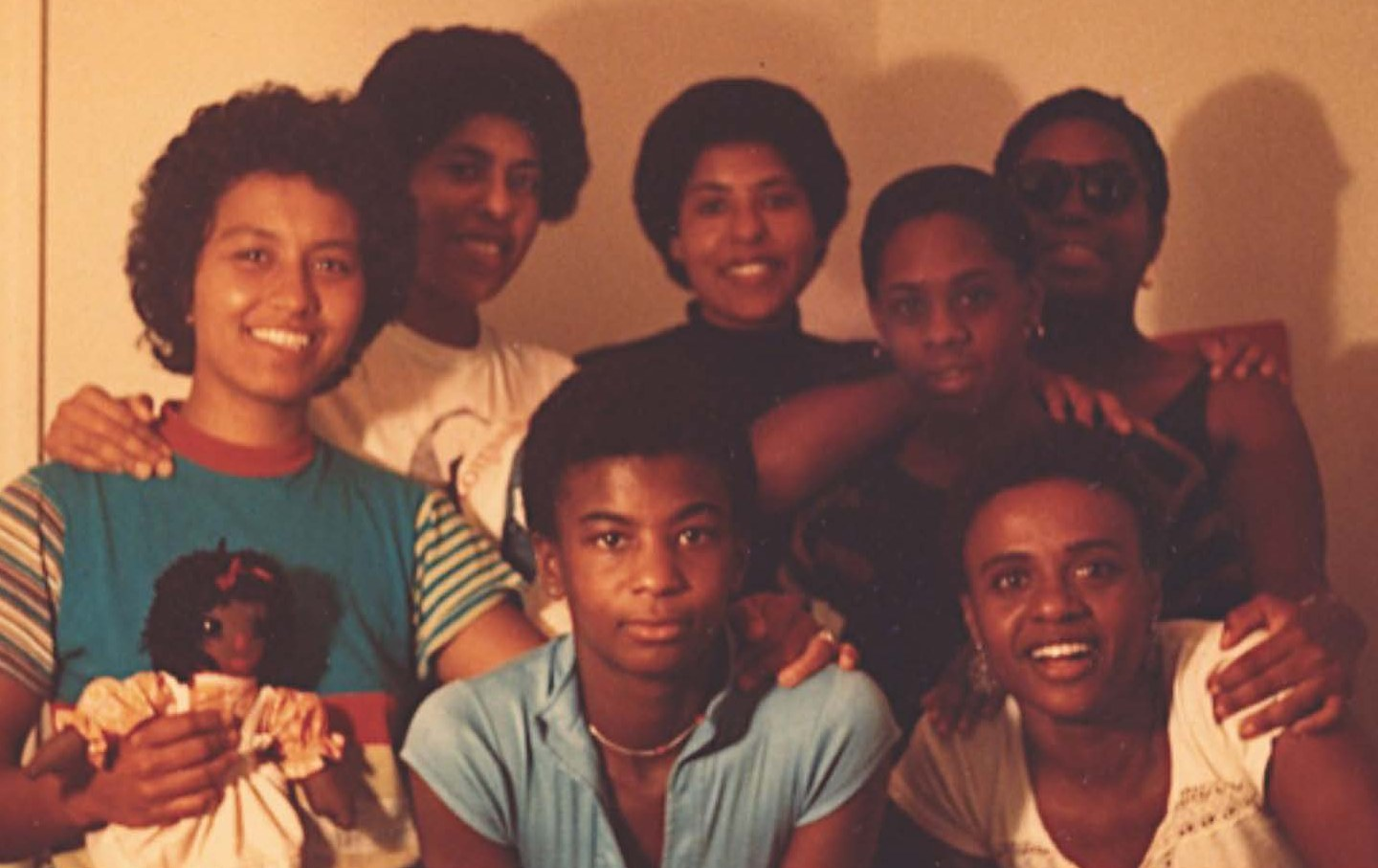
We’ll tip-off Black History Month with this excerpt from the Combahee River Collective Statement (1977). The Combahee River Collective was a group of Black feminists who met consistently for three years to define and clarify their politics while they worked in coalition with other progressive organizations and movements
We realize that the liberation of all oppressed peoples necessitates the destruction of the political-economic systems of capitalism and imperialism as well as patriarchy. We are socialists because we believe that work must be organized for the collective benefit of those who do the work and create the products, and not for the profit of the bosses. Material resources must be equally distributed among those who create these resources. We are not convinced, however, that a socialist revolution that is not also a feminist and anti-racist revolution will guarantee our liberation. We have arrived at the necessity for developing an understanding of class relationships that takes into account the specific class position of Black women who are generally marginal in the labor force, while at this particular time some of us are temporarily viewed as doubly desirable tokens at white-collar and professional levels. We need to articulate the real class situation of persons who are not merely raceless, sexless workers, but for whom racial and sexual oppression are significant determinants in their working/economic lives. Although we are in essential agreement with Marx’s theory as it applied to the very specific economic relationships he analyzed, we know that his analysis must be extended further in order for us to understand our specific economic situation as Black women.
This is from blackwomenradicals.com. Check out their site for a whole radical Black feminist reading list on a Free Palestine.
WE, WHO BELIEVE IN FREEDOM, WE AS BLACK FEMINISTS WHO BELIEVE IN FREEDOM –– FREEDOM FROM WHITE SUPREMACY, PATRIARCHY, CAPITALISM, TRANSPHOBIA, QUEERPHOBIA, ABLEISM, AND OTHER OPPRESSIONS –– UNABASHEDLY BELIEVE IN AND STAND IN SOLIDARITY FOR A FREE PALESTINE.
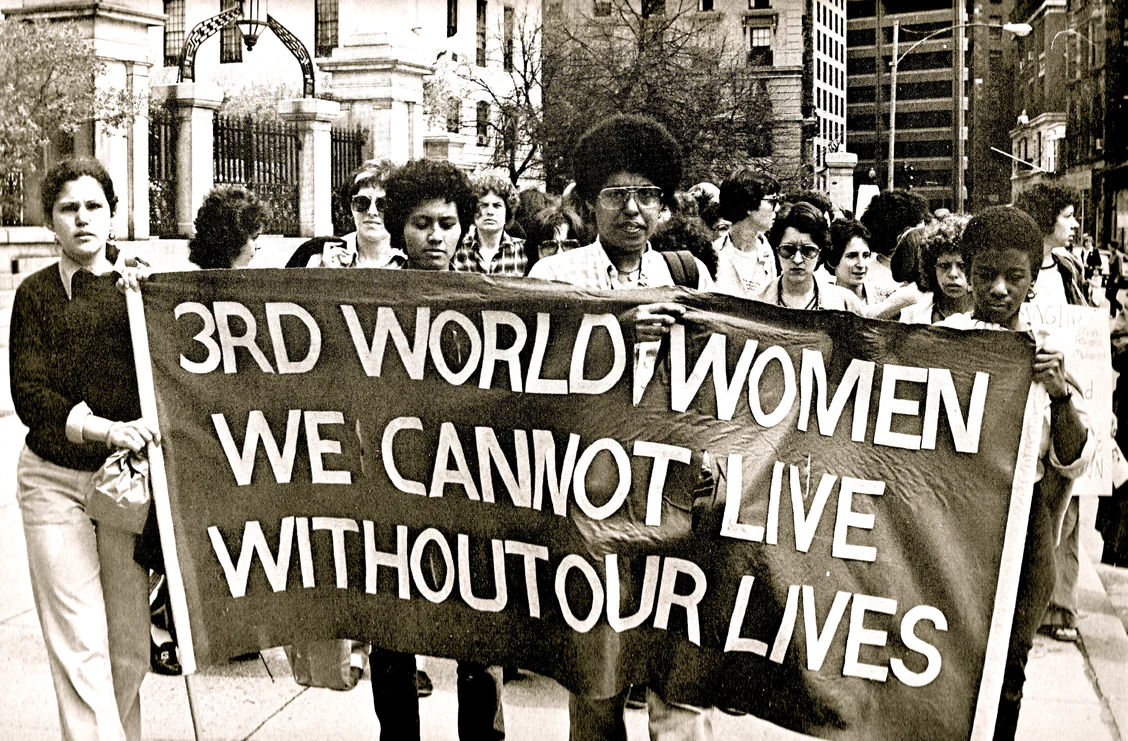
As students of Black feminist politics and movements, we know and understand that our liberation as Black women, femme, and gender expansive people in the United States, in the belly of the imperial beast, is tethered to the liberation, freedom, and emancipation of all marginalized peoples around the world. We know that we come from long radical and revolutionary traditions of Black women and gender expansive organizers, educators, and activists who have and continue to be committed to the liberation struggles of oppressed and “Third World” peoples.
MORE SPECIFICALLY, AND ESPECIALLY AT THIS CURRENT JUNCTURE IN GAZA AND THE WEST BANK, WE KNOW AS BLACK FEMINISTS THAT OUR POLITICAL COMMITMENTS, MANDATES, AND SOLIDARITY ARE BOUND UP AND INTERTWINED WITH THE LIBERATION AND SELF-DETERMINATION OF THE PALESTINIAN PEOPLE.
According to reports, more than 2,383 Palestinians are dead and 10,814 are injured. The organization, Defense for Children International–Palestine has reported that at least 724 Palestinian children have been killed by the Israeli military since October 7th. This past Friday, October 12th, the Israeli army issued an evacuation order – by way of dropping leaflets – of more than 1.1 million Palestinians in northern Gaza, giving them only 24 hours to leave their homes and move to southern Gaza toward a “safe route.” However, when many Palestinians migrated to southern Gaza, the army bombed the south part of the Gaza strip – the only road in and out of Gaza – killing and injuring hundreds. Israel has cut off Gaza from electricity, fuel, food, water, and humanitarian aid.
By Kateri Boucher, a homily for a Pride Celebration at St. Peter’s Episcopal Church (Detroit, MI) on June 4, 2023. Click here to watch the video version (homily starts around minute twenty-six).
It is a powerful thing to be celebrating this holiday in this space, with this community. I don’t take it for granted that we can gather here today in this way. It was only in 1976, 46 years ago, that the Episcopal church officially became open and affirming. As we know, there are many other streams of the Christian tradition that have done so even more recently, or still haven’t yet.
There are many people who believe that the phrase “queer Christian” is an outrage or an oxymoron. And I can feel it coming from both sides… I’ve joked with my friends that coming out as queer was not a very big deal for me, which I’m very grateful for, but coming out as Christian to my queer friends has caused a bit of a stir. People are like, “Oh my gosh… Are you okay? Can we support you?” Just yesterday I was at a brunch with a bunch of young queer folks and I told someone I work for a church. It was kind of uncomfortable. They were kind of like, “Why?”
Above all else, Our politics initially sprang from the shared belief that Black women are inherently valuable, that our liberation is a necessity not as an adjunct to somebody else’s may because of our need as human persons for autonomy. This may seem so obvious as to sound simplistic, but it is apparent that no other ostensibly progressive movement has ever considered our specific oppression as a priority or worked seriously for the ending of that oppression. Merely naming the pejorative stereotypes attributed to Black women (e.g. mammy, matriarch, Sapphire, whore, bulldagger), let alone cataloguing the cruel, often murderous, treatment we receive, indicates how little value has been placed upon our lives during four centuries of bondage in the Western hemisphere. We realize that the only people who care enough about us to work consistently for our liberation are us. Our politics evolve from a healthy love for ourselves, our sisters and our community which allows us to continue our struggle and work.
This focusing upon our own oppression is embodied in the concept of identity politics. We believe that the most profound and potentially most radical politics come directly out of our own identity, as opposed to working to end somebody else’s oppression. In the case of Black women this is a particularly repugnant, dangerous, threatening, and therefore revolutionary concept because it is obvious from looking at all the political movements that have preceded us that anyone is more worthy of liberation than ourselves. We reject pedestals, queenhood, and walking ten paces behind. To be recognized as human, levelly human, is enough.
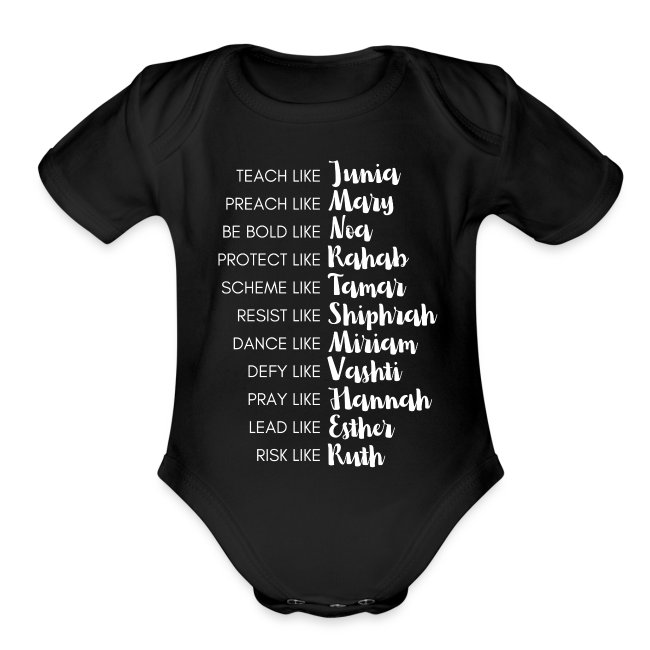
Check out the new gear designed by Rianna Isaak-Krauss, co-pastor at Frankfurt Mennonite Church in Germany! Order your own HERE. Adult sizes too!!!
“I was on Etsy looking for fun clothing for babies, as millennial parents do, and found really terrible Christian T-shirts for girls [with phrases] like, ‘Wait like Hannah’ and ‘Serve like Martha. The only images that capitalism has for women [are] doing laundry and waiting around, and I thought that sucked.” – Rianna Isaak-Krauss
“Let’s keep telling these stories of badass biblical women,” Isaak-Krauss says. “And let’s keep using strong, active verbs so that we’re not always forming girls to be passive.”
Read more about the inspiration behind Rianna’s work here.
Antidarkness is the social disregard for dark bodies and the denial of dark people’s existence and humanity. When White students attend nearly all-White schools, intentionally removed from America’s darkness to reinforce White dominance, that is antidarkness. When dark people are present in school curriculums as unfortunate circumstances of history, that is antidarkness. When schools are filled with White faces in positions of authority and dark faces in the school’s help staff, that is antidarkness. The idea that dark people have had no impact on history or the progress of mankind is one of the foundational ideas of White supremacy. Denying dark people’s existence and contributions to human progress relegates dark folx to being takers and not cocreators of history or their lives…
…What is astonishing is that through all the suffering the dark body endures, there is joy, Black joy. I do not mean the type of fabricated and forced joy found in a Pepsi commercial. I am talking about joy that originates in resistance, joy that is discovered in making a way out of no way, joy that is uncovered when you know how to love yourself and others, joy that comes from relieving pain, joy that is generated in music and art that puts words and/or images to your life’s greatest challenges and pleasures and joy in teaching from a place of resistance, agitation, purpose, justice, love and mattering.
It’s Black History Month, something we celebrate all year long at RadicalDiscipleship.net. This is from the conclusion of bell hooks’ classic essay “Killing Rage” (1995).
Rage can be consuming. It must be tempered by an engagement with a full range of emotional responses to black struggle for self-determination. In mid-life, I see in myself that same rage at injustice which surfaced in me more than twenty years ago as I read the Autobiography of Malcolm X and experienced the world around me anew. Many of my peers seem to feel no rage or believe it has no place. They see themselves as estranged from angry black youth. Sharing rage connects those of us who are older and more experienced with younger black and non-black folks who are seeking ways to be self-actualized, self-determined, who are eager to participate in anti-racist struggle. Renewed, organized black liberation struggle cannot happen if we remain unable to tap collective black rage. Progressive black activists must show how we take that rage and move it beyond fruitless scapegoating of any group, linking it instead to a passion for freedom and justice that illuminates, heals, and makes redemptive struggle possible.
Sarah and Angelina Grimke are 19th century models of white people breaking rank with supremacy. This is an excerpt from Drew Gilpin Faust’s recent article in The Atlantic Magazine: The Grimke Sisters and The Indelible Stain of Slavery. The article is longish, but certainly deserves to be read in it’s entirety. It explores a new book that details tensions and complications with the Grimke legacy. Tensions and complications that white people breaking rank can learn from today.
Thirteen years apart, the two sisters came to share an abhorrence of the slave system on which their family’s wealth and position depended. Angelina was particularly repelled by the institution’s violence—the sound of painful cries from men, women, and even children being whipped; the lingering scars evident on the bodies of those who served her every day; the tales of the dread Charleston workhouse that, for a fee, would administer beatings and various forms of torture out of sight of one’s own household. Both Sarah and Angelina became deeply religious, rejecting the self-satisfied pieties of their inherited Episcopalian faith, but finding in Christian doctrine a foundation for their growing certainty about the “moral degradation” of southern society. In 1821, Sarah moved to Philadelphia and joined the Society of Friends; by the end of the decade, Angelina had joined her.
Philadelphia was a focal point of the growing antislavery movement, and the sisters were swept up in the ferment. Soon defying Quaker moderation on slavery just as they had defied their southern heritage, the Grimke sisters embraced William Lloyd Garrison and what was seen as the radicalism of abolition. In essays appearing in 1837 and 1838, Angelina and Sarah each set out the case for the liberation of women and enslaved people. They joined the Garrisonian lecture circuit, and Angelina developed a reputation as a sterling orator at a time when women were all but prohibited from the public stage. In 1838, Angelina married the abolitionist leader Theodore Dwight Weld in a racially integrated celebration that adhered to the free-produce movement, including no clothing or refreshments produced by enslaved labor. Weld and the sisters shared a household for most of the rest of their lives, and Sarah became a devoted caretaker of Angelina and Theodore’s three children. Their opposition not just to slavery but to racial inequality and segregation, as well as their support for women’s rights, placed them in the vanguard of reform and at odds with many other white abolitionists. With emancipation, they took up the cause of the freedpeople, which they pursued until they died, Sarah in 1873, Angelina in 1879.






 Radical Discipleship