Easter: Resurrected Beyond a Social Ethic

BerriganBy Craig Larson, co-director (with his spouse, Carol) of a Catholic Worker farm, growing potatoes and haskap berries in Swan River, Manitoba.  They give their food freely away to food banks.  Originally posted on their wonderful site: The Parkland Worker Blog: An Unauthorized Diary of Care and Compassion (thanks to RD.net contributor Joshua Weresch for connecting us to this great work). 

In 1957 Daniel Berrigan, SJ, was appointed professor of New Testament studies at LeMoyne College in Syracuse, NY.  While there he organized students to look into the lack of adequate low-income housing.  Organizing a Catholic Worker house of hospitality earned him an irate phone call from the bishop insisting that he stop this endeavour.  It seemed that many of the slumlords were Catholic and held that at the very least a CW house would undercut their incomes.  Even though a bishop had no power over an academic position, Berrigan’s actions ultimately resulted in his being removed from priestly and academic assignment, relocated to Baltimore, and then reassigned to numerous locations in Central and South America.  He understood it as banishment…exile…punishment issued by his superiors, but used every opportunity there to immerse himself in the lives of the poor, the disenfranchised, and the people living in the barrios.  You may read about the particulars of this in his autobiography, To Dwell In Peace. Continue reading “Easter: Resurrected Beyond a Social Ethic” →

What it Would be Like to Win

ErnstA post from a couple of months ago from activist and Vanderbilt Divinity student Margaret Ernst:

For those taking action against Trump in Nashville today:

1) I love you.
2) This is a ritual I made up before participating in a direct action a few weeks ago, and I want to offer it to you.

Ritual for before direct action:

Light three candles.

With the first candle, name and honor the loved ones and ancestors who give you strength, who challenge you, hold you, and have your back.
Continue reading “What it Would be Like to Win” →

Easter’s Aftermath

ResurrectionBy Ken Sehested, the editor and author of prayerandpolitiks.org, an online journal at the intersection of spiritual formation and prophetic action

Easter resurrection is never as assured
as the arrival of Easter bunnies.

Clothiers and chocolate-makers alike yearn
for the season no less than every cleric.

And yet, in my experience, the Spirit
rarely blows according to the calendar,
much less on demand. Continue reading “Easter’s Aftermath” →

What Resurrection Means

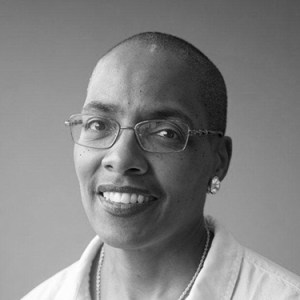
LyniceOur Last day of the Lenten Journey.  [S]he is risen indeed.  From Rev. Lynice Pinkard of Oakland’s Seminary of the Street, in an interview with Sun Magazine in 2014.

We’re not going to do this work — of bringing people together, of stemming the tide of ecological abuse, of dealing with income inequality — without having something inside us change. Before I even get to my interaction with you, I need to examine my own self-interest. That’s what resurrection means to me: being able to rise above self-interest and the interests of your group. For me resurrection is about laying down our weapons and getting up off our assets. Resurrection is not merely about whether Jesus is dead or alive, in the tomb or not. In Romans, the Bible says the same spirit that raised Jesus from the dead can quicken our mortal bodies to life. We can leave our cemeteries, abandon the deadness and the death-dealing nature of our lives. We can rise above the life-limiting forces that hold us down. For me, that’s resurrection: crossing over from self-interest to true solidarity.

A Struggle of Interpretation

ElsaDay 46 of our Lenten Journey beyond “Beyond Vietnam.”  From Costa Rican biblical scholar Elsa Tamez, an excerpt from an article entitled “The Bible and Five Hundred Years of Conquest” (2005).
We see that for five hundred years we have been involved in a struggle of interpretation: some from a liberating perspective and others from a legitimating perspective of oppression. The struggle for a liberating reading of the Bible is good, nevertheless, it seems to me. After taking a look at history and seeing ourselves there as in a mirror, we need to go beyond the hermeneutical struggle. We should revise the discourse of our written canon and the logic of Christian thought; maybe there is a deeper problem that facilitates the rapid inversion of values. I am referring to aspects such as the biblical conception of time, that is, infinite progression toward the final victory (the Day of the Lord, the battle of Armageddon, the crushing of the enemy). These can be a double-edged sword—or the idea of a universalist, tolerant, egalitarian God, which is projected in the following scheme: “God is good for all; for that reason, all are good for God.” There is no distinguishing the difference. The sacrificial discourse, principally christological, sometimes degenerates into demands of unnecessary sacrifices or into the logic of crucifying the crucifiers; others such as the Elect of God, the Holy War, and so on need to be reworked. This is a matter not just of intellectual concern but of honesty before unjust practices that are easily legitimated with the Bible and theology. All of this leads us to rethink popular hermeneutics and to rework in great depth the significance of biblical authority.

The Fourth Word

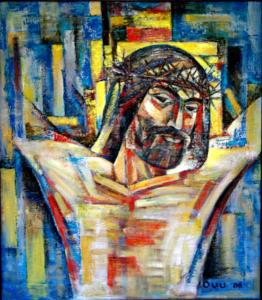
Hovsep MesropianBy Ric Hudgens, for Good Friday (art by Hovsep Mesropian)
He was hanging there trying to remember,
the weight of his body weighing on his mind.
What was the first line of that song we used to sing?
His head was perplexed with pain, his muscles
aching in place, his body stretched out along this beam,
no way to find rest that didn’t increase the sting.

Continue reading “The Fourth Word” →

Those Most Othered

KBDDay 45 of our Lenten Journey beyond “Beyond Vietnam.”  A Good Friday meditation from theologian Kelly Brown-Douglas, excerpted from a post on the Feminism and Religion blog.

In Jesus’ first century Roman world crucifixion was reserved for slaves, enemy soldiers and those held in the highest contempt and with lowest regard in society. To be crucified was, for the most part, an indication of how worthless and devalued by established power an individual was.  It also indicated how much of a threat that person was believed to be to the order of things. There was a decided crucified class of people. These were essentially the castigated and demonized as well as the ones who defied the status quo of power. It is in this respect that I believe Jesus’ crucifixion affirms his identification with the marginalized and outcasts. Indeed, on the cross Jesus fully divests himself of all pretensions to power and anything that would compromise his bond with those most othered in the world. The reality of the cross further affirms the profundity of god’s bond with put-upon bodies.. Continue reading “Those Most Othered” →

Here’s the Rub

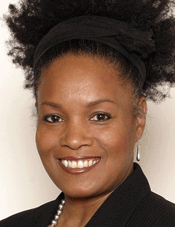
michelleDay 44 of our Lenten Journey beyond “Beyond Vietnam” continues.  An excerpt from Michelle Alexander’s recent comments on Mark Lewis Taylor’s re-release of The Executed God (2001), part of a longer back-and-forth dialogue that is well worth reading.
The truth is that I am still struggling to figure out what I believe about the nature of God and what it means to say that anyone has a “personal relationship” with God. I am just beginning my journey with theology, and therefore I have mostly questions — not answers or critiques.

What I do know is that I can no longer proceed as though mass incarceration is a purely political or legal problem that can be solved through forms of organizing, advocacy, movement-building and protest that lack a strong moral and spiritual foundation. The fact that Taylor offers a rigorous argument for spiritually-grounded actions that will force a national reckoning with our criminal injustice system is a cause for celebration. I wholeheartedly agree with him that political organizing and movement-building among faith communities is essential, and I also agree that political insurrection can be healing and transformative for those who have been traumatized, abused, and violated. Continue reading “Here’s the Rub” →

More Spending, Of Course

Sharon KyleDay 42 in our Lenten Journey beyond “Beyond Vietnam.”  From Sharon Kyle, publisher of the LA Progressive and a professor of law at Peoples College of Law in L.A., excerpted from “Is Racism a Racket?” in the L.A. Progressive:

What struck me was that Dr. King almost laid bare the notion that racism is a racket. Not to say that racism doesn’t exist but that it’s continued existence serves an elite few.

In a similar assertion, Smedley Butler—a career military man who received 16 medals, five for heroism, and is one of 19 men to receive the Medal of Honor twice— wrote a book entitled, “War Is a Racket” because he felt that his years of experience showed him that American corporations and other imperialist motivations were behind our wars. He came to see through the PR campaigns that prime the public — that set the stage for war.  After retiring from service, he became a popular activist, speaking at meetings organized by veterans, pacifists, and church groups. Continue reading “More Spending, Of Course” →

What My Soul Sings

LenyDay 41 of our Lenten Journey beyond “Beyond Vietnam.”  From Leny Mendoza Strobel (photo right), Professor of American Multicultural Studies at Sonoma State University, in her Foreword to Ethnoautobiography: Stories and Practices for Unlearning Whiteness, Decolonization, Uncovering Ethnicities (2013):

A long-time colleague asked me, for the first time the other day: Why did you become interested in the Indigenous?  My answer was an academic one: When I started doing research on Filipino Indigenous Knowledge Systems and Practices.

What I really wanted to say was: I have always been interested in the Indigenous worldview; it’s what my bones know and what my soul sings. Continue reading “What My Soul Sings” →