The Greatest Purveyor of Violence

greenwaldDay 6 of our Lenten Journey through Dr. King’s “Beyond Vietnam” speech.

My third reason moves to an even deeper level of awareness, for it grows out of my experience in the ghettos of the North over the last three years, especially the last three summers. As I have walked among the desperate, rejected, and angry young men, I have told them that Molotov cocktails and rifles would not solve their problems. I have tried to offer them my deepest compassion while maintaining my conviction that social change comes most meaningfully through nonviolent action. But they asked, and rightly so, “What about Vietnam?” They asked if our own nation wasn’t using massive doses of violence to solve its problems, to bring about the changes it wanted. Their questions hit home, and I knew that I could never again raise my voice against the violence of the oppressed in the ghettos without having first spoken clearly to the greatest purveyor of violence in the world today: my own government. For the sake of those boys, for the sake of this government, for the sake of the hundreds of thousands trembling under our violence, I cannot be silent.
——————
From Glenn Greenwald’s Obama-era reflection on Dr. King’s “Beyond Vietnam” relevance (Jan 21, 2013):

What I always found most impressive, most powerful, about King’s April 4 speech is the connection he repeatedly made between American violence in the world and its national character…

The debasement of the national psyche, the callousness toward continuous killing, the belief that the US has not only the right but the duty to bring violence anywhere in the world that it wants: that is what lies at the heart of America’s ongoing embrace of endless war. A rotted national soul does indeed enable leaders to wage endless war, but endless war also rots the national soul, exactly as King warned. At times this seems to be an inescapable, self-perpetuating cycle of degradation… Continue reading “The Greatest Purveyor of Violence”
A Society Gone Mad on War

billDay 4 of our Lenten Journey with Dr. King’s “Beyond Vietnam” Speech

Since I am a preacher by calling, I suppose it is not surprising that I have seven major reasons for bringing Vietnam into the field of my moral vision. There is at the outset a very obvious and almost facile connection between the war in Vietnam and the struggle I and others have been waging in America. A few years ago there was a shining moment in that struggle. It seemed as if there was a real promise of hope for the poor, both black and white, through the poverty program. There were experiments, hopes, new beginnings. Then came the buildup in Vietnam, and I watched this program broken and eviscerated as if it were some idle political plaything on a society gone mad on war. And I knew that America would never invest the necessary funds or energies in rehabilitation of its poor so long as adventures like Vietnam continued to draw men and skills and money like some demonic, destructive suction tube. So I was increasingly compelled to see the war as an enemy of the poor and to attack it as such.
—————–
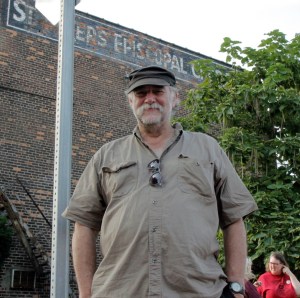
“A Lent Beyond Despair” By Rev. Bill Wylie-Kellermann (photo above) of St. Peter’s Episcopal Church in Detroit

As we begin the contemplative foray into Dr. King’s seven words on the war, it is well worth considering the overall structure of those reasons for resistance. The first three view the war through the lens of the reigning principalities of the U.S. domination system: materialism, white racism, and militarism: 1) that the war is an attack on the poor, dismantling programs of support in order to fund it, 2) that it is a racist war, sending young men in brutal solidarity to burn huts in Vietnamese villages, who wouldn’t be able to live next door in Detroit, and 3) that he couldn’t preach nonviolence to young people on the street without also opposing the “greatest purveyor of violence in the world today – my own government.” He will subsequently name these the “giant triplets,” the ruling powers of domination. Continue reading “A Society Gone Mad on War”

Always on the Verge of Being Mesmerized by Uncertainty

rose-and-vincentToday, we begin our Lenten journey together, daily meditating on the words of Dr. King’s “Beyond Vietnam” speech at Riverside Church in New York City on April 4, 1967.  

Mr. Chairman, ladies and gentlemen, I need not pause to say how very delighted I am to be here tonight, and how very delighted I am to see you expressing your concern about the issues that will be discussed tonight by turning out in such large numbers. I also want to say that I consider it a great honor to share this program with Dr. Bennett, Dr. Commager, and Rabbi Heschel, some of the most distinguished leaders and personalities of our nation. And of course it’s always good to come back to Riverside Church. Over the last eight years, I have had the privilege of preaching here almost every year in that period, and it’s always a rich and rewarding experience to come to this great church and this great pulpit.

 I come to this great magnificent house of worship tonight because my conscience leaves me no other choice. I join you in this meeting because I am in deepest agreement with the aims and work of the organization that brought us together, Clergy and Laymen Concerned About Vietnam. The recent statements of your executive committee are the sentiments of my own heart, and I found myself in full accord when I read its opening lines: “A time comes when silence is betrayal.” That time has come for us in relation to Vietnam.

The truth of these words is beyond doubt, but the mission to which they call us is a most difficult one. Even when pressed by the demands of inner truth, men do not easily assume the task of opposing their government’s policy, especially in time of war. Nor does the human spirit move without great difficulty against all the apathy of conformist thought within one’s own bosom and in the surrounding world. Moreover, when the issues at hand seem as perplexing as they often do in the case of this dreadful conflict, we are always on the verge of being mesmerized by uncertainty. But we must move on.
—————————
Highlights from Rose Berger’s April 2007 Sojourners Magazine interview with Vincent Harding (photo above: Rose with “Uncle Vincent”), the author of Dr. King’s “Beyond Vietnam” speech:

The Riverside speech (variously called “Beyond Vietnam” or “Breaking the Silence”) named the sickness eating the American soul as “the giant triplets of racism, extreme materialism, and militarism.” It was a watershed moment. Continue reading “Always on the Verge of Being Mesmerized by Uncertainty”

Sanctuary: To Stand and Suffer With

alexiaAn excerpt from the recent Christian Century interview with Alexia Salvatierra:

We sense that there are a lot of churches that can’t participate in the sanctuary movement because it is more radical than they are willing to be, including immigrant churches. We are creating something called the Matthew 25 Movement. It consists of individuals and congregations that pledge to protect and defend the vulnerable in the name of Jesus. This can mean a variety of things. There are churches that will pray and educate and give money. Others will participate in the creation of safe zones… Continue reading “Sanctuary: To Stand and Suffer With”

A Mass Movement

keeangaAn excerpt from Keeanga-Yamahtta Taylor’s “How to Build a Mass Movement,” originally posted at SocialistWorker.org.  Dr. Taylor is an assistant professor in Princeton University’s Center for African American Studies and the author of From #BlackLivesMatter to Black Liberation.
The issue for the Left is how we get from where we are today to where we want to be in terms of making our marches blacker, browner, and more working class. Simply complaining about it changes nothing.

There will no effective movement against Trump that doesn’t directly confront the issue of racism. It has to be front and center, and it seemed to me that the march organizers took that question seriously and made genuine efforts to shift shortcomings in their original approach. Continue reading “A Mass Movement”

Disrupting a System of Wealth Extraction

exodusA report on Exodus Lending from the Minneapolis Star-Tribune:

Exodus Lending, which launched two years ago from a Minneapolis Lutheran congregation as the first alternative to  payday loans, has made its 100th loan, including to 41 working-poor borrowers who were refinanced from the “payday loan debt trap” and repaid in full.

“We had no idea the program would grow this big and help so many people,” said Exodus co-founder Meghan  Olsen Biebighauser. Continue reading “Disrupting a System of Wealth Extraction”

Prophetic Moral Challenge

barberFrom the Intro to Rev. William Barber’s recent Op-Ed:

President Trump’s first appearance at the National Prayer Breakfast met awkward silence on Thursday (Feb 2) as he began his comments by touting ratings when he was on “The Apprentice.” Unpracticed in the public performance of piety, the candidate who was praised for “telling it like it is” made even his white evangelical base momentarily uneasy as he demonstrated the impotence of their religion to overcome his narcissism. Excused as a “baby Christian” during his campaign, the teen-like Trump continues to expose the hypocrisy of white evangelicalism.  Continue reading “Prophetic Moral Challenge”

#FaithJustice: Sacred Right to Rest

laborBy Grecia Lopez-Reyes, Organizer with Clergy and Laity United for Economic Justice, originally posted on the Law At The Margins blog
For the past year and half I have worked as a Faith-Rooted Organize for Clergy and Laity United for Economic Justice (CLUE). I educate, organize, and mobilize the community of faith to walk in intimate solidarity with workers and their families fighting for a living wage, respect, and better working conditions in industries such as the Ports of Los Angeles and Long Beach. The ports are an industry that thrives from the sweat and labor of misclassified Port Truck Drivers. Due to misclassification, drivers are considered independent contractors and not employees, which requires for workers to be responsible for paying the lease of their trucks, maintenance, insurance, and fuel to name a few of the costs. Misclassification makes these drivers vulnerable to wage theft, while also denying them of benefits such as overtime pay, worker compensation, and health care. Read more here: “The BIG RIG Poverty, Pollution, and the Misclassification of Truck Drivers at America’s Ports a survey and research report.Continue reading “#FaithJustice: Sacred Right to Rest”