Through the Wilderness

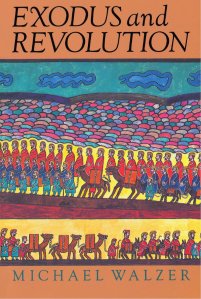
walzerFrom Jewish political theorist Michael Walzer’s Exodus and Revolution (1985):

So pharaonic oppression, deliverance, Sinai, and Canaan are still with us, powerful memories shaping our perceptions of the political world. The “door of hope” is still open; things are not what they might be–even when what they might be isn’t totally different from what they are. This is a central theme in Western thought, always present though elaborated in many different ways. We still believe, or many of us do, what the Exodus first taught, or what it has commonly been taken to teach, about the meaning and possibility of politics and about its proper form:

-first, that wherever you live, it is probably Egypt;

-second, that there is a better place, a world more attractive, a promised land;

-and third, that “the way to the land is through the wilderness.” There is no way to get from here to there except by joining together and marching.
Nature Against Empire

chedAn excerpt from Ched Myers‘ must-read article “Nature against Empire: Exodus Plagues, Climate Crisis and Hardheartedness.” Digest this taste-tester and then spend time with the entire piece, where Myers weaves together climate science and our sacred Scripture. Join Ched and other theological animators at the 2019 Bartimaeus Kinsler Institute in February.

British theologian Michael Northcott’s important 2013 Political Theology of Climate Change argues that our modern worldview offers no frame of reference for the “politics of slow catastrophe” stalking our history through ecological catastrophe.  He shows how traditional cosmologies, including the Bible, saw climate as political.  That is, the actions of nations influenced the health of nature; when people behaved badly, the earth behaved badly back.  Modernity, however, banished that notion as superstitious and unscientific.  Humans and our technologies are now in control, we believe, while nature is depersonalized, demystified and at our disposal.  That paradigm may have “worked” for a few centuries, but now we are realizing that nature seems to be biting back. Continue reading “Nature Against Empire”

Water to my Weary Soul

graceBy Joshua Grace, a pastor, pitcher, parent and DJ in North Philly
*This is the second installation of a year-long series of posts from contributors all over North America each answering the question, “How would you define radical discipleship?” We will be posting responses regularly on Mondays during 2019.

Radical discipleship doesn’t lend itself to the typical rat race towards better answers. We’re trying asking better questions. What does it mean to be a human being in our past, present, and future social and natural locations? How can our practices toward bioregional health shape our approach to faith and how do our spiritualties contribute to the health of the communities we root into? How can we contribute to the mission of God with eyes open to systemic oppressions, levels and layers of privilege, and hearts open to healing? Continue reading “Water to my Weary Soul”

The Advent of Stars and “Pagans”

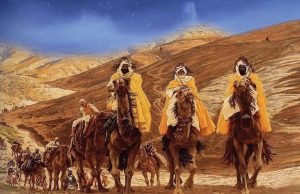
MagiBy Jim Perkinson, on Matthew 2:1-12

So, the stage is set. Matthew has an old horny codger taking up a young nubile teenager (could be a headline on CNN tomorrow) but then discovering he is late to the freshness. She already has a loaf in the oven. He resolves to part in quiet but is accosted by a Dream-Time appearance counseling adventure—the child is Spirit-born, the event is “Emmanuel,” the promise is deliverance. He wakes and tries to stay “woke.” Continue reading “The Advent of Stars and “Pagans””

Suffering the Gift: Decolonizing the Holidays

winslowBy Luke Winslow, a re-post from The Seattle School blog

Which story? Whose thanks?

In the days surrounding Thanksgiving, I was practicing mindful listening to Native and indigenous activists whom I follow on social media. As a kind of bookend to the emotional harm Native American communities re-experience every fall when the dominant culture still acknowledges days like Columbus Day (rather than its increasing replacement, Indigenous Peoples’ Day), followed by the colonial version of Thanksgiving, I find myself searching for language weeks later for how to translate what I’m hearing back to my own communities.

Although each holiday focuses on different themes (one could say, American and Christian identity formation, respectively), perhaps Thanksgiving and Christmas need to be viewed together, not separately, that with a retrospective, deconstructive view we can look at the ways these holidays mutually inform how and what we celebrate at the end of the year. In short, what does giving thanks and giving gifts mean in the specific context of—for we white and settler communities—being guests on stolen land? Continue reading “Suffering the Gift: Decolonizing the Holidays”

Radical Discipleship in a Time of Extinction

Puck JPerkBy James W. Perkinson 

*This is the first of a year-long series of posts from contributors all over North America each answering the question, “How would you define radical discipleship?” We will be posting responses regularly on Mondays during 2019.

“Radical discipleship” is one way of stating the call of the gospel. At face value, it means something like “following the root” (“radical” comes from the Latin “radix,” meaning “root”). But Christianity since Constantine has become so much the creature of urban imperial regimes that we typically approach the language of roots and plants as metaphor—nice “conceits” from earlier times that we have more literally “left behind” in our collaboration with a high-tech takeover of the planet. Indeed, in evangelical circles the great hope of the age in books going by the “Left Behind” nomenclature is to be “raptured” out of the mess of history and the barbarity of nature. The vision of salvation is one of exiting everything to do with earthly living—such as plant bodies growing, root-systems exchanging with soil, or animals eating and reproducing. Indeed, if heaven offers any “food” delights (like pizza or beer, in my paradise)—they will surely not issue in bacterial-driven metabolic processing and defecation or entail beheading of wheat or fermenting yeast or fungi handing off nitrogen to roots! (Not to mention anything as scandalous as sexual intercourse!) Continue reading “Radical Discipleship in a Time of Extinction”

Truth, Trust, and Power

Jesus RadA CALL FOR CONTENT from our co-conspirators at Jesus Radicals for their third issue of Rock! Paper! Scissors!

Tools for anarchist + Christian thought

Issue 3: Truth, Trust, and Power

Guest Editor: Ted Lewis

In the field of restorative justice, which seeks to address and repair harm in relationships, two elements have been central to people’s experience: truth-telling and trust-building. In this way, truth and trust (which share word origins in a number of languages) work together to bring about healing and restoration between people and even communities. In this third issue of Rock! Paper! Scissors! Tools for anarchist + Christian thought, we seek to wrestle with the tensions of speaking truth and building trust in the midst of power-imbalances in relationships and in movements for justice. Continue reading “Truth, Trust, and Power”

What is Your New Years (R)evolution?

Grace LeeBy Marcia Lee, Healing by Choice!, a women of color healing circle in Detroit, MI

Now that Christmas is over, you may be thinking about what new years’ resolutions you want to make and how you want to show up in this new year.  I want to invite you to consider, instead of a resolution, to make a New Years (R)evolution. Grace Lee Boggs  (right) taught us that the next revolution needs to be a (r)evolution = the re-evolution of ourselves and our community.  Although it is helpful to have goals for how we want to grow as individuals, we live in the context of the times we live in and in God’s time.   Continue reading “What is Your New Years (R)evolution?”