Identification With The Mind

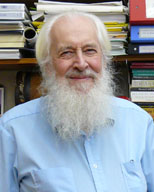
TolleFrom spiritual master Eckhart Tolle in his classic The Power of Now (1999):

If you are pulled into unconscious identification with the emotion through lack of presence, which is normal, the emotion temporarily becomes “you”…You will not be free of that pain until you cease to derive your sense of self from identification with the mind, which is to say from ego. The mind is then toppled from its place of power and Being reveals itself as your true nature.

The Only Defense She Has

RandyFrom Randy Woodley in Shalom and the Community of Creation: An Indigenous Vision (2012):

Humans have moved recently from tertiary consumers to becoming primary consumers. Such change is beyond the earth’s natural cycles and recharge rates, creating imbalance and disharmony on the whole planet. In order to restore balance, the earth is being forced to “consume” the primary consumer, moving her temporarily to confront humanity with the only defense she has, namely, natural disasters. In a very real sense, the top of the food chain is now the earth herself.

Wild Lectionary: For They Were Fishermen

014
PC: Arthur Black

Epiphany 3B

As Jesus passed along the Sea of Galilee, he saw Simon and his brother Andrew casting a net into the sea–for they were fishermen. And Jesus said to them, “Follow me and I will make you fish for people.” And immediately they left their nets and followed him.
Mark 1:16-17 

As this week’s lectionary readings tell about the fishing families of Galilee, Wild Lectionary talked to ‘Nagmis fisherman Arthur Black. The ‘Namgis First Nation take their name from a halibut-like sea creature who saved a lone human during a flood when water covered the whole world. We asked Arthur to talk to people of faith about fishing on the West Coast of British Columbia and the threats to wild salmon which have been a staple food and source of wealth and culture for indigenous people in this region for millennia.

Wild Lectionary: Can you talk about fishing in your family?

Arthur Black: I am a fourth generation commercial native fisherman, my kids and grandchildren fish commercially with me on our vessel. Growing up I fished on my grandfather’s boat; when I started skippering boats my great-grandfather Harry Brown came out of retirement and fished with us till his passing in1987. Continue reading “Wild Lectionary: For They Were Fishermen”

The Left Cheek

BayoBy Bayo Akomolafe, Nigerian author and “walkout academic,” [re]posted from his blog

Through this year, my explorations into new materialisms possessed me. In talks and text, in teachings and learnings, I dived into the queerness of seriously rethinking the boundaries I had been conditioned to erect between me and nature. I asked the question: what if we really took seriously the idea that the world is alive, that nature is more mind-like, magical and incorporeal than we know how to speak about, and that humans are more animal-like, embodied and carnal than our stories of centrality allow us to see? My book, These Wilds Beyond our Fences, struggled with these ideas and their implications for the ways we understand race, social justice, culture, loss, environmental degradation, and our perennial fascination with scaling heights. Continue reading “The Left Cheek”

Ratzlaff Reviews: The Pagan’s Apostle

Vern RAnother short and sweet book review-summary from legendary pastor Vern Ratzlaff, posting up on the Canadian prairies, pouring his heart and mind into anti-imperial theology and soul-tending.  

Paul: the Pagans’ Apostle. Paula Fredriksen. Yale University Press, 2017.

Paul’s letters concentrate on two ancient worlds, one Jewish, one pagan. The first is incandescent with apocalyptic hopes, expecting G-d through his messiah to fulfill his ancient promises of redemption to Israel. The second teems with human and divine actors, with superhuman forces and hostile cosmic gods. Fredrikson clearly outlines Paul’s situation within the social/cultural content of gods and humans, pagans and Jews, cities, synagogues and competing Christ-following assemblies, with particular attention to Paul’s letter to the Roman church. Continue reading “Ratzlaff Reviews: The Pagan’s Apostle”

Shaming or Shading is Not Organizing

GarzaA social media [re]post from Oakland-based organizer and Black Lives Matter co-founder Alicia Garza (Dec 27, 2017):

I’ve been traveling the last two weeks, meeting people from many different places in the world. The number one question I’ve been asked—besides the questions about my hair, which we will definitely talk about later—is this:

What is your country doing about Trump?

And I have to be honest and say:
We have a resistance movement but it is very divided, and lacks a path to power.

And then I sit with the shame of that. I live in a country that does terrible things around the world. And those of us who know that lack a path to power.

So in 2018, my simple resolution is this: to work to contribute to building a movement that takes its work seriously and is clear about what the work is and what it is not. The work isn’t to like each other and be besties. The work is to do something about our country—for and with the oppressed people inside of it and for and with the people oppressed around the world—and that requires building a movement in the millions with people who may or may not have your same approach or even the same political line but certainly share the same interests.

That means the Left needs to learn from its errors and become a different Left that does the work of organizing. Shaming or shading is not organizing. In a nation with more than 323 million people, our movement cannot be comprised of a few thousand people who think the same way and feel good with each other. A path to power means taking power and building power. We can’t build power if we aren’t taking power, and power isn’t just about our feelings or what is in our minds.

So I’m making a resolution to take that mandate much more seriously. I hope others will join me, and I’m gonna work to make it so.


An Alternative Seminary Experience

24254683_1992621874348930_4807097317723441469_o (1)By Laura Newby of Twin-Cities-based Underground Seminary

*NOTE: Underground Seminary is now accepting applications for their 3rd cohort starting Fall 2018. 

Christian leadership requires radical revisioning in the twenty-first century. The patriarchal, white, Western, capitalist framework that has dominated the globe the last few hundred years has lost credibility. Whiteness was birthed in conquest and theft, and has led to a global neoliberal system where everything is a commodity to be devoured for profit. The earth cries out on the brink of eco-systemic collapse.

This is an age for prophets and healers. Yet we are heirs of a religious tradition that is deeply complicit in our apocalyptic moment. What does it mean to serve as Christian leaders when Christianity has been the primary ideological center of this destructive colonial worldview? Do we realize the extent to which our ideas about leadership continue to be shaped by the chimera of whiteness? Continue reading “An Alternative Seminary Experience”

Brave Spaces

trump protest
PC: Elizabeth Conley

Excerpts from a recent interview with justice doula Micky Scottbey-Jones of the Faith Matters Network (re-posted from the Nobel Women’s Initiative site):

On “movement chaplaincy:”

We’ve been taught to think of movements and protests as “Who’s the target? What’s the action? We’re done.” In the same way that we have medics at protests to attend to the physical needs of people, a movement chaplain would be the person who’s clued into the emotional, spiritual, and mental needs, both in the moment of protest, and afterwards. They would help us decompress, celebrate, lament. We shouldn’t be going on to the next action until we’ve had time to process and celebrate our wins, and mourn our losses, and talk about how scared we were during one part and how great this other part felt. We need to change the way we are taught to organize. Continue reading “Brave Spaces”