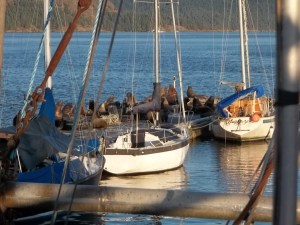
A litany of repentance from the Salal + Cedar community, seeking transformative encounters with the species and geography of the Fraser River to Salish Sea basin and the wider Cascadia bioregion:
May all I say and all I think
be in harmony with thee,
God within me,
God beyond me,
maker of the trees. Chinook prayer, Pacific Northwest
We stand in this place, this watershed, this holy ground, remembering its creatures and asking them respectfully to stand with us. Stand to remember together our stories. Stand to be in conscious, respectful relationship. Stand to resist commercial interests at creation’s expense. Let’s join with creation in pledging ourselves to live to praise God’s holy name. Continue reading “For Ash Wednesday: Let Us Join With Creation”→
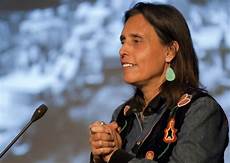
From Winona LaDuke, the executive director of Honor the Earth, responding to an interview question from Amy Goodman about PTSD in the Native American community:
You say “Enbridge,” and I get this little like quirk because the Indian wars are far from over out here. But what you get is intergenerational trauma, is what it is known as, historic trauma. And other people have it. But you have a genetic memory, and every day you wake up, and you see that your land was flooded. And that big power line that runs through this land, that doesn’t benefit you. Everything that is out here was done at your expense, but you still have to pay for it. And every day you go out there, and you got a roadblock, that the white people put up, coming into your reservation. And every day you go out there, and you look at your houses, and you see that you’ve got crumbling infrastructure, and nobody cares about it. And you’ve got a meth epidemic, and you’ve got the highest suicide rates in the country, but nobody pays attention. So you just try to survive. That’s what you’re trying to do. Like 90 percent of my community, generally, I would say, is just trying to survive. Continue reading “Just Trying to Survive”→
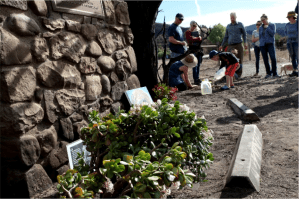
Note: This reflection was given at a Farm Church gathering at the Asistencia memorial site in California’s Ventura River Watershed on Sunday, Jan 14, 2018 (right; young Wesley Lehman waters a newly planted sycamore seedling; all photos of the gathering by Chris Wight). You can also find it on Ched’s blog.
This weekend we as a nation rightly commemorate the life and work of Dr. Martin Luther King, Jr. So a good place to start our circle this Sunday morning before the national holiday is with this passage from King’s 1963 book Why We Can’t Wait:
Our nation was born in genocide when it embraced the doctrine that the original American, the Indian, was an inferior race. Even before there were large numbers of Negroes on our shores, the scar of racial hatred had already disfigured colonial society. From the sixteenth century forward, blood flowed in battles of racial supremacy. We are perhaps the only nation which tried as a matter of national policy to wipe out its Indigenous population. Moreover, we elevated that tragic experience into a noble crusade. Indeed, even today we have not permitted ourselves to reject or feel remorse for this shameful episode. Our literature, our films, our drama, our folklore all exalt it.
PC: Bill Wingell/National Museum of African American History and Culture/Smithsonian.
Dr. King summarizes why we are gathered as Farm Church at this unusual venue and time, for a special commemoration of a history that lingers in this very spot. [Right: Mattie Grinnell, a 101-year-old Mandan tribeswoman, speaks to the press outside the Supreme Court during the 1968 Poor People’s Campaign in Washington, D.C.]
Mohecan activist Jim Bear Jacobs taught us that westerners tend to steward our narratives through texts, while indigenous cultures understand their sacred history to be embedded in the land. The land holds the stories. And this Asistencia Santa Gertrudis memorial site is just one small, indeed hidden, chapter in the long and sordid history of Settler displacement of indigenous peoples that marks every single square mile of Turtle Island. Continue reading “Re-membering the Asistencia Santa Gertrudis”→
Decades ago, Alice Walker suggested that the White House should be run by twelve grandmothers. I spent my Wednesday at the state capital bearing witness to the obvious brilliance of her proposal.
It was almost two years since my first visit to Lansing, days after the Flint water poisoning scandal broke out like an upper respiratory infection. The brutal part: both viruses still linger.
Back then, business brought my friend Mike to Michigan. But his heart and his camera prodded him all the way to Capitol with me to brave a single-digit-wind-chilled protest during the Governor’s annual State of the State address. A year later, the state’s Civil Rights Commission issued a scathing 135-page report naming “systemic racism” as a major factor in Flint’s water contamination. Redlining, white flight to the suburbs, intergenerational poverty and “implicit bias” were all chronicled as contributing to the unnatural disaster. Fifty years after the Kerner Commission report, history came full circle. Continue reading “No Additional Comments”→
I am a native of San Fernando, Pampanga in Central Luzon, Philippines. I grew up in the small barrio of Teopaco next door to calesa drivers with their handsome horses and their backyard stables. I shared with my five siblings duties feeding pigs and raising chickens and collecting horse manure for fertilizing our small family garden. Although I grew up colonized (tutored by American missionaries and Peace Corps Volunteers and Filipino teachers who taught strictly in English), I retain memories of sitting at my Apu Sinang’s feet listening to her tell stories as I strung fragrant sampaguita leis or as I watched with fascination as she prepared her betel nut chew, breaking open the nut and sprinkling shell lime on the meat, then rolling the concoction in betel pepper leaf before putting the bite-size pouch into her mouth for chewing. Then there were the home deliveries of fresh milk in unbranded glass bottles that you handed back when the milkman came back around, and the early morning toot-toot announcing the arrival of Apay Tinapay on his bike, the hot pandesal vendor, who magically kept the fresh-baked buns steaming hot in his big newspaper-insulated basket hanging by the side of his bike. Continue reading “A Gateway to My Indigenous Soul”→
By Rev. Denise Griebler
1st UCC Richmond, Michigan
January 28, 2018
Mark 1:21-28
Psalm 111
Well, I will tell you this: I went to worship that evening with the usual expectations – which is to say, I wasn’t expecting anything unusual. It was just after sunset – which is when we worship. By our way of thinking, sundown is the beginning of the new day – a time to rest in God’s presence – a time to rest in the company of family and friends and neighbors. Continue reading “Sermon: As One Who Was There”→
By Jim Perkinson, a sermon on Jonah 3:1-5, 10 and Mk 1:14-20, January 21, 2018, St. Peter’s Episcopal Church (Detroit, MI)
I am not a fish person—which is why I volunteered to preach this Sunday, where the lessons focus on fish, in the stories of Jonah and the whale and of the disciples on the Sea of Galilee called to become “fishers of humans.” To “catch” the significance of the latter, we need to reel in the former carefully. Though not included in the lectionary, the heart of the Jonah story turns on the following verse:
And the Lord appointed a great fish to swallow Jonah; and Jonah was in the belly of the fish three days and three nights (Jon 1:17).
The text is clear. Jonah was saved by a fish. But we need to go slow, since we often read it the other way around—that Jonah was saved from a fish. So in the interests of getting us hooked on the story-line, I want to string out three pieces of bait. Continue reading “The Sunday Long Read: Dove Songs and Fish Offerings”→
From spiritual master Eckhart Tolle in his classic The Power of Now (1999):
If you are pulled into unconscious identification with the emotion through lack of presence, which is normal, the emotion temporarily becomes “you”…You will not be free of that pain until you cease to derive your sense of self from identification with the mind, which is to say from ego. The mind is then toppled from its place of power and Being reveals itself as your true nature.
Humans have moved recently from tertiary consumers to becoming primary consumers. Such change is beyond the earth’s natural cycles and recharge rates, creating imbalance and disharmony on the whole planet. In order to restore balance, the earth is being forced to “consume” the primary consumer, moving her temporarily to confront humanity with the only defense she has, namely, natural disasters. In a very real sense, the top of the food chain is now the earth herself.
As Jesus passed along the Sea of Galilee, he saw Simon and his brother Andrew casting a net into the sea–for they were fishermen. And Jesus said to them, “Follow me and I will make you fish for people.” And immediately they left their nets and followed him. Mark 1:16-17
As this week’s lectionary readings tell about the fishing families of Galilee, Wild Lectionary talked to ‘Nagmis fisherman Arthur Black. The ‘Namgis First Nation take their name from a halibut-like sea creature who saved a lone human during a flood when water covered the whole world. We asked Arthur to talk to people of faith about fishing on the West Coast of British Columbia and the threats to wild salmon which have been a staple food and source of wealth and culture for indigenous people in this region for millennia.
Wild Lectionary: Can you talk about fishing in your family?
Arthur Black: I am a fourth generation commercial native fisherman, my kids and grandchildren fish commercially with me on our vessel. Growing up I fished on my grandfather’s boat; when I started skippering boats my great-grandfather Harry Brown came out of retirement and fished with us till his passing in1987. Continue reading “Wild Lectionary: For They Were Fishermen”→

 A litany of repentance from the Salal + Cedar community, seeking transformative encounters with the species and geography of the Fraser River to Salish Sea basin and the wider Cascadia bioregion:
 From Winona LaDuke, the executive director of
  By Ched Myers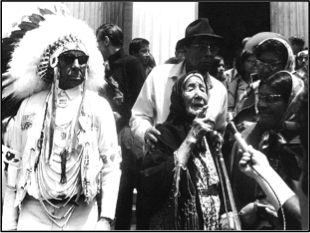

 By S. Lily Mendoza (right), from
  By Rev.
  By Jim Perkinson, a sermon on Jonah 3:1-5, 10 and Mk 1:14-20, January 21, 2018, St. Peter’s Episcopal Church (Detroit, MI)
 From spiritual master Eckhart Tolle in his classic The Power of Now (1999):
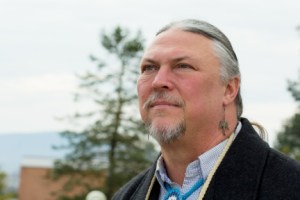 From Randy Woodley in