Salted the Nile with her Tears

By Kelley Nikondeha, o

Salted_the_Nile_with_Her_Tears_800_533_90
: “Striated Heron,” Nile River, Luxor, Egypt, Becky Matsubara CC, flickr.com/beckymatsubara.

riginally printed in Geez magazine on Mothering.

A cry broke the early morning silence and interrupted the royal daughter’s bath.

Already knee-deep in the river, she knew instantly that it was a Hebrew baby. On the opposite shore a mother, exhausted from the crossing, dragged her wet body out of the river and collapsed – arms now empty.

As an adopted child, I grew up mesmerized by Moses with only a cursory interest in his mothers. Sunday school lessons didn’t help, offering a sentimentalized characterization of these women – the one who let go and the other who saved the boy through adoption. But as I grew, so did my understanding of the mothers. I learned their story existed against a socio-political backdrop complete with hard edges and harder choices. Continue reading “Salted the Nile with her Tears”

Scaffolding This Appalling Silence

By Tommy AireyWexler

Late last month, Ruby Sales lobbed me my first reading assignment: The Awful Grace of God: Religious Terrorism, White Supremacy and the Unsolved Murder of Martin Luther King, Jr. by Stuart Wexler and Larry Hancock. Over the phone, she delivered a tutorial on its fresh relevance for late stage racial capitalism. We hung up a week before white men targeted Black and Brown bystanders in El Paso and Dayton.

As it turns out, the real terrorists are white Christians. The Awful Grace of God details the ways and means of white pastors and their KKK-congregants who conspired to kill Dr. King in the 50’s and 60’s. This clandestine movement fused religious passion, reactionary politics and the spirituality of hatred. By 1967, the price on Dr. King’s head was $100,000. The news of this rapidly circulated through federal prisons, where King’s supposed killer James Earl Ray was about to escape. Of course, this strand is still alive and well, but as King himself noted time and time again, the greatest tragedy remains “not the strident clamor of the bad people, but the appalling silence of the good people.” The grandest conspiracy of all is the collective denial of white supremacy in all its insidious forms. Continue reading “Scaffolding This Appalling Silence”

Seeking Right Relationship

Kingsbay7An excerpt from Clare Grady’s oral arguments earlier this month in Georgia. Clare is a member of the Kingsbay Plowshares 7.

At this point, I would like to take a moment to look at the word religion. I learned that it has its roots in the word re-ligament. I translate that as re align, or to be in right relationship. Before I finish my time, I would like to share a few paragraphs from my affidavit and my testimony from the evidentiary hearing. All of my testimony was about religion, was about seeking right relationship. I will begin with a passage I quoted from Mark’s gospel chapter 12. It was the Sunday Mass reading on November 9, 1958, the day that I was born. In many ways it has been a rudder in my faith journey, one that has informed my religious beliefs, choices and practices. Continue reading “Seeking Right Relationship”

Healing as Liberation from Crippling Debt

DebtBy Ched Myers, on Luke 13:10-17

Note: This is part of a series of weekly comments on the Lukan gospel readings from the Revised Common Lectionary during year C, 2016.

This part of Luke’s gospel offers two symbolic stories about the healing of “political bodies” that signify pathology in the body politic: the “bent over” woman (13:10-17) and the “too big” man (14:1-6). Sadly, the second of these is (literally) skipped over by the lectionary. These intimately related healings bracket a series of Jesus’ sayings concerning the Kingdom as surprise and mystery (13:18-21), the “narrow Way” (13:22-30) and the cost of prophetic discipleship (13:31-35). Continue reading “Healing as Liberation from Crippling Debt”

Wild Lectionary: Agency, Age, and Attentiveness to Power

69204377_943906822622582_9211619679188025344_n
Photo from Salal and Cedar

Proper 16 C
Jeremiah 1:4-10

By Rachael Bullock

The word of the Lord came to me, saying,
“Before I formed you in the womb I knew you,
before you were born I set you apart;
I appointed you as a prophet to the nations.”
“Alas, Sovereign Lord,” I said, “I do not know how to speak; I am too young.” Continue reading “Wild Lectionary: Agency, Age, and Attentiveness to Power”

A Moral Reckoning

PPCFrom The Poor People’s Campaign: A National Call for Moral Revival (August 8, 2019).

If you really change your ways and your actions and deal with each other justly, if you do not oppress the foreigner, the fatherless or the widow and do not shed innocent blood in this place, and if you do not follow other gods to your own harm, then I will let you live in this place, in the land I gave your ancestors for ever and ever. But look, you are trusting in deceptive words that are worthless.
Jeremiah 7:5-8

One week ago, we were in El Paso at the invitation of the Border Network for Human Rights to highlight the violence that their community has been suffering. We heard stories of families separated, asylum seekers turned away and refugees detained like prisoners of war. We heard how their community has been militarized and how poor border communities have been especially targeted. We promised that we would do everything in our power to compel the nation to see this violence. Just a few days later, a terrorist opened fire in El Paso. And then another attack occurred in Dayton. Continue reading “A Moral Reckoning”

Jesus of Nazareth, Arsonist

FireBy Wes Howard-Brook and Sue Ferguson Johnson, on this Sunday’s Gospel text (Luke 12:49-56)
*Note: this piece was originally posted on RadicalDiscipleship.net during the summer of 2016.

Jesus, erstwhile proclaimer of peace and love, hopes for fire and anticipates division within households. Was the Lord having a bad day on the Way to Jerusalem in this Sunday’s Gospel? How can we reconcile his word in this week’s lectionary text (Luke 12.49-56) with what we hear in the rest of Luke’s Gospel? Continue reading “Jesus of Nazareth, Arsonist”

Thoughts and Prayers

BayoFrom spiritual practitioner Bayo Akomolafe (Facebook, August 4, 2019). 

The phrase “thoughts and prayers” needs a new cosmology. The one it now operates in presumes ‘God’ is absolutely transcendent, heavenly, irretrievably cast away at an unbridgeable remove from our earthly goings-on. Brought down to our material earth, thoughts and prayers take on a new urgency. Thoughts become public things, the shared fabric through which my life becomes yours and yours mine; prayers become matters of accountability and justice. Thoughts and prayers should be ecological matters that enable us to meet ourselves, to share our tears and ask hard questions about our complicity in the suffering of others. Not Twitter templates that deepen our indifference and bypass our complacency, masking as piety.

Stay Awake

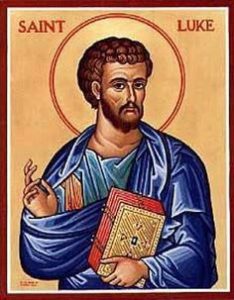
St LukeBy Wes Howard-Brook & Sue Ferguson Johnson, on this week’s lectionary Gospel passage (Luke 12:32-40)

*Originally posted in August 2016.

In the soporific summertime, it is easy enough to lie back, close one’s eyes, and fall into a tranquil sleep. Indeed, many of us could use more sleep, driven as we often are by the exigencies of empire into never-ending task mode. Perhaps ironically, getting more sleep could help prepare us for Jesus’ word to us this Sunday: stay awake (12.32-40)!

The church cycle offers us Lent and Advent as seasonal opportunities to practice anti-imperial wakefulness. With school out, though, the church year seems to take a break from the call to faithful vigilance. But the lectionary surprises us this week, just as Jesus’ message within the text from Luke gives us images of surprising arrivals. Perhaps equally surprisingly, a close listen to our Gospel text invites us to hear precisely what we are called to stay awake against: the lure of the exploitative, anxiety-ridden, imperial economy. At the same time, we are called to stay awake for the opportunity to be servants to one another and all creation. Continue reading “Stay Awake”

Wild Lectionary: “I do not delight in the blood of bulls!”- God’s Invitation to Participate in Prophetic, Poetic Proclamation

flock of geeseBy Wes Howard-Brook and Sue Ferguson Johnson

Proper 14 (9) C

Solomon offered as sacrifices of well-being to the LORD twenty-two thousand oxen and one hundred twenty thousand sheep. So the king and all the people of Israel dedicated the house of the LORD.
—1 Kings 8.63

What to me is the multitude of your sacrifices? says the LORD; I have had enough of burnt offerings of rams and the fat of fed beasts; I do not delight in the blood of bulls, or of lambs, or of goats. When you come to appear before me, who asked this from your hand? Trample my courts no more; bringing offerings is futile; incense is an abomination to me.
—Isaiah 1.11-13

I will not accept a bull from your house, or goats from your folds.
For every wild animal of the forest is mine, the cattle on a thousand hills.
I know all the birds of the air, and all that moves in the field is mine.
“If I were hungry, I would not tell you, for the world and all that is in it is mine.
Do I eat the flesh of bulls, or drink the blood of goats?”
—Psalm 50.9-13

Continue reading “Wild Lectionary: “I do not delight in the blood of bulls!”- God’s Invitation to Participate in Prophetic, Poetic Proclamation”