Wild Lectionary: Dry Seed and Soil

Screen Shot 2018-10-29 at 9.39.02 AM
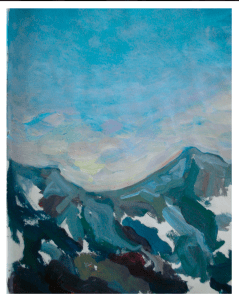
Dawn, Yukon, 2001 by Tia McLennan

Proper 26(31) B
24th Sunday after Pentecost

Happy are those whose help is the God of Jacob, whose hope is in the LORD their God, who made heaven and earth, the sea, and all that is in them;

Psalm 146:5-6

By Juleta Severson-Baker

Psalm 146

Everyone who turns around to look for God is dancing

Every word spoken of God’s love is a poem

Every name pinned on the mystery of God is a metaphor

I will not put my trust in the parts of the whole
I will praise the whole Continue reading “Wild Lectionary: Dry Seed and Soil”

Like a Roadmap of Resistance

4.2.7By Chava Redonnet, Oscar Romero Inclusive Catholic Church (Rochester, NY)

When I first visited El Salvador in 2005 with a class from Divinity School, we went to the Divina Providencia cancer hospital where Monseñor Romero lived (because he refused to live in the bishop’s palace when the people were living in such terrible conditions). We were there again, on Thursday, October 11, just a few days before his canonization. A Carmelite nun showed us around, and I told her the story of how on my first visit there, I looked at all of his things – daily objects, so lovingly preserved – all so male and old-fashioned and foreign – and they felt strange and distant. But then I saw a pair of clip-on sunglasses that had been his. They were identical to a pair of my own! I could have bought them at Wegmans. And it hit me: this struggle is not some strange, distant, foreign thing. It’s here and it’s now, and the work continues. I am also a part of the struggle; the work is mine, as well. Continue reading “Like a Roadmap of Resistance”

Seeking True Vision


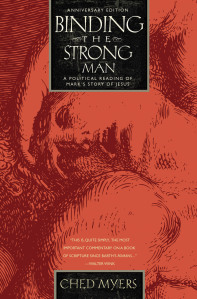
Binding30 years in and Ched Myers’ Binding the Strong Man: A Political Reading of Mark’s Story of Jesus (1988) is more relevant than ever. We’ve got five more Sundays to celebrate it! This week’s commentary homes in on Mark 10:46-52.

The community now approaches the suburbs of Jerusalem. Mark opens this second story of a blind man as he did the first: “And they came into” (kai erchontai; see 8:22) Jericho. Mark sets a scene for this episode, which was no doubt familiar to anyone who had gone to Jerusalem on pilgrimage. Jericho was the last stop en route to the city of David; the road out of town, representing the final, fifteen-mile leg of the pilgrim’s journey, would have been the standard beat for much of that city’s beggar population. The odds were good that pilgrims would have the mood and means to give alms. There Jesus, the disciples, and a great crowd meet Bartimaeus, the destitute blind man. Continue reading “Seeking True Vision”

Into the Jaws of a Crocodile

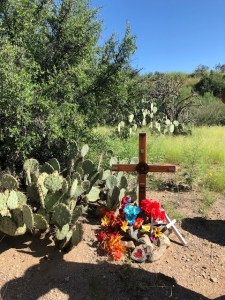
Cross in desert (1)
PC: Rebecca Heskamp

By Joyce Hollyday

To our right the desert sunset was a dazzling blaze of gold with streaks of red behind towering saguaro cacti, as my partner Bill, our friend Becca, and I drove south from Phoenix to the Arizona-Mexico border. To our left a glowing, salmon-colored full moon rose and perched on a blue-gray mountain peak. We were on our way to participate with a hundred other people of faith from around the country in a week of prayer and protest, communion and confrontation, organized by the Southwest Conference of the United Church of Christ. Continue reading “Into the Jaws of a Crocodile”

Help Wanted

By Tommy Airey, co-curator of RadicalDiscipleship.net and the author of Descending Like a Dove: Adventures in Decolonizing Evangelical Christianity

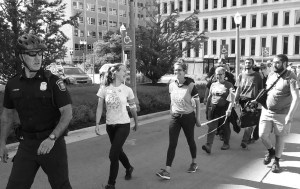
Arrest (1)On that Spring day in Lansing, when Lindsay joined the band of holy rebels getting arrested for civil disobedience (right), I participated in civil discourse with a police officer hired to keep the peace at the peaceful demonstration. Despite the overtime pay, he wasn’t happy. He confessed that he was reluctant to support anyone too lazy to get off their butts to get a job. I shared with him the data—there are hundreds of jobs for hundreds of thousands of applicants. But he had a comeback: “No way. I see help wanted signs everywhere.” Continue reading “Help Wanted”

I Speak of Jesus of Nazareth

will-headshot4-225x300By Will O’Brien

While I loathe almost everything about the Trump Administration, it is fitting to applaud and be grateful for the release of Pastor Andrew Brunson after two years of detention in Turkey. Now it is time to turn our attention to another tragic case of a religious leader being unjustly imprisoned in a hostile country.

I speak of Jesus of Nazareth, who for many years has been imprisoned under harsh circumstances in the United States.  Reports suggest he has suffered brutal torture during his detention – some followers who have glimpsed him in prison say he has been beaten so badly they could hardly recognize him.  The regime insists that Jesus is not being detained and in fact has complete freedom to function in society, though in fact he has not been seen in public for many years.  Regime supporters also frequently mention him in positive terms, but his followers say the statements about him are utterly false and distorted, which they cite as further proof that Jesus himself is not in fact active in ministry.  Scattered appearances of “Jesus” are, according to human rights observers, highly staged state events, using a poorly disguised double.

The regime denies claims of Jesus’ imprisonment, labeling them “fake-Good New propaganda” by Jesus’ supporters, who it asserts are a threat to the social order.  International observers say that the Trump regime’s treatment of Jesus is a departure from similar situations under modern authoritarian rule, such as the case with Pastor Brunson:  Rather than charging the religious leader with crimes against the government as a justification for detention, the U.S. is instead denying the detention and instead promoting the notion that Jesus is free, active, and working in support of the government.  One regime spokesperson, speaking on the condition of anonymity, said, “We saw how Rome tried to handle Jesus through state-sanctioned law-and-order violence – which obviously didn’t work.  We felt that the strategy of Constantine was more appropriate to the U.S. situation, and so far it is working quite well” …

Alas, a little levity is in order, … but conscientious disciples must undertake the hard work of “liberating Jesus” if we are to have the power to be liberators.


On the Right and the Left

Binding30 years in and Ched Myers’ Binding the Strong Man: A Political Reading of Mark’s Story of Jesus (1988) is more relevant than ever. This week’s commentary homes in on Mark 10:35-45.

The petition by James and John shows that the disciples are still “deaf” to Jesus’ portents, continuing to understand his talk of the manifestation of the Human One’s “glory” (en te doxe sou) to mean some kind of messianic coup. Convinced their leader will prevail, they are already considering the administration of the new regime; they lobby for “first and second cabinet position.” The image of “sitting on the right and left” could be an allusion to Psalm 110:1, or to places at the messianic victory banquet, or subordinate thrones. In either case, it is an overtly political euphemism. Continue reading “On the Right and the Left”

Wild Lectionary: Wild God, Wild Beauty

DSC01830.JPGProper 24 (29)B
22nd Sunday after Pentecost
Job 38:1-7, 34-41

By Wendy Janzen

The the first reading and Psalm for this Sunday are both creation texts – passages that describe God’s amazing work in creating the cosmos. The text from Jobs is part of the longest passage in the bible about more-than-human creation (Job 38-42). It is written in exquisitely beautiful poetry, and it is God’s rhetorical answer to Job’s probing questions about God’s justice – why bad things happen to good people. Continue reading “Wild Lectionary: Wild God, Wild Beauty”

The Eye of the Needle

Binding30 years in and Ched Myers’ Binding the Strong Man: A Political Reading of Mark’s Story of Jesus (1988) is more relevant than ever. This week’s commentary homes in on Mark 10:17-31.

Mark’s wry joke about the camel and the needle in particular has received ingenious “manipulation at the hands of bourgeois conscience-tranquilizing exegetes” (Jose Miranda). The famous medieval assertion that the “eye of the needle” referred to a certain small gate in ancient Jerusalem through which camels could enter only on their knees (!) is only one of the more obvious ways devised to rob this metaphor of its class-critical power. The proposition is plainly an impossible one. Bailey points out that the Babylonian Talmud records a similar hyperbole–an elephant going through the eye of a needle–and comments that “the elephant was the largest animal in Mesopotamia and the camel the largest in Palestine.” Mark’s stinging sarcasm is perhaps more recognizable in Frederick Buechner’s contemporary paraphrase: for wealthy North Americans it is harder to enter the kingdom “than for Nelson Rockefeller to get through the night deposit slot of the First National City Bank!”  Continue reading “The Eye of the Needle”