Wild Lectionary: Ecological Theology of the Vineyard

kj
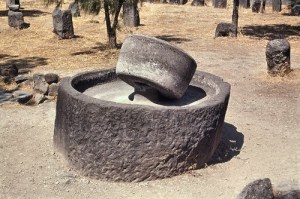
Old millstone, Palestine

Proper 22 (27)
18th Sunday after Pentecost

Isaiah 5:1-7
Matthew 21:33-46

By Ched Myers

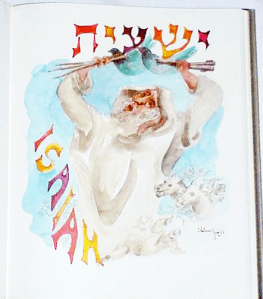
The 18th Sunday after Pentecost this year comes on the heels of the “Season of Creation,” a contemporary liturgical and lectionary movement celebrated during the four Sundays in September prior to St Francis of Assisi Day (4 October). Today’s haftorah—Isaiah’s famous “Song of the Vineyard”—continues this vein of ecological theology. Continue reading “Wild Lectionary: Ecological Theology of the Vineyard”

The Primal Story Line: Peace, Respect & Reconciliation

VernAnother short and sweet book review-summary from legendary pastor Vern Ratzlaffposting up on the Canadian prairies, pouring his heart and mind into anti-imperial theology and soul-tending. 

Instead of Atonement. Ted Grimsrud, Cascade, 2013.

Grimsrud does a double theological treatment: of penal theory and of atonement theory.

Penal theory. The difference between retributive and restorative approaches to retaliatory justice. Continue reading “The Primal Story Line: Peace, Respect & Reconciliation”

Wild Lectionary: Our Default State is Goodness

20882079_10154703261826366_3299820859768196481_nProper 21(26)
Seventeenth Sunday after Pentecost

Ezekiel 18:1-4, 25-32
Philippians 2:1-13
Matthew 21:23-32

By the Reverend Doctor Victoria Marie

As I reflected on today’s readings the theme that emerged is: our response to God. In the first reading Ezekiel is saying that when we turn away from what is just, we die. When we return to acting with justice, we save our lives. Continue reading “Wild Lectionary: Our Default State is Goodness”

When the Landowner is not God

day laborerBy Tommy Airey, adapted from a sermon on Matthew 10:1-16
Most interpretations of Jesus’ “parable of the landowner” equate the vineyard owner with God and the workers with God’s People or humanity at large.  God is seen as “generous” and “equitable” with the people and expands the population of those who, by grace, are ushered through the heavenly gates.   The grumbling worker at the end of the story is representative of Israel at large or the Pharisees, chief priests and other Jewish leaders who confronted Jesus during his life and ministry—the lesson being that we should all be thankful for God’s equal treatment and unconditional generosity and kindness.

Infused by the scholarship of William Herzog and his former student Ched Myers, there is a more compelling and contextual interpretation of Matthew 20 flowing out of the “minority report” of the radical discipleship movement.  Fortunately, nothing in the parable forces us to assume that the vineyard owner in the parable is God!  Instead, like a political cartoon, the parable is an exaggerated representation of what life was actually like during the time of Jesus and in the culture of the very first hearers of the parable five decades later. Instead of offering us heavenly principles that permit us to rest easy, the parable functions as a jarring illustration that prods us to face reality. Continue reading “When the Landowner is not God”

Fifteen Years Fermented

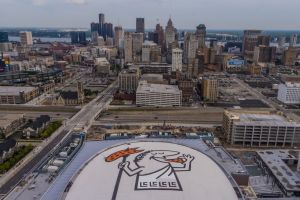
Little CaesarOn September 12, the brand new $800 million+ Little Caesar’s Arena kicked off with a Kid Rock concert on the southern edge of the Cass Corridor in Detroit. It was the culmination of white billionaire Mike Ilitch’s* fifteen-year “dereliction by design,” scores of properties purchased and left to rot.  Land values were intentionally driven lower so Ilitch could buy even more. One week after the grand opening, prompted by this journalistic prose, Lindsay Airey was visited by a nightmare. Her attempt to relay it in poetry: 

A sea of black faces.
Beaten, downtrodden
by violent displacement,
callous disregard.
Greed turned sick
the souls
of these precious ones’
attackers.
Gluttonous murder,
seeping like poison,
hemorrhaging
out their murdering pores. Continue reading “Fifteen Years Fermented”

Irma and La Tuna, Charlottesville and North Korea: The Voice Under the Voice, Still Unheard

KidRockTrump
Detroit, Michigan: Six sold-out shows to open up the new $800 million Little Caesar’s Arena

Dr. James Perkinson, Ecumenical Theological Seminary (Detroit, MI)

The signs of our time shout! Harvey hammers Houston and the entire Gulf Coast camps out in a boat or a grave. Then comes Irma with Jose and Katya in Her wake, raking an entire peninsula with rebuke. While fire ungraced with gendered traces of naming, blisters the west. All on top of Charlottesville, itself evoking Trump, chopping restraints militant and policing, channeling a large chunk of the dominant demographic of the country! As I write, Kid Rock readies his concert of hate in downtown Detroit, as front for the Ilitch family take of Motown turf, faking concern, raking in tax dollar support, celebrating white vituperation in the gala opening of a new ice hockey stadium at the core of an 82 % black city. Little Caesar indeed! But what do all of these events have to do with each other? How might a community aspiring to some measure of humanity and morality “hear” what these events sound out? I do not yet even dare to say, “Respond.” Continue reading “Irma and La Tuna, Charlottesville and North Korea: The Voice Under the Voice, Still Unheard”

Sermon: It’s Like Burning Fire Shut Up in my Bones

roseBy Rose Berger, preached at St. Stephen’s & The Incarnation Episcopal Church (Washington, D.C.)
June 25, 2017

Jeremiah 20:7-13, Psalm 69: 8-11, (12-17), 18-20, Romans 6:1b-11, Matthew 10:24-39

[Piscataway people on whose land this church stands. Bishop Budde, Pastor Sam, Rev. Linda. The Beloved Community that gathers at St. Stephen’s and the Incarnation.]

The prophet Jeremiah was asked to carry out one of the most difficult tasks ever assigned to any servant of God.[1]

During the last years of the kingdom of Judah, Jeremiah was to prophesy to King and Congress that because of their sin their fragile nation would be subsumed by the Babylonian Empire and they would all forcibly removed to the capital city of Babylon. Continue reading “Sermon: It’s Like Burning Fire Shut Up in my Bones”

Wild Lectionary: The Riff Raff, the Bedbugs, and the Signs

23-PovertyMascotsProper 18(23)

Exodus 7-12

By Laurel Dykstra

Now you know and I know, that lice, mice, roaches, bed-bugs, and rats are no respecters of persons. They invade the house of Pharaoh, the houses of his officials, and of all his people (Exod 8:21, 10:6); they infest the luxury hotels and the welfare hotels. But when the special shampoo costs eight dollars a bottle, and a visit from the exterminator $125, those that can—pay, and those that can’t, or whose landlord won’t—scratch.

Continue reading “Wild Lectionary: The Riff Raff, the Bedbugs, and the Signs”

Wild Lectionary: “Fire in the Earth: Burning but Flourishing”

imagesThirteenth Sunday after Pentecost
Proper 17 (22)

Exodus 3:1-15

By Rev. Matthew Syrdal

“There the angel of the Lord appeared to him in flames of fire from within a bush. Moses saw that though the bush was on fire it was not consumed… “Do not come any closer,” God said. “Take off your shoes, for the place you are standing is holy ground.”

And we know, when Moses was told,
in the way he was told,
“Take off your shoes!” He grew pale from that simple

reminder of fire in the dusty earth.
He never recovered
his complicated way of loving again

and was free to love in the same way
he felt the fire licking at his heels loved him.
As if the lion earth could roar
and take him in one movement…
-all poetry excerpts from David Whyte, Fire in the Earth

Continue reading “Wild Lectionary: “Fire in the Earth: Burning but Flourishing””

Sermon: Power of Names

10576925_10203724502133713_5217887874462831456_n
My Grandma Bea, me, my mom, and my sister Lucy

Preached by Lydia Wylie-Kellermann at the Day House Catholic Worker
August 27, 2017

Exodus 1:8-2:10
Matthew 16:13-20

As I read the opening piece of the text from Exodus, it feels like I am reading a script from the white men who marched on Charlottesville two weeks ago.

It begins with the Pharaoh naming his fear that the Israelites are becoming too numerous and powerful. He is scared they will out-number and over-take him. He orders that they be forced into labor and when that doesn’t work, he orders murder.

It echoes of the treacherous low-wage labor forced on undocumented folks living in constant fear.

It echoes of a prison industrial complex holding captive more black men today than were enslaved in the south. Continue reading “Sermon: Power of Names”