Not as the World Gives”: Receiving Jesus’s Gift of Peace

DiscourseBy Wes Howard-Brook and Sue Ferguson Johnson
Readers of radicaldiscipleship.net hardly need to be reminded of the sharp contrast between the pax imperium and pax Christi. It is foundational that Jesus’s messiahship is grounded not in militarism but in love. What it can be easy to forget—or to remember but not practice so well—is the holistic nature of the peace Jesus offers: the “ease of fit” between our inner and outer, our individual and communal lives. Continue reading “Not as the World Gives”: Receiving Jesus’s Gift of Peace”

Radical Book Recommendations

NicholaNichola Torbett of Oakland’s Seminary of the Street recently posted this great question:

Radical Christian friends, what books do you recommend that do deep exegesis of Matthew and Luke of the sort that Ched Myers has done on Mark and Wes Howard-Brook has done with John? And actually, while I have your attention, what are your indispensable go-to books for radical Christian inspiration?

Here are some of the responses: Continue reading “Radical Book Recommendations”

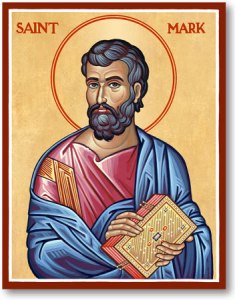
The Feast of St. Mark

St MarkFrom Ched Myers’ Binding The Strong Man: A Political Reading of Mark’s Story of Jesus (1988):

Mark’s Gospel originally was written to help imperial subjects learn the hard truth about their world and themselves…His is a story by, about, and for those committed to God’s work of justice, compassion, and liberation in the world…to those willing to raise the wrath of the empire, Mark offers a way of discipleship.

Hovering

Hovering
Photo: Michael Smith

By Tommy Airey

A great gale arose, and the waves beat into the boat, so that the boat was already being swamped. But he was in the stern, asleep on the cushion…
Mark 4:37-38a

A violent squall came up,
waves of shame-based codependency,
white supremacy,
addiction to efficiency,
fear of intimacy,
lack of emotional competency
flooding my boat. Continue reading “Hovering”

I give them life of the age to come!

LightBy Wes Howard-Brook & Sue Ferguson Johnson

As we continue through the season of Uprising, the lectionary pulls a passage from John’s gospel totally out of context (John 10.22-30). It finds Jesus in the temple during the festival of Chanukah, the celebration of the military victory of a guerrilla band of Judeans over their Seleucid (Greek) oppressor, some two centuries before Jesus. It is the only mention of Chanukah in the Bible (the books which describe the battles leading to the feast are in 1-2 Maccabees, which are among the Apocrypha and not part of Hebrew Scripture). It comes after a long series of confrontations and challenges in and around the feast of Sukkoth, aka “Tabernacles” or “Booths,” that fills John 7.1-10.21. Chanukah carried no scriptural mandate requiring all male Israelites to journey to Jerusalem, as did the three torah-temple feasts of Pesach (Passover), Sukkoth and Shavuoth (Pentecost), as found in Deuteronomy 16. Thus, we can imagine that those still in Jerusalem during the rainy, winter season would be the “true” Jerusalemites, those most eager to hear a word about a coming “messiah” who would vanquish the Romans with military power and divine authority. Continue reading “I give them life of the age to come!”

Conspiracy Theories: Rise Up!

DSC02622By Tommy Airey, a sermon preached at Shalom Community Church: A Mennonite and Church of the Brethren Congregation (Ann Arbor, MI), 04.03.16

But Thomas (who was called the Twin), one of the twelve, was not with them when Jesus came. So the other disciples told him, ‘We have seen the Lord.’ But he said to them, ‘Unless I see the mark of the nails in his hands, and put my finger in the mark of the nails and my hand in his side, I will not believe.’  A week later his disciples were again in the house, and Thomas was with them. Although the doors were shut, Jesus came and stood among them and said, ‘Peace be with you.’ Then he said to Thomas, ‘Put your finger here and see my hands. Reach out your hand and put it in my side. Do not doubt but believe.’ Thomas answered him, ‘My Lord and my God!’ Jesus said to him, ‘Have you believed because you have seen me? Blessed are those who have not seen and yet have come to believe.’
John 20:24-29 Continue reading “Conspiracy Theories: Rise Up!”

My Lord and My God!

Thomas

By Wes Howard-Brook and Sue Ferguson Johnson, Commentary for April 3 (John 20.19-31)

Today, as we continue through the season of Uprising, we encounter a character often known as “doubting Thomas.” Looking closely at the scene, though, we hear no doubt in Thomas at all. Having missed the other disciples’ encounter with the Risen One, he proclaims: “Unless I see the mark of the nails in his hands, and put my finger in the mark of the nails and my hand in his side, I will not [Gk, ou me] believe” (John 20.25). Put a bit more colloquially, one could render his words, “No way I’m going to believe!” Continue reading “My Lord and My God!”

A Good Friday Homily

Miserere-Plate-LVII
“Obedient unto death, even death on a cross.” Georges Rouault 1948

By Tom Cornell, Co-founder of Catholic Peace Fellowship

After the Last Supper, Jesus and his companions walked across the Kedron Valley to Gethsemane, the Mount of Olives.  If you visit Israel today, you will surely want to see the Mount of Olives where Jesus suffered his Agony in the Garden.  You come to a little stream at the bottom of the valley on the way.  The guide tells you, “This is the Kedron River.” You are surprised.  It’s not much of a river now, just a little stream, not much more than a trickle.  You can hop over it.  It was broader then, the guide tells you.  Jesus and the apostles took their sandals off to wade across.  Imagine it. Continue reading “A Good Friday Homily”

The First Bible Study in the History of the Church

EmmausBy Ched Myers

Note: This is part of a series of Ched’s occasional comments on the Lukan gospel readings from the Revised Common Lectionary during year C, 2016. Because the Easter Sunday reading from Luke is long, so too is this reflection. It is abbreviated from a chapter entitled “Easter Faith and Empire: Recovering the Prophetic Tradition on the Emmaus Road,” in Getting On Message, edited by Peter Laarman, Beacon Press, 2006.

In the first century Pax Romana, Christians had the difficult and demanding task of discerning how to cling to a radical ethos of life—symbolized preeminently by their stubborn belief in the Resurrection of Jesus—while living under the chilling shadow of an imperial culture of domination and death. Today, in the twenty-first century Pax Americana, U.S. Christians are faced with the same challenge. Continue reading “The First Bible Study in the History of the Church”