The Towel Before The Tomb

footwashingBy Tommy Airey

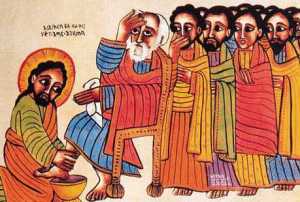
[Jesus] got up from the table, took off his outer robe, and tied a towel around himself. 
John 13:4

To invite people to look at, to wash, to care for our feet is to invite them to accept us as we are.
Wes Howard-BrookJohn’s Gospel & The Renewal Of The Church (1997)

In each of the four canonical Gospels, Jesus is portrayed in terms of kenosis, or self-emptying. In none of the canonical Gospels is the scandal of the cross removed in favor of the divine glory.
Luke Timothy JohnsonThe Real Jesus (1996)

For those just now tuning in, Western Christianity is in the midst of a massive intramural contest over what it means to follow Jesus. Fortunately & strategically, Holy Week re-calibrates us towards a creative & constructive imitation of Jesus’ life of service. If the various brands of Christianity (from evangelical to ecumenical, from Catholic to Charismatic, from fundamentalist to free thinking) can come together tomorrow and focus our respective energies & resources on acting out the Gospel script (washing one another’s wretched feet), we can realistically hope for a more compelling witness to our audacious claim that a redemptive Something pervades our existence.
Continue reading “The Towel Before The Tomb”

The ‘Liturgy of the Palms’ as Political Street Theater

Palm SundayBy Ched Myers, for Palm Sunday

Note: This is part of a series of Ched’s occasional comments on the Lukan gospel readings from the Revised Common Lectionary during year C, 2016.

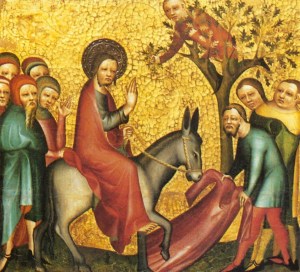
Luke’s Jerusalem narrative commences with the so-called “Triumphal Entry,” a misnomer for several reasons. For one, Luke’s version of the story omits the Hosannas and the palms—indicating that these are not the most important parts of the “Palm Sunday” parade (even though that’s all most First World Christians focus on). For another, this carefully choreographed political street theatre is designed to repudiate Messianic triumphalism.

Let’s take a careful look. Continue reading “The ‘Liturgy of the Palms’ as Political Street Theater”

The earth we are leaving for our children…The children we are leaving for our earth…

Wilderness WayBy Solveig Nilsen-Goodin

Just a few weeks ago, the Wilderness Way Children’s School (read: Sunday School…Wilderness Way style) opened its doors to invite children whose parents are not regularly participating in the life of the community. Why?

Imagine this…

Imagine a “Sunday School” program happening mostly outside.

Imagine a Sunday School program led by two well-paid (for the few hours a week they prepare for and work with our children), highly skilled and experienced teachers of children, who view their work with children as a calling. Continue reading “The earth we are leaving for our children…The children we are leaving for our earth…”

This Lent

romero.jpg

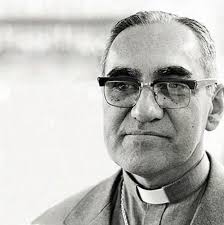
This Lent, which we observe amid blood and sorrow, ought to presage a transfiguration of our people, a resurrection of our nation. The church invites us to a modern form of penance, of fasting and prayer – perennial Christian practices, but adapted to the circumstances of each people

Lenten fasting is not the same thing in those lands where people eat well as is a Lent among our third-world peoples, undernourished as they are, living in a perpetual Lent, always fasting. For those who eat well, Lent is a call to austerity, a call to give away in order to share with those in need. But in poor lands, in homes where there is hunger, Lent should be observed in order to give to the sacrifice that is everyday life the meaning of the cross.

But it should not be out of a mistaken sense of resignation. God does not want that. Rather, feeling in one’s flesh the consequences of sin and injustice, one is stimulated to work for social justice and a
genuine love for the poor. Our Lent should awaken a sense of social justice.

  • Archbishop Oscar Romero


Outrageous Anointing

Mary AnointingBy Wes Howard-Brook and Sue Ferguson Johnson, commentary on the Gospel for Sunday, March 13, 2016

Of all the shocking aspects of Mary’s anointing of Jesus, Judas objects to the supposed waste of money. Why not first, though, object to her apparently shameless unveiling of her hair and intimate engagement with Jesus’ feet? As Lent comes to its climax, we enter into this wildly outrageous story. Continue reading “Outrageous Anointing”

Threatened With Resurrection

Julia EsquivelFrom Guatemalan poet Julia Esquivel:

It is something within us that doesn’t let us sleep,
that doesn’t let us rest,
that won’t stop pounding
deep inside…

…because in this marathon of Hope,
there are always others to relieve us
who carry the strength
to reach the finish line
which lies beyond death. Continue reading “Threatened With Resurrection”

All Are Welcome at God’s Party!

MAFA_SA_C_^_SATURDAY

By Wes Howard-Brook and Sue Ferguson Johnson, commentary on Luke 15, for March 6, 2016

There is probably no Gospel passage more beloved than Luke’s parable of the Prodigal Son. Henri Nouwen and others have rightly emphasized the image of the story’s father as the God of infinite mercy and forgiveness, who runs to meet repentant sinners before they can even confess. Yet, taken in the narrative context of Luke’s broader story, there are other themes in this parable that are important to the journey of Lent. Jesus’ parable is yet another Lucan image of the solution to the problem of exile: the practice of jubilee, with its comprehensive forgiveness and freedom from all the relational breaches that are the “fruit” of attachment to money. Continue reading “All Are Welcome at God’s Party!”

Unless we turn around from Empire, the victimization will continue

Fig TreeBy Ched Myers, for the 3rd Sunday of Lent

Note: This is part of a series of Ched’s occasional comments on the Lukan gospel readings from the Revised Common Lectionary during year C, 2016.

Somewhat strangely, the RCL reading this week moves backwards, from the end of Luke 13 on Second Lent to its beginning this Sunday, leapfrogging the poignant story of the “Bent Over Woman” in the middle of that chapters (which we’ll look at on the 14th Sunday after Pentecost, Aug 21st). Continue reading “Unless we turn around from Empire, the victimization will continue”

The Prophetic Script

bartBy Ched Myers, for the 2nd Sunday of Lent (Luke 13: 31-35

Note: This is part of a series of Ched’s occasional comments on the Lukan gospel readings from the Revised Common Lectionary during year C, 2016.

More than any other gospel writer, Luke portrays Jesus as using Israel’s prophets for his own interpretive lens. This theme stretches across the whole arc of Luke’s story, from its beginning where the coming promise of redemption comes “through the mouth of God’s holy prophets from of old” (1:70) to the Emmaus road epilogue, which stresses this traditions as a hermeneutic key to the problem of suffering: “Then beginning with Moses and all the prophets he interpreted to them the scriptures” (24:25-7; 44f). Continue reading “The Prophetic Script”