By Wes Howard-Brook and Sue Ferguson Johnson, commentary on the Gospel for Sunday, March 13, 2016
Of all the shocking aspects of Mary’s anointing of Jesus, Judas objects to the supposed waste of money. Why not first, though, object to her apparently shameless unveiling of her hair and intimate engagement with Jesus’ feet? As Lent comes to its climax, we enter into this wildly outrageous story. Continue reading “Outrageous Anointing”→
It is something within us that doesn’t let us sleep,
that doesn’t let us rest,
that won’t stop pounding
deep inside…
…because in this marathon of Hope,
there are always others to relieve us
who carry the strength
to reach the finish line
which lies beyond death. Continue reading “Threatened With Resurrection”→
By Wes Howard-Brook and Sue Ferguson Johnson, commentary on Luke 15, for March 6, 2016
There is probably no Gospel passage more beloved than Luke’s parable of the Prodigal Son. Henri Nouwen and others have rightly emphasized the image of the story’s father as the God of infinite mercy and forgiveness, who runs to meet repentant sinners before they can even confess. Yet, taken in the narrative context of Luke’s broader story, there are other themes in this parable that are important to the journey of Lent. Jesus’ parable is yet another Lucan image of the solution to the problem of exile: the practice of jubilee, with its comprehensive forgiveness and freedom from all the relational breaches that are the “fruit” of attachment to money. Continue reading “All Are Welcome at God’s Party!”→
Note: This is part of a series of Ched’s occasional comments on the Lukan gospel readings from the Revised Common Lectionary during year C, 2016.
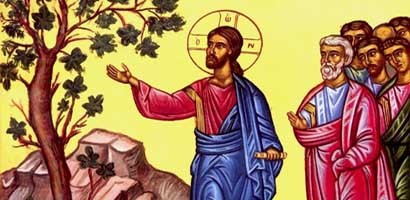
Somewhat strangely, the RCL reading this week moves backwards, from the end of Luke 13 on Second Lent to its beginning this Sunday, leapfrogging the poignant story of the “Bent Over Woman” in the middle of that chapters (which we’ll look at on the 14th Sunday after Pentecost, Aug 21st). Continue reading “Unless we turn around from Empire, the victimization will continue”→
By Ched Myers, for the 2nd Sunday of Lent (Luke 13: 31-35
Note: This is part of a series of Ched’s occasional comments on the Lukan gospel readings from the Revised Common Lectionary during year C, 2016.
More than any other gospel writer, Luke portrays Jesus as using Israel’s prophets for his own interpretive lens. This theme stretches across the whole arc of Luke’s story, from its beginning where the coming promise of redemption comes “through the mouth of God’s holy prophets from of old” (1:70) to the Emmaus road epilogue, which stresses this traditions as a hermeneutic key to the problem of suffering: “Then beginning with Moses and all the prophets he interpreted to them the scriptures” (24:25-7; 44f). Continue reading “The Prophetic Script”→
The church traditionally inaugurates Lent by reflecting on the “wilderness temptations” of Jesus. In preparation for his mission, Jesus follows a mysterious yet compelling calling to radical wilderness solitude. He fasts. He lives in the wild. He wrestles with spirits. (Above: Ivan Nikolaevich Kramskoy, “Christ in the Wilderness,” 1873.)Continue reading “Jesus on a Wilderness Vision Quest”→
So many of us wake up in the morning and eat a breakfast of food we don’t believe in and then drive a car we don’t believe in to a job we don’t believe in. We do things that we know are wrong, day after day, just because that’s the way the system is set up, and we think we have no choice. It’s soul-devouring. Kathleen Dean Moore, Professor of Philosophy at Oregon State University
A hundred days after the U.S. military drone bombed a hospital in Kunduz, killing 42 patients and doctors, and about an hour after I filled up my car for $1.53/gallon, Rev. Peterson shot me an anguished text:
How does one live in an oppressive system but not be of it? My clothes bare the label of oppression. My little retirement fund bares the gains/losses of corrupt capitalism.
For all of us with some semblance of privilege, working tirelessly for church renewal and social change, this is the question. We live in The Tension, a stressful, uncomfortable, inconvenient space often bombarded by guilt, shame, anxiety, fear and exhaustion. Continue reading “Living in the Tension”→
By Wes Howard-Brook and Sue Ferguson Johnson, Commentary on Readings for Feb 7, Transfiguration Sunday
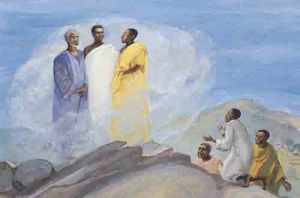
Then from the cloud came a voice that said, “This is my Son, my Chosen; listen to him!”
Our gospel this week finds Jesus and a few companions taking some time out on the earth for what Dorothy Day might have called “clarification of thought” or others have called “illumination.” Luke has just shown that the disciples don’t understand who Jesus is. In the wider narrative context, Luke has Jesus ever more clearly revealing that the divine power he embodies and offers to disciples is not that of the warrior “messiah,” but of the suffering Human One (9.20-26). But the disciples, like so many “Christians” through the ages, cling stubbornly to the hope that he would be the military leader who would remove the Romans by force (see Lk 24.21). Even worse, they seem utterly deaf to Jesus’ Good News of radically inclusive hospitality and leadership from below. Surrounding the Transfiguration scene are numerous situations where we see how out of tune they are with the song Jesus is singing. Consider this sequence of encounters: Continue reading “Transfiguration”→
To secure peace with justice, whether locally or globally, requires that peacemakers assume a double stance. On one hand, we must be close enough to a given conflict that we can identify the particularities of each party and situation, which calls for the approach of community organizers, social workers and pastors. On the other hand, we also need to step back enough to see the influence of larger historical, social and ideological forces, requiring the skills of social analysis and advocacy. Holistic peacemaking cannot ignore any of these competences or perspectives if it is to be transformative. And if we do not experiment with alternatives, we are left with the retributive solutions of sheriffs and the prison system, which merely manage the inevitable conflicts generated by a dysfunctional society.

 By Wes Howard-Brook and Sue Ferguson Johnson, commentary on the Gospel for Sunday, March 13, 2016
 From Guatemalan poet Julia Esquivel: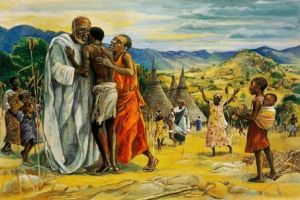
 By Ched Myers, for the 3rd Sunday of Lent
 By Ched Myers, for the 2nd Sunday of Lent (Luke 13: 31-35
 By Ched Myers, 1st Sunday in Lent (Luke 4:1-13)
 By Wes Howard-Brook and Sue Ferguson Johnson, Commentary on Readings for Feb 7, Transfiguration Sunday
 From Elaine Enns & Ched Myers in their 2nd Volume of
  Radical Discipleship