Alone

2cBy Tommy Airey

Born
on the edge of reservation
genocide, son of an old working,
smoking, drinking, distancing
immigrant. You were robbed of
intimacy, emotion, left with
nothing but the counterfeit world of
patriarchy–hiding, achieving,
planning, controlling. You were trained to
not take up too much space, to
stay out of conflict, to
play your role, dad hiding,
mom never confiding, neither
ever fighting. Continue reading “Alone”

Lent with Howard Thurman

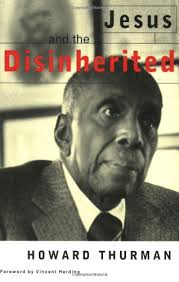
thurman.jpgBy Will O’Brien, Alternative Seminary, Philadelphia, PA

This Lent, I have using as a meditation guide Howard Thurman’s classic Jesus and the Disinherited. This book and other writings of Thurman, an African American scholar, theologian, and activist whom Vincent Harding called our “Black prophet-mystic,” were a spiritual taproot of the civil rights movement and continue to animate many people of faith who hunger and thirst for justice. Just in the first pages, his writing has revealed itself to be an unsettlingly relevant text for this season of repentance and metanoia.

Early in the book, Thurman recounts a visit to India in 1935 – a delegation of American students on a “pilgrimage of friendship.” One day, the principle of a Law College in Ceylon personally asked Thurman to have coffee. He posed a pointed question, addressing Thurman as an African American Christian: “What are you doing here?” Continue reading “Lent with Howard Thurman”

What “Empire” Adds

If Not EmpireBy Berry Friesen, originally posted to his blog on February 1, 2016
Does the word “empire” enter your conversations with friends, colleagues and family members?   Is it used in your place of worship?  Do you see it in the articles and books you read, the videos you watch?

When “empire” is part of your lexicon, here’s what also becomes part of your analytical framework.   Continue reading “What “Empire” Adds”

Weeds as a Model of Healing Broken Places

KyleMitchBy Kyle Mitchell

Having worked on an urban vegetable farm for the past 3 years, I’ve had the chance to encounter lots of things we affectionately call weeds. They mostly get a bad rap for stealing water, nutrients, and sunlight from the cultivated plants. They can certainly do this.

However, being a metaphor person, I’m constantly thinking about what things mean in my life. I first encountered weeds with an almost militant mindset. Continue reading “Weeds as a Model of Healing Broken Places”

Infinite Circles: Celebrating Female Friendship in the Bible and Beyond

By Cara Curtis, a lifelong Quaker, a student at Harvard Divinity School, and a fan of noodles of all kinds. This piece is part of the ongoing series on badass biblical women.IMG_3146

When I think about the idea of “badass women of the Bible,” my mind immediately jumps to the several courageous and fierce ladies of scripture who pull off daring and deeply powerful acts. The Magnificat is a downright badass poem. Esther was clearly not one to be messed with. Ruth has a whole book commemorating her faith and story. I celebrate these women in all of their strength and power, as well as the many others like them whose acts of faith and bravery were not preserved for us in the canon. But you know that saying, “behind every successful man is a strong and wise woman”? In my experience, this is just as true of successful women–in fact, I’ve often found that it takes a whole community of women encouraging and supporting each other for acts of deep caring, bravery, justice, and truth telling to become possible. Simply put, badass women help each other be more badass! Continue reading “Infinite Circles: Celebrating Female Friendship in the Bible and Beyond”

Eating Cookies

images“When I was four years old, my mother used to bring me a cookie every time she came home from the market. I always went to the front yard and took my time eating it, sometimes half an hour or forty-five minutes for one cookie. I would take a small bite and look up at the sky. Then I would touch the dog with my feet and take another small bite. I just enjoyed being there, with the sky, the earth, the bamboo thickets, the cat, the dog, the flowers. I was able to do that because I did not have much to worry about. I did not think of the future, I did not regret the past. I was entirely in the present moment, with my cookie, the dog, the bamboo thickets, the cat, and everything.

It is possible to eat our meals as slowly and joyfully as I ate the cookie of my childhood. Maybe you have the impression that you have lost the cookie of your childhood, but I am sure it is still there somewhere in your heart. Everything is still there, and if you really want it, you can find it. Eating mindfully is a most important practice of meditation. WE can eat in a way that we restore the cookie of our childhood. The present moment is filled with joy and happiness. If you are attentive, you will see it.”

  • Thich Nhat Hanh, Peace Is Every Step

#ReclaimMLK

ReclaimMLKBy Ric Hudgens, January 27, 2015

Last night at Northwestern
Michelle Alexander wielded words
like swords slicing
shrouds of persistent illusion.
#ReclaimMLK.
Not MLK the reformer
pushing legislation
only making things “better”
never making them whole.
Rather the Rev(olutionary) King
preaching the words of Jesus,
setting the captive free,
overturning the tables,
the first last the last first.
The charter of liberty for
an America that does not yet exist.
University admins, Gov officials,
parents and children of privilege,
ovate her celebrity before and after,
but don’t feel the shaking
of the foundations. When
such words scare them,
when they feel their threat,
when they hear the storm
rattling the windows,
see waves crashing at the door,
then we will know
they truly understand.

Continue reading “#ReclaimMLK”

Remaining Awake

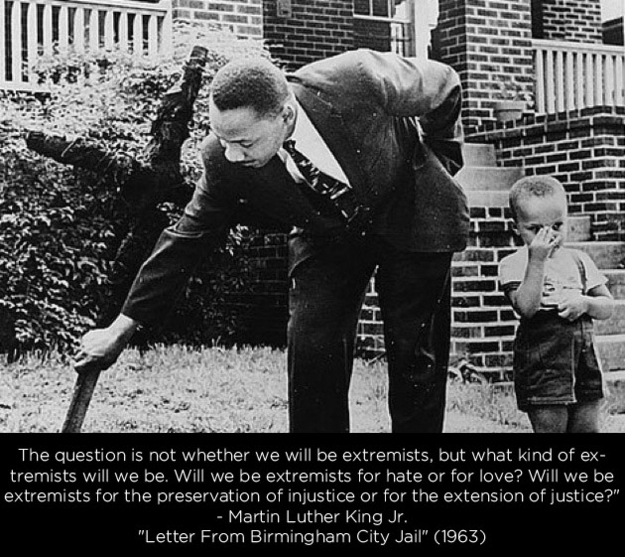
Dr. King1From Dr. King’s last sermon “Remaining Awake Through a Great Revolution,” March 31, 1968:

We must all learn to live together as brothers or we will all perish together as fools. We are tied together in the single garment of destiny, caught in an inescapable network of mutuality. And whatever affects one directly affects all indirectly. For some strange reason I can never be what I ought to be until you are what you ought to be. And you can never be what you ought to be until I am what I ought to be. This is the way God’s universe is made; this is the way it is structured.
——————–
Somewhere we must come to see that human progress never rolls in on the wheels of inevitability. It comes through the tireless efforts and the persistent work of dedicated individuals who are willing to be co-workers with God. And without this hard work, time itself becomes an ally of the primitive forces of social stagnation. So we must help time and realize that the time is always ripe to do right.