Suburban Radical Discipleship?

JPerkFrom Dr. James Perkinson, Professor of Ethics and ​Systematic Theology at Ecumenical Theological Seminary, Detroit, MI:

I am very close to arguing — as a kind of hermeneutic strategy of trying to occasion conversion by way of “shock” — that I don’t think it is possible to live in the suburbs (or their commuter-friendly equivalent of gentrified and gated “enclosures” inside the city itself) and be Christian. At least, not to live “peacefully” in the suburbs and try to make sense of being a disciple only on its own terms. If one lives there and regularly raises issue with who is being excluded from there, that is a different story. If one advocates for low-income housing, or homeless shelters, or HIV-treatment centers, and tries to make apparent the way a “suburb” constitutes a kind of simultaneous realization of economic appropriation (of resources from elsewhere) and social exclusion (of people whose class position and racial affiliation make them “suspect”), then that is a serious form of witness. But simply to live in a suburb “neutrally” is merely to participate in — and perpetuate — a quintessential American fiction of innocence. The suburb is not, and has not ever been, a neutral entity. Neither is it innocent.

The Root of Who We Are

Wen StephensenFrom Wen Stephenson’s What We’re Fighting For Now Is Each Other (2015):
What I have found, in the stories of those profiled here, and many others, is that the climate struggle, like so many struggles of the past, is essentially a spiritual struggle—it forces us to confront the deepest, most difficult questions about ourselves. The climate catastrophe is so fundamental that it strikes to the root of who we are: it’s a radical situ- ation, and it requires a radical response. But not radical, necessarily, in the conventional sense of ideology. Rather, it confronts us with a kind of radical necessity—a moral necessity. It requires us to wake up—to face the facts, to find out who we really are—and to act. In some cases, to lay everything on the line: our relationships, our reputations, our careers, our bodies, maybe even our lives.

Incarnating the Reign of God

DoveBy Wes Howard-Brook and Sue Ferguson Johnson, Commentary on Readings for Jan 10, Baptism of the Lord
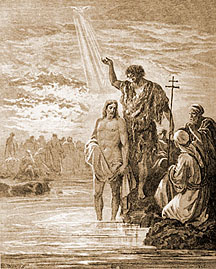
[John] proclaimed, “The one who is more powerful than I is coming after me; I am not worthy to stoop down and untie the thong of his sandals. I have baptized you with water; but he will baptize you with the Holy Spirit.” In those days Jesus came from Nazareth of Galilee and was baptized by John in the Jordan. : And just as he was coming up out of the water, he saw the heavens torn apart and the Spirit descending like a dove on him. And a voice came from heaven, “You are my Son, the Beloved; with you I am well pleased.” (Mark 1.7-11)
Continue reading “Incarnating the Reign of God”

Annunciation/ Magnificat/ Epiphany

Sunflowers.jpgMeg Arlyn was raised Evangelical, educated Quaker, and spends her Sundays with the Mennonites. She lives in Oakland.
Annunciation

I am crossing San Pablo
Avenue at twilight and suddenly
the sky is riven with angels
one of whom
falls at my feet.

Look out!
says the man
on the bike.
You’re so beautiful,
that angel just fell from the sky Continue reading “Annunciation/ Magnificat/ Epiphany”

Enfleshing the Word

John the WordBy Wes Howard-Brook and Sue Ferguson Johnson, commentary on readings for Jan 3, the 2nd Sunday after Christmas

Note: This is part of a series of Wes & Sue’s occasional comments on the Lukan gospel readings from the Revised Common Lectionary during year C, 2015-16.

In the beginning was the Word, and the Word was with God, and the Word was God….the Light shines in the darkness and the darkness did not overcome it…The true light, which enlightens everyone, was coming into the world.
John 1.1, 5, 9

To those who received him, who trusted into his name, he gave power to become children of God.
John 1.12

In the ongoing Christmas season, we celebrate John’s Gospel’s powerful beauty of the Incarnation: the Word of God, made flesh in the person of Jesus, the crucified and risen One. In a time of darkness—on the earth, in the world and often in our own lives—God’s unquenchable Light continually shines Life into being. That Light, in and through Jesus, is the enlightening gift offered to everyone.
Continue reading “Enfleshing the Word”

Why the Empire Needs Terrorism

Berry FriesenBy Berry Friesen, Originally Posted to Bible-And-Empire.Net

Imagine a political entity that can constantly watch everyone and everything on Earth, listen to/read every digitally-transmitted message, reach into the safety of private homes anywhere and murder the people who live there, incinerate any military/industrial target with the flick of a switch, and fabricate slanders that are repeated publicly a billion times a day.

You’ve just imagined the US-led empire.
Continue reading “Why the Empire Needs Terrorism”

Getting to the Street

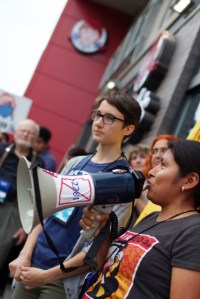
JuliaFrom Julia de la Cruz, a farmworker, an organizer, and a member of the Coalition of Immokalee Workers–this is her response, in an interview with Sojourners Magazine, to the question: Does it help farm workers if consumers stop purchasing products that are grown in bad working conditions?

More and more we hear this idea of voting with your fork: this idea that consumers affect conditions based on how they use their dollar. But the truth is that if somebody chooses to refrain from buying a good, the impact really won’t be felt by corporations such that they’ll be forced to change their policies. But corporations will be impacted and forced to change their policies when a worker-led campaign forces them.

So we’d ask consumers to build consciousness by listening to farm workers and their experience and their analysis of the food system that nourishes each of us. The second thing we’d ask for is commitment—and that can mean a lot of things, but it definitely means getting to the street and protesting the corporations that have turned a blind eye to the abuses they have perpetuated.

An Upside Down World

upside down worldBy Joyce Hollyday

A frigid wind sent snow dancing and swirling through the streets of Washington, DC, that Christmas Eve. Shopping carts and paper bags loaded with years’ worth of collected string, cans, broken umbrellas, and other street items had been dragged in out of the cold and were parked in the foyer of the church that served as an overnight shelter. The women who owned them were finishing a dinner of soup and bread, made special by dozens of sugar cookies that had been baked and decorated by the church’s children. Continue reading “An Upside Down World”