The Wilderness Way: 7 Sustainable Practices

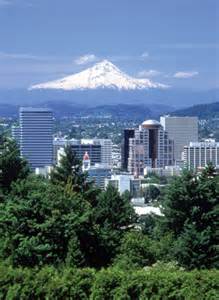
portlandThe Wilderness Way Community (Portland, OR) is a practice-oriented community pledged to be “guided by the wisdom of Nature, the undomesticated Jesus and his movement, and the wilderness tradition in which Jesus was grounded.” They share a common life by committing to live by a common set of daily practices. These practices flow from their mission statement and shape their life according to values other than those of the marketplace or the battlefield.

Over the years their practices have changed as the community has changed. For several years they used these Seven Sustainability Practices to shape their lives. For many of them, those once-new practices have now become simply part of how they live their lives.
Continue reading “The Wilderness Way: 7 Sustainable Practices”
Reinhabiting Place: The Work of Bioregional Discipleship

Tell me the landscape in which you live and I will tell you who you are.
Ortega Y Gasset

From Matthew W. Humphrey of the Little Campbell River Watershed (right), working to integrate the life of faith with the practices of caring for creation. Since earning an MATS from Regent College in Vancouver, Humphrey has worked with A Rocha Canada, a Christian environmental stewardship organization (www.arocha.ca), as both an educator and practitioner. Alongside overseeing various experiments in sustainable agriculture, Humphrey teaches in churches, colleges, and community settings. In his free time, he enjoys reading, listening to bluegrass, tending his flocks, and spending time outside with his wife, Roxy, and two children, Abigail and Elijah. This is an excerpt from a longer piece that appeared in The Other Journal, which we encourage readers to read in its entirety.
————————
Continue reading “Reinhabiting Place: The Work of Bioregional Discipleship”

Watershed Discipleship: Toward A Bioregional Food Covenant

Todd Wynward writes, farms, teaches and leads wilderness trips in northern NM. He is an animating force behind TiLT, an intentional discipleship co-housing community in the Rio Grande Watershed. His new book, Rewilding the Way, is to be published by Herald Press in 2015.

This is the 5th post in an 8-part series every Friday, covering unique experiments in Watershed Discipleship.
—————-
We are making choices that will affect whether beings
thousands of generations from now
will be able to be born sound of mind and body.

Joanna Macy

To what extent can we thrive within the bounty—and the boundaries—of our bioregions? If we are to survive much longer as a species, many of us addicted to unbounded affluenza need to make this question central to our lives. As David Orr writes:

It makes far better sense to reshape ourselves to fit a finite planet than to attempt to reshape the planet to our infinite wants.

How can we—habituated to global gluttony—begin to reshape ourselves, as Orr suggests? Let me suggest a practical challenge that might be contagious: The 25/75/100 Bioregional Food Covenant [bioregionalfoodcovenant.org]. What’s daunting about this is that I’ve never done it before. What’s inspiring about this is that millions of people across the globe are already doing it, whether they’re conscious of it or not. To join, an individual would make this pledge: “By the year 2025, I will source 75% of my food from within 100 miles.”

Continue reading “Watershed Discipleship: Toward A Bioregional Food Covenant”

Watershed Discipleship: Transformation Through Picking Berries

Watershed Discipleship Fridays continues with this piece from Kyle Mitchell, who lives with his wife Lynea on the 3rd floor of an old house in Cleveland. They have a couple egg-laying hens in the backyard and tons of red wiggler worms. Kyle spends his days working alongside folks with developmental disabilities on a 2-acre urban farm down the street from his house. In his spare time, he works alongside Lynea in the 2 youth gardens she started in the neighborhood. They are both passionate about growing food, spreading that knowledge, and figuring out ways to get healthy food to folks that don’t have access to it.
——————–
A few years back, I had a dramatic conversion experience. Someone introduced me to the act of picking berries. Continue reading “Watershed Discipleship: Transformation Through Picking Berries”

Watershed Discipleship: A People’s History of Elkhart, Indiana

This piece, by Katerina Friesen, is part of a series of Friday posts on watershed discipleship. Katerina hails from central California, and is currently a student in theology and peace studies at Anabaptist Mennonite Biblical Seminary. She lives in the Prairie Wolf Collective, a co-housing community in Elkhart, with five friends, a cat named Zip, and the newest resident: a skunk that just made its home in the woodpile.

————————-

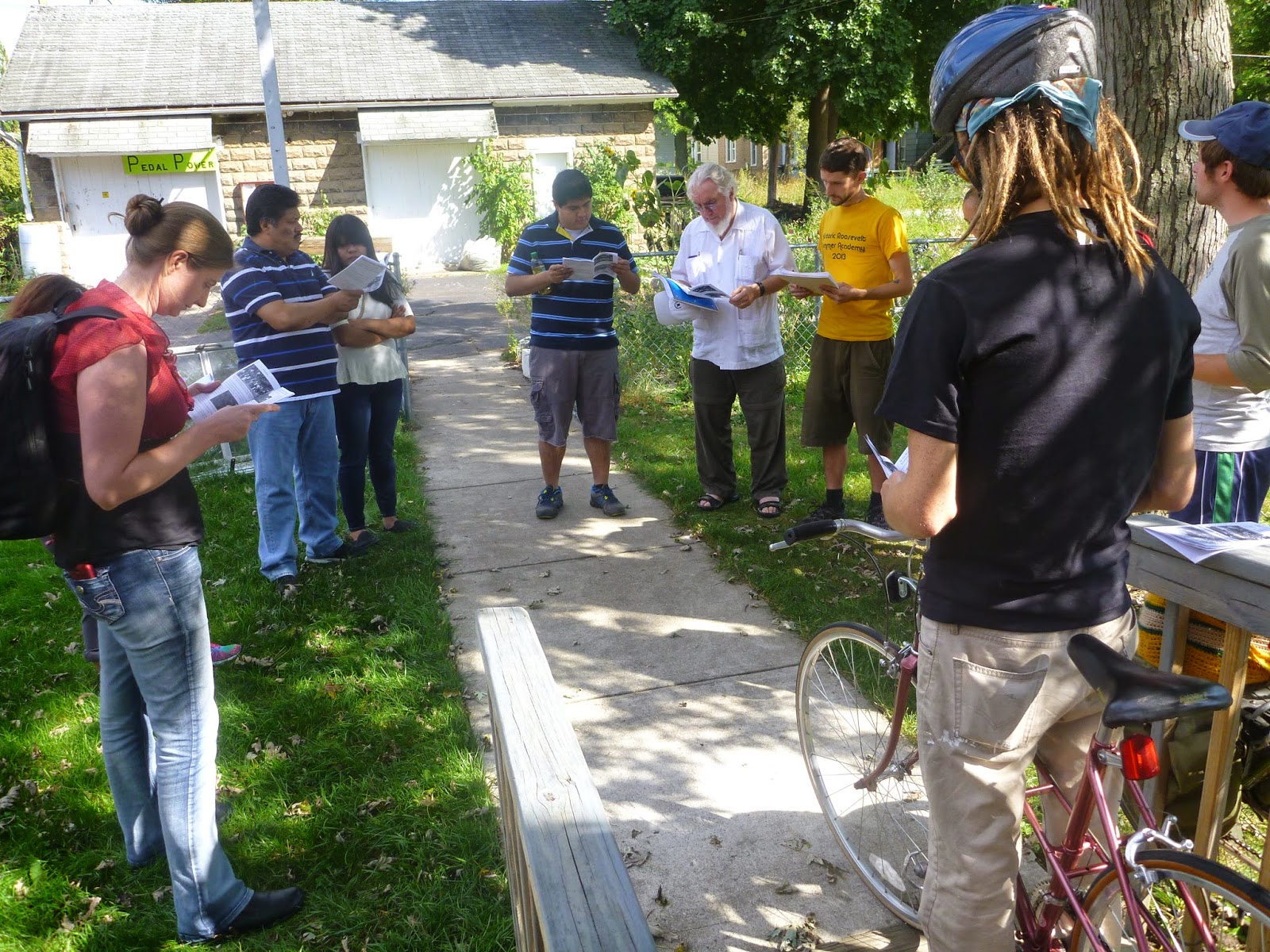
On a sunny afternoon in late September, I joined a group of neighbors and friends for the 6th annual People’s History tour of Elkhart, Indiana. The tour, in the tradition of Howard Zinn’s classic subversive book, A People’s History of the United States, highlights the often unheard stories of local folks, their memories of south-central Elkhart, the struggles here that must not be forgotten, and people’s ongoing work for change (above: Participants in the tour begin with recognition of the Potowotami peoples whose ancestral lands we inhabit). Continue reading “Watershed Discipleship: A People’s History of Elkhart, Indiana”

Carnival de Resistance

Carnival Mask Image

Beginning today, we are excited to hold Mondays as a day to celebrate and give voice to the role of art in discipleship. Today we highlight the Carnival de Resistance!

The Carnival de Resistance is an arts carnival, unconventional school and “village demonstration project” that focuses on ecological justice and radical theology. The Carnival Crew seeks to experiment with how art can teach, play can inspire, practices can transform, and resistance can be embodied. They intentionally look to the wisdom of indigenous and other earth based cultures whose music, spirituality and life-ways preserve a liberating way to resist the dominant culture of oppression. The Carnival de Resistance first launched in the fall of 2013, sequentially residing in and building the Carnival world in two church lots in Virginia. In the summer of 2014, they re-built the Carnival experiment in the context of the Wildgoose Festival.

Continue reading “Carnival de Resistance”

the strait is not straight

In a paper he delivered at the AMBS Rooted & Grounded Conference last month, the Ecumenical Theological Seminary professor Jim Perkinson reflected on the deep meaning found in the renaming of his beloved Detroit River Watershed in 1701:

“Wawiatonong” the Ojibwa say, the place “where the river goes around,” a name conveying at once respect and locale and abundance. I, however, write from a Detroit become the epitome of thirst and lack. Three centuries ago, the Jesuits came around the bend and re-named the Ojibwa curve a “strait,” “de-troit,” the link between Lakes Erie and Huron, shifting its orientation toward the priority of trade and commodities, a mere conduit in the circuits of global capital, and now the country’s most heavily trafficked “commercial” border.

Continue reading “the strait is not straight”