Wild Lectionary: Baptized in Dirty Water

08b16ba9-5421-4489-912d-90b3f2b9ff43Proper 10(15) B
By Tevyn East and Jay Beck

Some were saying, “John the baptizer has been raised from the dead.” Mark 6:14

No shape. No symbols. Everything fluid. Everything wind and water.
God created chaos.
Swirling swamp potential of formlessness.
Only out of this swirling chaos can any creation be born.

I see.
I hear.
I feel. Continue reading “Wild Lectionary: Baptized in Dirty Water”

The Means

Helen Moore
Detroit legend Queen Mother Helen Moore orders a table for one from Michigan Governor Rick Snyder (PC: Jennifer Teed)

By Tommy Airey

This is the sequel to The Ways, posted on the day after the Spring Equinox 2018.

I won’t apologize.  But I must confess. I am a “biblical Christian.” Yet, in this post-colonial conversation, I know I can’t just testify. I must specify. The spiritual movement of the Hebrew prophets and Jesus is fundamentally a descent. The bible, like a broken record ever-resisting imperial feedback, plays a prejudiced tune that sides with the poor and oppressed and demonized and scapegoated. To be clear, the way of Jesus does not have the patent on the prophetic path less plodded. It is simply the route I’ve chosen. Or perhaps it has chosen me. Continue reading “The Means”

Rekindled by Ritual

bonfire.jpegBy Joyce Hollyday

How to hold the heartbreak and the outrage? Hundreds of babies and toddlers, schoolchildren and teenagers wrenched from the embrace of their parents, many now sobbing inconsolably in immigrant detention centers—some unbelievably lost in the system. My friend Rosalinda, who used to earn just pennies an hour working in a U.S. factory on the Mexican border, who had a nephew who was murdered there, felt a need to tell me her own family’s story of escape from desperate poverty and rampant violence. She related a harrowing saga of vulnerable hiding places, grueling river and desert crossings, capture and release by Border Patrol agents, and a second attempt—all endured so that her children might have safety, enough food, and the chance to grow up. It is unimaginable to think that they might have been stolen from her here. Continue reading “Rekindled by Ritual”

A Prayer for this Disaster

36361372_10160523878850174_6146160486191726592_o
Photo by Meg Marshall

By Micah Bucey

You are trying to kill our joy,
But you have no idea
How strong disaster makes us.

Joy is permanent, not temporary or erasable,
As it seems civil rights are.
Joy is sturdy, not weak and shifty,
As it seems our leaders are.
Joy is deep, not shallow or fleeting,
As it seems our democracy is.

Continue reading “A Prayer for this Disaster”

Strategies of a Subversive Movement

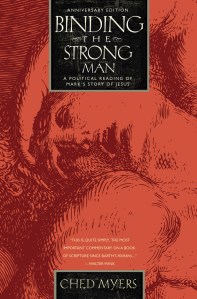
BindingWe continue our celebration of the 30th anniversary of Binding The Strong Man, Ched Myers’ political reading of Mark’s Gospel.  Today’s passage is Mark 6:1-13.

There is no indication that Jesus’ “orders” are unique to this mission; they are for “the way” (eis hodon)–that is, paradigmatic of discipleship lifestyle (6:8).  Their narrative significance lies not in some model of heroic asceticism (which would contradict Jesus’ ambivalence toward, e.g., fasting), but in the emphasis upon the utter dependence of the disciples upon hospitality.  The “apostles” (so designated for the only time in Mark upon their return from the mission in 6:30) are allowed the means of travel (staff, sandals) but not sustenance (bread, money bag and money, extra clothes).  In other words, they, like Jesus who has just been renounced in his own “home,” are to take on the status of a sojourner in the land.  We might note that the “donning of sandals” as a Markan metaphor for discipleship was missed by both Matthew (who forbids them, Mt 10:10) and Luke (who omits the reference, Lk 9:3). Continue reading “Strategies of a Subversive Movement”

What Radical Change Would Require

ZinnFrom the conclusion of “The Coming Revolt of the Guards,” chapter twenty-four of Howard Zinn’s classic A People’s History of the United States of America:

Let us imagine what radical change would require of us all.

The society’s levers of powers would have to be taken away from those whose drives have led to the present state–the giant corporations, the military, and their politician collaborators. We would need–by a coordinated effort of local groups all over the country–to reconstruct the economy for both efficiency and justice, producing in a cooperative way what people need most. We would start on our neighborhoods, our cities, our workplaces. Work of some kind would be needed by everyone, including people now kept out of the work force–children, old people, “handicapped” people. Society could use the enormous energy now idle, the skills and talents now unused. Everyone could share the routine but necessary jobs for a few hours a day, and leave most of the time free for enjoyment, creativity, labors of love, and yet produce enough for an equal and ample distribution of goods. Certain basic things would be abundant enough to be taken out of the money system and be available-free–to everyone: food, housing, health care, education, transportation. Continue reading “What Radical Change Would Require”

Building a Progressive Populism

Clancy
June 11, 2018 in Olympia, Washington (PC: Clancy Dunigan)

An excerpt from Jonathan Matthew Smucker’s “The Establishment is not a Viable Candidate,” originally posted on The New Internationalist site in April 2017 (the entire article is very much worth reading–more relevant than it was fifteen months ago!):

Compared to half a century ago, we are a weakened and fragmented civil society, unaccustomed to large-scale organized collective action. What remains of the US Left is paralyzed by an unprecedented class-based insularity. In both liberal professional and edgy radical subcultural circles, this insularity typically manifests as a kind of ‘enlightened elitism’ that tends to repel the uninitiated. Over the past few decades a new category called activism has emerged in place of civics and politics. Civics and politics imply a public sphere, a common terrain, and a shared responsibility. Activism, on the other hand, may concern itself with public issues, but it organizes itself along the contours of neoliberalism’s designs – as a private space for self-selecting individuals, typically from middle-class backgrounds. As such, activism often becomes more concerned with maintaining itself as an enclave than with actually mounting a political challenge to contest the direction of society and the state. Labour unions remain an important exception to this pattern, and their decline has added profoundly to the weakening of progressive political power in the US over the past half-century. Continue reading “Building a Progressive Populism”

Wild Lectionary: Wild and Unpredictable Incarnate Word

onondaga
Photo credit Holly Rockwell

Proper 9 (14) B
7th Sunday after Pentecost
Mark 6:1-3

By Holly Rockwell

 Jesus left that place and went to his hometown . . . he began to teach in the synagogue, and many who heard him were astounded.   They said, “Where did this man get all this? What is this wisdom that has been given to him? What deeds of power are being done by his hands! Is not this the carpenter, the son of Mary and brother of James and Joseph and Judas and Simon. Aren’t his sisters here with us?” And they took offense at him.

“Where did this man get all this?”

The townspeople hear and comment on Jesus’ wisdom, note his healing power, and are “astounded.” And still they are blinded by what they think they already know. Continue reading “Wild Lectionary: Wild and Unpredictable Incarnate Word”

A Mourn-In and Day of Fasting

Carvans to the BordersFrom Ruby Sales and Rev. Jacqui Lewis, who, today, begin the Caravans to the Borders Movement by facilitating a Mourn-In and a Day of Fasting at the Cayuga Center in New York City to shed light on the inhumane conditions, deprivation and homelessness that asylum seekers and refugees endure in 21st century sites of terror called detention centers, in addition to shedding light on the sexual crimes against Brown and Black girls by guards and others in the immigration industrial complex:
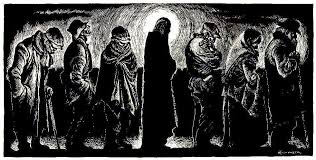
We fast to begin Caravans to the Borderlands where we navigate the terrain necessary to redeem the soul of America from its historical sins: the dehumanization, commodification, captivity, fragmentation, criminalization, state sanctioned rape, psychological terrorism, spiritual injury and economic exploitation of Black and Brown bodies. These assaults bind us together because they invade all of our lives despite our social location. Therefore, this is the common ground that will shape and universalize our movement.

We will not only mourn and fast, we will celebrate and resurrect the cultural resources that generations of all colors have developed and used in freedom struggles. We will unveil a list of demands to the government, and we will not rest until they are met.

Continue reading “A Mourn-In and Day of Fasting”

Is Small Always Beautiful?

indexBy Will O’Brien

A few years ago I was visiting good friends at an intentional Christian community in a large city.  This was a community I dearly loved: For many years, persons from privileged backgrounds, following Jesus’ call, had served, lived with, and developed ministries with the folks who lived on the streets of that city.  They engaged in powerful and creative prophetic witness to the compassion and justice of God, insisting on a commitment to struggle with society’s most marginalized persons.  These good saints had taught me, inspired me, challenged me, and emboldened my faith in countless ways. Continue reading “Is Small Always Beautiful?”