Blessed Assurance: Call to the Table in the Face of Terror

ChildrenBy Ken Sehested

One important thing that hasn’t been said this week [about the savagery of separating of children from parents at the US-Mexican border] is that this Department of Justice policy change is in fact a form of terrorism.

The point of terrorism isn’t killing people. Terrorists make strategic use of aggressive trauma to spread fear for the purpose of affecting social or political objectives. Look up the FBI’s definition.* Continue reading “Blessed Assurance: Call to the Table in the Face of Terror”

Hauling the Sanctuary on to the Street

Marian (1)By its simple public character a measure of light is directed upon an otherwise hidden and inconspicuous evil. By it an aspect of the historical crisis is expressly identified.  A kairos moment of decision for the community of faith is named and commended and acted upon.
Bill Wylie Kellermann, Seasons of Faith and Conscience: Kairos, Confession, Liturgy (1991)

More than a quarter century ago, Detroit native and ordained United Methodist Bill Wylie-Kellmann coined the phrase “liturgical direct action” to describe a brand of Christian witness that goes beyond charitable giving and moves outside the church building to expose and resist the powers that be.  Now 70 and retired from formal ministry, Bill is still hauling the sanctuary out on to the street.  Yesterday, in downtown Detroit, he joined 250+ friends and faithful in the final moral Monday of the national Poor People’s CampaignContinue reading “Hauling the Sanctuary on to the Street”

Wedding Poem

crescent_moonBy Bill Wylie-Kellermann
For Joanna and Eitan, August 25, 2010

When the half-moon hangs
faint in the mid-day sky
and earth already turns toward dusk
make a wedding

When the city, faint and far, cracks and cries
and blood forgotten runs beneath the streets
make a wedding

When earth and sea gasp for air
when the heat is on
and dread would rise
make a wedding Continue reading “Wedding Poem”

Like a Mustard Seed

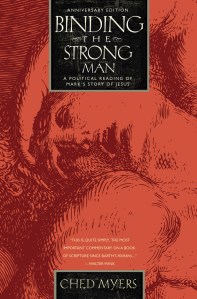
BindingToday, we continue our celebration of the 30th anniversary of Binding The Strong Man, Ched Myers’ extraordinary political reading of Mark’s Gospel.  Each Sunday, we will post excerpts from Myers’ comments on the lectionary reading of the day.  Today’s passage is Mark 4:26-34.

He also said, “With what can we compare the kingdom of God, or what parable will we use for it? It is like a mustard seed, which, when sown upon the ground, is the smallest of all the seeds on earth; yet when it is sown it grows up and becomes the greatest of all shrubs, and puts forth large branches, so that the birds of the air can make nests in its shade. (Mark 4:30-32)

In the famous parable of the mustard seed Mark one last time expands upon the theme of sowing in the earth (4:30-32).  There can be no question that this similitude concerning the disproportion between the seed and the mature plant is meant to instill courage and hope in the small and fragile discipleship community for its struggle against the entrenched powers.  As in 4:29, the appended scriptural citation places the parable firmly within a political context.  Mark adopts the conclusion of Ezekiel’s cypress tree parable for his own: the “small sprig” planted by Yahweh will bear fruit, and its branches will give shelter to birds (Ezekiel 17:22f).  In late biblical literature the sheltering branch was a common metaphor for political hegemony.  Daniel explains the image to Nebuchadnezzar: Continue reading “Like a Mustard Seed”

Planting Their Work In Community

Ruby SalesAnother compelling post “From The Front Porch” of Ruby Sales, co-founder of The SpiritHouse Project

During the Southern Freedom Movement we used the term freedom high to refer to participants who flitted from action to action without planting their feet in any community. Instead they sought the thrill of the moment. Therefore their work did not bear fruit.

Today freedom high seems to describe what I am observing as activists move from one action to the next without planting their work in community. Continue reading “Planting Their Work In Community”

Into this River: For your baptisms Ira and Cedar from your parents

baptismWritten by Lydia Wylie-Kellermann
with  Erinn Fahey, Lucia & Daniel Wylie-Eggert

For the baptisms of Ira Cole and Cedar Martin
June 11, 2017

With the swallows in quick flight
The willows making music in the wind
The movement of the water at our feet
And a circle of people we love
We step into this river Continue reading “Into this River: For your baptisms Ira and Cedar from your parents”

Wild Lectionary: Where the Mustard Seed Grows

IMG_2066.JPGOn the Road to Golgotha

Proper 6 (11) B
4th Sunday after Pentecost

Mark 4:30-32

By Anne Ellis

The day was beautiful, the strangely liminal day that is Holy Saturday. Good Friday had come and gone and we awaited the Good News of the Empty Tomb. Knowing it would come made the day of waiting oddly anticipatory, there was an air of excitement and without realising it we instinctively moved  towards joy. We don’t like to feel the pain and suffering of Good Friday any longer than we absolutely have too, so it’s easy to slip and forget that those alive and grieving on that first Holy Saturday so long ago had no idea how the story would continue. Continue reading “Wild Lectionary: Where the Mustard Seed Grows”

When They Call You A Terrorist

When They Call YouBy Tommy Airey

In our hyper-connected world, a buffet of spiritual practices abound. One immediately thinks of meditation, contemplative ecology, yoga, fasting, sabbath, jubilee, self-reflective bible study, liturgical direct action, poetry, therapy, 12-step recovery, mutual edification and confession. Now is a better time than ever for the somewhat privileged people of faith and conscience among us to fast-pass the practice of attentive listening to the front of the line. After all, Spirit moves when the marginalized and muted are given voice—those who are Women, who are Black and Brown, who are Queer, who hail from Somewhere Else. Continue reading “When They Call You A Terrorist”

The Violence Happening in Our Midst

Clancy Dunigan
The Poor People’s Campaign resists and rises above systems of oppression in Olympia, Washington (PC: Clancy Dunigan)

The Poor People’s Campaign keeps on rolling. This is from Jeremy Porter in Kentucky:

There is a long history of nonviolent civil disobedience in this country and around the world. The goal is not to be arrested, but to bring attention to the violence happening in our midst. If we get arrested on the road to justice, then we are willing. This violence includes: People without dignified affordable housing (where an individual in KY has to work 77 hours a week on minimum wage just to afford a two bedroom apartment), the 40% of homeless youth who are queer, 200,000 people who die in this country annually from lack of wealth, 1 in 5 KY children who don’t know where their next meal will come from…these are just the tip of the iceberg of violence happening daily.

Our goal in the Kentucky Poor People’s Campaign: A National Call for Moral Revival is to wage peace and justice against this violence, but first people must know it exists…and so we name it and make it known through nonviolent moral fusion direct action, which sometimes means risking the breaking of a law to bring attention to the unjust laws all around us.

What Remains

psalmBy Dee Dee Risher

For her 40th birthday, my friend, artist Michaelanne Harriman Helms asked a group of artist friends to spend a year reflecting on Psalm 90. We all did work—some of it visual art, some of it written. She asked me to write on the themes that came up for me, sparked by the psalm. For me, that became a three-part poem. But for our broad community at Radical Discipleship, I have adapted that poem into this psalm-prayer. I suggest reading Psalm 90, then this redaction of my poem.

To gain a heart of wisdom, I must
no longer
number my days:
release the clock that haunts
my small self,
lusting after illusions of influence
which will decay, scatter, leave no mark Continue reading “What Remains”