Abolition Spell (summer solstice)

015D4709-872B-4C04-8011-54999221350C-300x300.jpegBy adrienne maree brown. Re-shared from her blog.

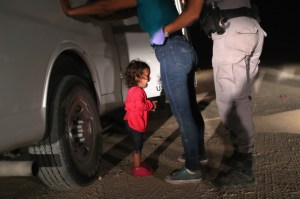
the other small thing i can offer is an abolition spell, for siwatu, for the babies at the border, for their families, for all political prisoners, for all nonviolent offenders, for all those who have caused harm and are not being helped to find a different way.

all that is light
break bars between teeth
grind bricks down to dust
explode a sunscale life force
in each direction
until the cages shed like dead skin Continue reading “Abolition Spell (summer solstice)”

The Other Side

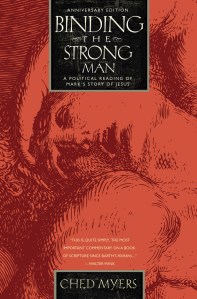
BindingWe continue our celebration of the 30th anniversary of Binding The Strong Man, Ched Myers’ political reading of Mark’s Gospel. Mark, according to Myers, represents a dissenting socio-political movement.  As the narrative continues, Jesus breaks through the social and economic barriers to the realization of human solidarity.  Today’s passage is Mark 4:35-41.

“On that day, when evening had come, he said to them, ‘Let us go across to the other side.’ And leaving the crowd behind, they took him with them in the boat…”–Mark 4:35-36

…the two sides of the Sea of Galilee symbolize Jewish and gentile territory, and the two major boat journeys represent the crossing from one side to the other.

…Throughout the Gospel, Mark is far more interested in articulating geo-social “space” in terms of narrative symbolics than actual place-names.  Indeed, it is not impossible that Mark may have intentionally dissociated the coordinate “other side” from a literal correspondence with eastern and western shores of the sea;  straining the geographical credulity of the sea narrative would have forced his first readers to focus upon the journeys as symbolic action (which is their purpose) rather than upon details of marine transit around the Sea of Galilee (which is not).  Continue reading “The Other Side”

The Major Philanthropists of Our Society

BarbaraFrom Barbara Ehrenreich’s Nickel and Dimed: On (Not) Getting By in America (2011):

When someone works for less pay than she can live on—when, for example, she goes hungry so that you can eat more cheaply and conveniently—then she has made a great sacrifice for you, she has made you a gift of some part of her abilities, her health, and her life. The “working poor,” as they are approvingly termed, are in fact the major philanthropists of our society. They neglect their own children so that the children of others will be cared for; they live in substandard housing so that other homes will be shiny and perfect; they endure privation so that inflation will be low and stock prices high. To be a member of the working poor is to be an anonymous donor, a nameless benefactor, to everyone else.

Why is Grandpa in Jail?

33116241_10214353738810852_6880318968586829824_oBy Lydia Wylie-Kellermann

I wrote this as a children’s book for Isaac during the Poor People’s Campaign. He was very concerned about why Grandpa kept going to jail when we were also teaching about how we dont believe in jails and prisons. So, I wrote this to try to explain it to him. We printed it out and he and Cedar and Ira and their friend helped illustrate it as a birthday gift to my dad.

Why is Grandpa in jail?
We don’t like jails. We think they shouldn’t exist.

If people make bad choices, there are better ways to help them be better.
Talking.
Caring.
Paying attention to what they need.
Teaching.
Loving.

Locking people up for years of their life only….
Takes them away from their families.
Makes people feel lonely.
Takes them away from the sun and the trees.

It is a broken, sad system.

So, why is Grandpa in jail? Continue reading “Why is Grandpa in Jail?”

Blessed Assurance: Call to the Table in the Face of Terror

ChildrenBy Ken Sehested

One important thing that hasn’t been said this week [about the savagery of separating of children from parents at the US-Mexican border] is that this Department of Justice policy change is in fact a form of terrorism.

The point of terrorism isn’t killing people. Terrorists make strategic use of aggressive trauma to spread fear for the purpose of affecting social or political objectives. Look up the FBI’s definition.* Continue reading “Blessed Assurance: Call to the Table in the Face of Terror”

Hauling the Sanctuary on to the Street

Marian (1)By its simple public character a measure of light is directed upon an otherwise hidden and inconspicuous evil. By it an aspect of the historical crisis is expressly identified.  A kairos moment of decision for the community of faith is named and commended and acted upon.

Bill Wylie Kellermann, Seasons of Faith and Conscience: Kairos, Confession, Liturgy (1991)

More than a quarter century ago, Detroit native and ordained United Methodist Bill Wylie-Kellmann coined the phrase “liturgical direct action” to describe a brand of Christian witness that goes beyond charitable giving and moves outside the church building to expose and resist the powers that be.  Now 70 and retired from formal ministry, Bill is still hauling the sanctuary out on to the street.  Yesterday, in downtown Detroit, he joined 250+ friends and faithful in the final moral Monday of the national Poor People’s CampaignContinue reading “Hauling the Sanctuary on to the Street”

Wedding Poem

crescent_moonBy Bill Wylie-Kellermann
For Joanna and Eitan, August 25, 2010

When the half-moon hangs
faint in the mid-day sky
and earth already turns toward dusk
make a wedding

When the city, faint and far, cracks and cries
and blood forgotten runs beneath the streets
make a wedding

When earth and sea gasp for air
when the heat is on
and dread would rise
make a wedding Continue reading “Wedding Poem”

Like a Mustard Seed

BindingToday, we continue our celebration of the 30th anniversary of Binding The Strong Man, Ched Myers’ extraordinary political reading of Mark’s Gospel.  Each Sunday, we will post excerpts from Myers’ comments on the lectionary reading of the day.  Today’s passage is Mark 4:26-34.

He also said, “With what can we compare the kingdom of God, or what parable will we use for it? It is like a mustard seed, which, when sown upon the ground, is the smallest of all the seeds on earth; yet when it is sown it grows up and becomes the greatest of all shrubs, and puts forth large branches, so that the birds of the air can make nests in its shade. (Mark 4:30-32)

In the famous parable of the mustard seed Mark one last time expands upon the theme of sowing in the earth (4:30-32).  There can be no question that this similitude concerning the disproportion between the seed and the mature plant is meant to instill courage and hope in the small and fragile discipleship community for its struggle against the entrenched powers.  As in 4:29, the appended scriptural citation places the parable firmly within a political context.  Mark adopts the conclusion of Ezekiel’s cypress tree parable for his own: the “small sprig” planted by Yahweh will bear fruit, and its branches will give shelter to birds (Ezekiel 17:22f).  In late biblical literature the sheltering branch was a common metaphor for political hegemony.  Daniel explains the image to Nebuchadnezzar: Continue reading “Like a Mustard Seed”

Planting Their Work In Community

Ruby SalesAnother compelling post “From The Front Porch” of Ruby Sales, co-founder of The SpiritHouse Project

During the Southern Freedom Movement we used the term freedom high to refer to participants who flitted from action to action without planting their feet in any community. Instead they sought the thrill of the moment. Therefore their work did not bear fruit.

Today freedom high seems to describe what I am observing as activists move from one action to the next without planting their work in community. Continue reading “Planting Their Work In Community”