Ecological Stations of the Cross

IMG_1214
Tanker in the Burrard Inlet near the proposed end of the Kinder Morgan Transmountain pipeline

This liturgical resource was assembled by members of Salal + Cedar (www.salalandcedar.com) and Earthkeepers (www.theearthkeepers.org) two Christian environmental groups on Coast Salish Territory, lower mainland British Columbia who host an Ecological Stations of the Cross each year during Holy Week. Stations of the Cross are a Good Friday tradition of prayer and contemplation on images depicting the events from the time that Jesus is sentenced to death to his burial. We walk outdoors at a site slated for the expansion of a tar-sands bearing pipeline and draw connections between Jesus’ suffering and the suffering and betrayal of creation. The traditional passion narrative from John (18:1-19:42) moves from the betrayal and arrest in the garden to Jesus’ burial. Our stations include action, poetry, song and contemplation when we read from John we use the word Judeans (a more accurate and less anti-semetic translation) instead of “the Jews.”  Themes include: repentance, culpability, betrayal, complicity, empire, suffering, compassion, power/powerlessness, death, lament, longing despair, hope and hopelessness, outrage.

Coast Salish Territory
Water Station (overlook)

Come all you who are thirsty, come to the waters. Isaiah 55:1

And Jesus, knowing that all was now finished said, “I thirst.” John 19:28

Here where Fraser River, the Sto:lo, flows into the Salish Sea, where parts of our region are temperate rainforest, our reservoirs are full and we consign gallons of clean drinking water to the sewers with every flush –we can forget, or even ignore, those who thirst. Continue reading “Ecological Stations of the Cross”
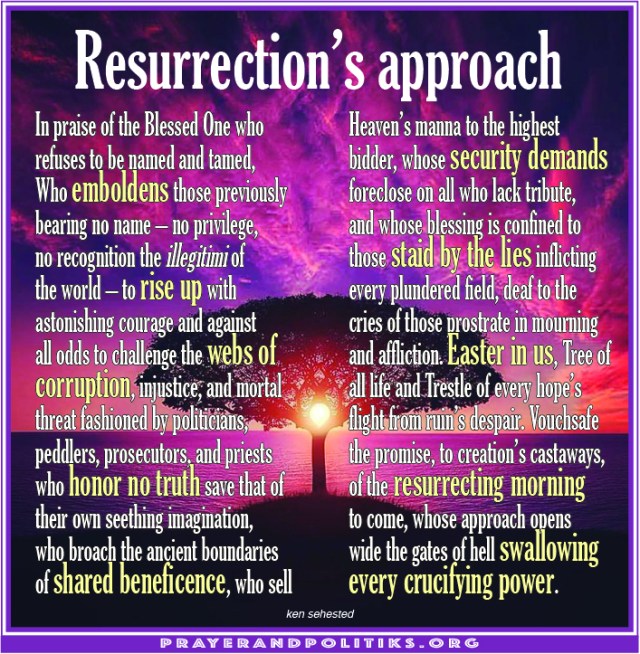
Resurrection’s Approach AND Commentary on the March For Our Lives

A Prayer and Commentary from Ken Sehested

Resurrection's approach.jpeg

Whisper words of wisdom, let it be:
Commentary on the March For Our Lives rally in Washington, DC
Saturday 24 March 2018

I am not ashamed to admit it. They made me do it. Cry. More than once. “They” being the uncommonly common students who led the March For Our Lives rally—three-quarters of a million strong—in Washington, DC. The day may well be accounted as among the most significant in our nation’s history. Continue reading “Resurrection’s Approach AND Commentary on the March For Our Lives”

Seraphim Serpents, Bronze Gifts, and Saving Sights

CrossBy Jim Perkinson, a sermon on John 3: 14-21 and Numbers 21:4-9 (March 11, 2018, St. Peter’s Episcopal, Detroit, MI)

The sermon begins today with this year’s early advent of the parade for St. Patrick. The sea of green we already witnessing this morning provides interesting backdrop for the lectionary readings. In mainstream Christian invocation, Patrick is remembered for clearing the snakes from Ireland and often depicted as such, with crozier in hand and coiled serpents at his feet. Patrick mastered the slithering ones. But for our purposes here, it is important likewise to lift up Afro-diaspora creativity with the Gaelic saint and his serpents. In colonized Haiti, the displaced slaves amalgamated their traditional Yoruban-Dahomean-Congolese spiritual practices with the Roman Catholic orthodoxy into which they were forced. For them, the depiction of the snake-mastering Patrick “spoke” of Damballah, the Creator-Serpent-Spirit (or Loa, in their terminology) whose surreptitious presence they saw “mounting” Patrick in possession and using his snake proclivity to express something quite different. Far from banning the Serpent Power, for the creolized community of the French colony, Patrick became the host body for this African indigenous spirit-guide. The Snake mastered Patrick. And something like that intuition will help us open the Hebrew text to its indigenous root this morning. Continue reading “Seraphim Serpents, Bronze Gifts, and Saving Sights”

Activate That Love

LyniceIn an interview a few years back, Rev. Lynice Pinkard of the Oakland’s Seminary of the Street was asked if there was ever a time that she lost her faith.  This was her answer.

Through it all I’ve continued to love Jesus and the prophets. I love the church. I am a product of it, and I have spent my life serving it in various ways. The problem for me is that institutional church programs and denominational structures are too often removed from real, radical, biblical discipleship. The institutions often become bulwarks against the movement of the Spirit and act to preserve old patterns of power ill-suited to the real message of our faith. And I have to admit that Christians sometimes scare me. I even scare myself.
Continue reading “Activate That Love”

40 Birds of Lent: Final Count

Laurel1By Laurel Dykstra

While the word Lent comes from Middle English, quadragesima, the Latin word for the season means fortieth referring to the fortieth day before Easter. And while this resonates with a host of biblical wilderness forties—the 40 days of the flood, the Hebrew’s 40 year sojourn in the desert, Moses’ 40 days on Sinai, Elijah’s 40 day journey to Mt. Horeb, Jesus’ 40 days in the wilderness—the actual number of days doesn’t quite add up, so different traditions have different metrics, (don’t count Sundays, Lent ends on Maundy Thursday) in order to get to 40. I love the biblical associations but the 40 Birds of Lent involved some cheating to make the numbers come out right.
Continue reading “40 Birds of Lent: Final Count”

Wild Lectionary: Leafy Branches Sunday – Domingo de Ramos

imagejpeg_0-5Palm Sunday, Year B
Mark 11:1-11

By Carmen Retzlaff

The Palm Sunday story in the Gospel of Mark says that

Many people spread their cloaks on the road, and others spread leafy branches that they had cut in the fields. (Mark 11:8)

The Greek (from Thayer’s Greek Dictionary) is:

stiba¿ß; stibas, stibados; a. a spread or layer of leaves, reeds, rushes, soft leafy twigs, straw, etc., serving for a bed; b. that which is used in making a bed of this sort, a branch full of leaves, soft faliage Continue reading “Wild Lectionary: Leafy Branches Sunday – Domingo de Ramos”

The Ways

Japan-1
PC: Michael Raymond Smith

By Tommy Airey

Unless I see the mark of the nails in his hands, and put my finger in the mark of the nails and my hand in his side, I will not believe.
John 20:25

In order to believe (Greek pistis), Thomas had to see and touch the brutal wounds inflicted by empire. Belief, for the first radical disciples, was far more than head knowledge. It was about what one pledged allegiance to, who one was willing to suffer and die for. Thomas wasn’t going down with some crazy-ass conspiracy theory about Jesus the tortured-and-crucified freedom fighter coming back from the dead.   Continue reading “The Ways”

On These Holy Mountains: From Rio Negro to Burnaby Mountain

rionegroBy Emilie Smith. Re-posted from Narrativa Y Ensayo

On this day, as I do every 13th of March, I turn my heart to the women and children of Rio Negro. On this day in 1982, during the peak of the Guatemalan genocide, 177 Achi-Maya women and children were pulled from their homes, forced to march up a mountain, and then made to dance. Then many of them were raped and finally most of them were killed and left in a shallow hollow. Continue reading “On These Holy Mountains: From Rio Negro to Burnaby Mountain”

Bright Sadness

indexA litany for Lent, to be read while “How Can I Keep From Singing” is played in the background, after which the congregation sings one or more verse of the song

by Ken Sehested

In the Eastern Orthodox tradition, the season of Lent is described as a “bright sadness.”

In the sadness that surrounds our lives, our community, our world, we give thanks, nevertheless. More is at work than we can see. Continue reading “Bright Sadness”

The Friendly Fire Collective

May DayFrom fellow angelic troublemakers in the Philly area:

The following is a call for a gathering in Philadelphia, PA from May 1st to May 3rd.

Local Quakers and friendly mystics from around the so-called “United States” are gathering outside of so-called “Philadelphia,” from May 1-3rd for direct action, worship, collaboration, mysticism, and fellowship to stir-up an emerging revolutionary Christian/religious Left. We invite mystics and people of faith from all traditions who share our struggle “against the rulers, against the authorities, against the powers of this dark world.” (Ephesians 6:12)

In the Spirit of International Workers’ Day, we will be participating in various direct actions which are currently being planned by our ever growing planning committee. The retreat fee will be a sliding scale of $45-95 and we will have scholarships available to ensure accessibility. If you would like to donate to allow poor, qpoc, and other marginalized people come to our event please email us.

For safety concerns we will not be discussing the location of our event until a few weeks out.

We are currently taking applications for the May Day retreat! Apply here!

For more information: friendlyfireinfo@protonmail.com https://friendlyfirecollective.wordpress.com