School of the Americas Watch is a nonviolent grassroots movement working to close the SOA / WHINSEC and similar centers that train state actors such as military, law enforcement and border patrol. We strive to expose, denounce, and end US militarization, oppressive US policies and other forms of state violence in the Americas. We act in solidarity with organizations and movements working for justice and peace throughout the Americas.
Our demands:
An end to US economic, military and political intervention in Latin America
Demilitarization and divestment of the borders
An end to the racist systems of oppression that criminalize and kill migrants, refugees and communities of color
Respect, dignity, justice and the right to self-determination of communities
An end to Plan Mérida and the Alliance for Prosperity
This piece was developed during the second Bartimaeus Institute Online (BIO) Study Cohort 2016-2017. These pieces will eventually be published in a Women’s Breviary collection. For more information regarding the BIO Study Cohort go here.
In the cave of a great sanctuary, a granite womb full of light and bones, I sat among songs of the annunciation next to a new friend. Listening next to me, she didn’t know that I was having a holy moment of uncertainty. Each apex was an almond reminder of sacred arches, gateways of birth and body: seen, sacred, secret and silenced. I was considering, fiercely and privately, a surgery that would open my thick sealed hymen, a birth defect known as “Virgin Mary.” Continue reading “Our Lady comes”→
In today’s Gospel when asked about the greatest of all the commandments, Jesus’ reply is simple, “love God, love your neighbor.” In Luke, this same exchange is followed by the question, “who is my neighbor?” which Jesus answers with the parable of the Good Samaritan. The story of upstanding citizens who fail to respond to suffering after an assault has obvious parallels for first world Christians confronted by climate crisis, species extinctions, and environmental racism. Continue reading “Wild Lectionary: Who Is My Neighbor?”→
By Jyarland Daniels (right), founder of Harriet Speaks, doing diversity differently by providing a Black voice and perspective in diversity, equity, & inclusion
Today my newsfeed greeted me with a story of a PhD student assistant at The University of Pennsylvania with the following headline:
This instructor calls on black women first and white men last. Critics want her fired.
In a world where we are bombarded by information and everyone wants to be in the know, going beyond the headline can seem passé. Yet, being “Headline Hoppers” is one way we give our implicit consent for the media to dominate the narrative on race in a way that does not reflect reality; these narratives are why, in a recent study, 55% of whites reported they believe they are discriminated against, but a much smaller percentage say they have actually experienced this discrimination. Continue reading “Black Women & Equity at UPenn”→
7th c. Bavarian Christian fresco of the Trinity, with the Holy Mother in the Middle.
By Chelsea Forbrook, a Spiritual Director, and Liberationist-Buddhist-Universalist-Mystic-12 step-Queer-Christian. Playing with questions, answers, and surrender. Re-posted with gratitude and permission from Spiritual Subversive: a blog for 21st century seekers.
With the deluge of social media posts using #Metoo, women are hoping that men will finally understand that sexual assault and harassment happen to us on the daily. Perhaps they will wake up to the fear that women have internalized and had to accept as “normal.” Thankfully, I have not (thus far) experienced the horror of rape or physical assault. I have, however, experienced harassment as regular as sneezes during allergy season. Think I’m exaggerating? Think again. Here’s a (partial!) list of my experiences:
~ After hitting puberty, I wore baggy pants and large shirts for 15 years in an attempt to keep roaming eyes and inappropriate comments away from me. It didn’t work. So I chopped off all my hair, and lots of people assumed I was a lesbian. It still didn’t work.
~ I bike everywhere, as opposed to taking public transit, because it has reduced the amount of street harassment I experience by about 90%. My bike makes me feel safe and free. However, there are still plenty of guys who shout at me while I’m riding past, “Hey girl, ride that bike a little slower for me!” or “Damn, girl! You look good on that bike!” or the classic dog whistle followed by “Hey girl, come back here and go on a ride with me!” Sigh…
~ I used to ride public transit for three years, and I was sexually harassed every day, often multiple times a day while waiting at the bus stop. Everyone wanted my phone number, and everyone had comments about my ass or my weight. One stranger walked up and said, “Ooo, I really want to suck on those sexy toes,” and I was even solicited twice for prostitution (while fully covered and wearing baggy clothes, breaking out in profuse acne, and sporting dirty dreadlocks. In case you were wondering, it’s not about what she wears.). Everyday before leaving the house I took deep breaths and prepared a response to this verbal abuse. Hyper vigilance became the norm.
~ I once had a van full of men try to kidnap me on a Sunday morning at 10am. They used a woman to try to lure me inside by having her ask me for directions. Luckily, my intuition told me to run right before the guy tried to reach out and grab me, and I was close enough to my church to find Sanctuary.
~ I got a dog for many reasons, one of them being so that I could walk alone around my neighborhood and feel a little safer. Even though I trust Chancho would try to protect me, I always bring my wallet with me when I walk, because I know I could end up dead and pantless in a country ditch somewhere and I want my ID there to make the identification process quicker. This thought feels quite casual, as it is routine. “Keys? Check. Phone? Check. Wallet-in-case-I get-raped-and-die? Check. All right Chancho, let’s go!”
~ I have been dumped because I didn’t wear tight enough pants. I have been dumped because I was “too old to be a virgin” at age 23. I have had a partner not believe that my “no” actually meant “no.” I have found out 5 times that the guy I thought I was dating actually had another real girlfriend, and I was just for fun. I have been cheated on in a committed partnership twice. Every day it’s a struggle to convince myself that I am good enough, and that I deserve respect. Not because I’m some man’s sister or daughter, but because I am a human being worthy of respect. It’s hard to feel worthy and whole some days when my experience keeps telling me otherwise.
Ken Sehested, Circle of Mercy, 9.19.05
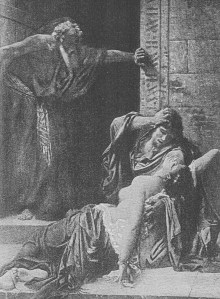
Judges 19:1-30
There have been two special occasions in my life when I have become agonizingly aware of the special fear women feel over the threat of sexual assault.
From theologian Elsa Tamez, in the September 1983 issue of Sojourners Magazine:
God remains silent so that men and women may speak, protest, and struggle. God remains silent so that people may really become people. When God is silent and men and women cry, God cries in solidarity with them but doesn’t intervene. God waits for the shouts of protest
Unfortunately, during the course of 2,000 years of Christian history, this symbol of salvation has been detached from any reference to the ongoing suffering and oppression of human beings—those whom Ignacio Ellacuría, the Salvadoran martyr, called “the crucified peoples of history.” The cross has been transformed into a harmless, non-offensive ornament that Christians wear around their necks. Rather than reminding us of the “cost of discipleship,” it has become a form of “cheap grace,” an easy way to salvation that doesn’t force us to confront the power of Christ’s message and mission. Until we can see the cross and the lynching tree together, until we can identify Christ with a “recrucified” black body hanging from a lynching tree, there can be no genuine understanding of Christian identity in America, and no deliverance from the brutal legacy of slavery and white supremacy.
Strider: They were once men. Great kings of men. Then Sauron the deceiver gave to them nine rings of power. Blinded by their greed, they took them without question. One by one, they fell into darkness and now they’re slaves to His will. They are the Nazgûls, Ringwraiths. Neither living nor dead. At all times, they feel the presence of the Ring. Drawn to the power of the One, they will never stop hunting you.




 By Jyarland Daniels (right), founder of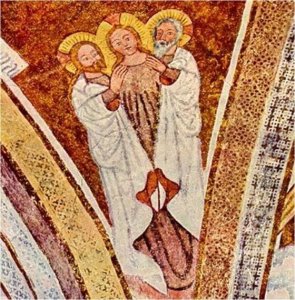
 Ken Sehested, Circle of Mercy, 9.19.05
 From theologian Elsa Tamez, in the September 1983 issue of Sojourners Magazine:
 From James Cone’s
  Frodo: What are they?
