Place-Based Resurrection

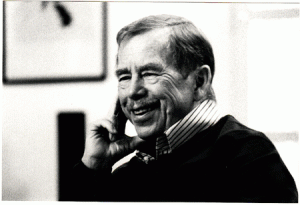
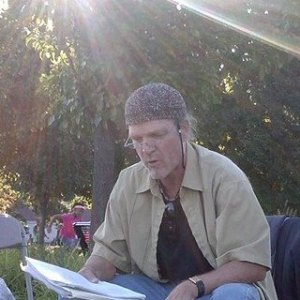
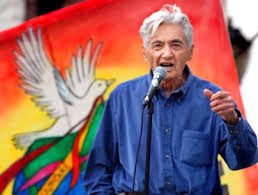
PerkBy Dr. James Perkinson (right), a sermon on Luke 24:13-35

I want to begin with a word of prayer before we jump into the gospel for today, but to facilitate that, first—a story about prayer and some necessary preliminaries. I have a half-Filipino poet friend in Detroit who tells of his first experiences of the Lord’s prayer, while growing up. Whenever he heard “Our Father who art in Heaven,” his five-year-old vernacular ears could not compute “art” as anything other than what happened when you put paint on paper, so his five year-old mind supplied a little slurred “n” in there, and what he actually thought he heard was “Our Father, who aren’t in heaven.” And it rattled him; he couldn’t figure it out; he says he kept thinking, “Well, where is he then?” If not there, then where? But he gradually came to hear it as a positive affirmation: a God who “aren’t” in heaven, because that God’s “place” is really right here, with us. A deep intuition, I would say, for all—what I would call place-based confession. Continue reading “Place-Based Resurrection”
Learning from Laughter and the Trees: Even Donald Trump

photo(1)By Lydia Wylie-Kellermann

We were sitting in the car and I had somehow managed to have NPR on rather than some song about trains on repeat. I have to start being careful, because Isaac is listening and understanding what he is hearing. I don’t remember the context, but on the radio it says “She loves people.”

“Mommy, it said she loves people.” Continue reading “Learning from Laughter and the Trees: Even Donald Trump”

Wild Lectionary: Good Shepherd

Catacomb-Art-Shepherd
Earlychurch.com

Good Shepherd Sunday
Acts 2:42-47 • Psalm 23 • 1 Peter 2:19-25 • John 10:1-10
By Noel Moules

A shepherd is a wilderness figure. Distinctive, as they move across the horizon line, while at the same time blending and flowing with and within their surrounding landscape. Always an outsider in terms of mainstream society, yet across the story of human cultures their mystique has left an imprint out of all proportion to their actual power and influence.

Biblically, the concept of the ‘shepherd’ presents a multitude of possible perspectives we might explore, even within the confines of our chosen lectionary passages. However, as a Christian animist I want to focus on a theme of central importance to me, that of ‘relationship’. Continue reading “Wild Lectionary: Good Shepherd”

Always Vigilant

audreFrom Audre Lorde’s “Learning from the 60’s,” a talk delivered at Malcolm X weekend, Harvard University, February 1982:

Revolution is not a one-time event. It is becoming always vigilant for the smallest opportunity to make a genuine change in established, outgrown responses; for instance, it is learning to address each other’s difference with respect. Continue reading “Always Vigilant”

Sermon: Sacred Stones

17991880_1356210924426880_4541864573151262921_n.jpgKaterina Friesen, Rooted and Grounded Conference,Chapel Message, April 21, 2017

At one time, the confluence of two powerful rivers churned with such energy that they created smooth, spherical stones. The Lakota people named one of these rivers the “Stone-Make-For-Themselves River,” (‘Íŋyaŋwakağapi Wakpá) because of the round stones the river formed, which they call Iŋyaŋ Wakháŋagapi Othí. Sacred Stones. These stones are used in prayer and ceremony, and are seen as enspirited, part of all our relations, like the river, plants and animals. Continue reading “Sermon: Sacred Stones”

A Knowledge Gap

StevensonFrom Christina Gregg in an article entitled “Bryan Stevenson: America’s failure to deal with history of slavery and Jim Crow has manifested” reposted from AOL.com:

As a white nationalist says President Trump incited him to shove a black female protester at a campaign rally last March, a new museum in Montgomery, Alabama aims to advance truth and reconciliation while addressing the often unspoken reality of racial horror in America.

Burning black people alive, hanging them, mutilating their bodies — the graphic history of U.S. racial violence is a shameful and difficult thing to confront, says Equal Justice Initiative founder and executive director Bryan Stevenson, adding racially-driven hatred present today is “a manifestation of our failure to deal effectively” with that past. Continue reading “A Knowledge Gap”

A Dissident

HavelFrom Vaclav Havel’s The Power of the Powerless, quoted by Chris Hedges in his always challenging column (“The Price of Resistance“) earlier this month:

You do not become a ‘dissident’ just because you decide one day to take up this most unusual career.  You are thrown into it by your personal sense of responsibility, combined with a complex set of external circumstances. You are cast out of the existing structures and placed in a position of conflict with them. It begins as an attempt to do your work well, and ends with being branded an enemy of society. … The dissident does not operate in the realm of genuine power at all. He is not seeking power. He has no desire for office and does not gather votes. He does not attempt to charm the public. He offers nothing and promises nothing. He can offer, if anything, only his own skin—and he offers it solely because he has no other way of affirming the truth he stands for. His actions simply articulate his dignity as a citizen, regardless of the cost.

Queen Lili’uokalani of Hawaii

220px-liliuokalani_of_hawaiiBy Grace Aheron.

This piece was developed during the first Bartimaeus Institute Online Cohort (2015-2016), aka “The Feminary.”  These pieces will eventually be published in a Women’s Breviary collection.  For more information regarding the Feminary go here.

80 million years ago, the earth opened up in the middle of the Pacific Ocean, liquid land bubbling up through the ocean to cool into a jade island chain. Through the intricate folding of land, sea, wind, and the breath of creation, life came to the islands and flourished in the rich volcanic soil. A few hundred years after the death of Christ, using only the stars and the sea to navigate in their outrigger canoes, master navigators from the West crossed thousands of miles of water to find paradise. In the Kumulipo, the creation chant sacred to native people in the Islands of Hawai’i, the story tells of the intimate linkage between people, the gods, the earth, and plants and animal indigenous to that place. Veneration of the `aumakua (ancestors) and gods weaves the story of present-day Hawaiians into the fabric of history— it is impossible to speak of the origin of native people without telling the origin of the sacred land that provided life. An extensive portion of the Kumulipo is dedicated to enumerating the lineage of the monarchs and royal family of the Kingdom of Hawai’i, and, fittingly, the chant was first translated into English by the kingdom’s first, last, and only sovereign queen, Liliu’okalani. Continue reading “Queen Lili’uokalani of Hawaii”