
 Reflections given by Halima Cassels, Michelle Martinez, and Lydia Wylie-Kellermann
at First Unitarian Universalist, Detroit, MI
May 14, 2017
Our Seemingly Small Gestures
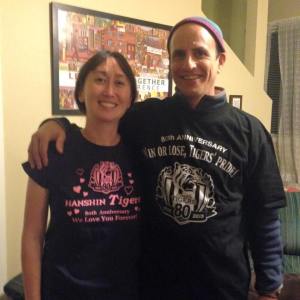 By Julian Washio-Collette (right: with his wife, Lisa), on behalf of Casa de Clara, the San Jose Catholic Worker community (originally posted in the Fall Newsletter)
Everywhere in these days people have…ceased to understand that the true security is to be found in social solidarity rather than in isolated individual effort. But this terrible individualism must inevitably have an end, and all will suddenly understand how unnaturally they are separated from one another. It will be the spirit of the me, and people will marvel that they have sat so long in darkness without seeing the light.
Fyodor Dostoyevsky
Our friend Angie called this afternoon. She has been staying at a local shelter for the past couple of months and has been calling us regularly just to check in. Amazingly, she has been clean and sober since she arrived at the shelter, and has seen other remarkable health improvements. When I talk to her, her voice is clear, her mind is lucid, and she is in an upbeat mood. In other words, she seems like a completely different person from the Angie we know who comes to our door pushing her shopping cart, slurring her words, speaking incoherently, rambling about what to us sound like paranoid delusions. Continue reading “Our Seemingly Small Gestures”
Brimming Multitudes
 From Rainer Maria Rilke’s Third Duino Elegy:
…Our loving is not, like the flowers’, the offering
of a single year. When we love, there rises in us
a sap from time immemorial. Oh my dear girl,
it is this: that we loved, in each other, not an individual
or one coming toward us, but brimming multitudes;
not a single child but the fathers
fallen to the depths of us like crumbled mountains,
and the dry riverbeds of ancestral mothers;
the whole soundless landscape
under the clear or clouded sky of fate:
all this, my dear, came before you.

Jesus and the Easter Bunny
By Joyce Hollyday

During an overly pious phase in my childhood, my favorite holiday was Maundy Thursday. I had nothing against the traditional favorites of Christmas, Easter, and Halloween. I did, after all, grow up in Hershey, Pennsylvania—raised in the First United Methodist Church on Chocolate Avenue, where the domes on the street lights resemble Hershey’s kisses and the fragrance of chocolate hung often in the air. I had no complaint against holidays that brought bonanzas of candy and gifts. Continue reading “Jesus and the Easter Bunny”
25 Years Later by a Long Shot
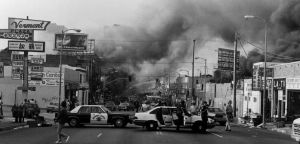 By Tommy Airey
We have come over a way that with tears have been watered,
We have come, treading our path through the blood of the slaughtered,
Out from the gloomy past,
Till now we stand at last
Where the white gleam of our bright star is cast.
James Weldon Johnson, “Lift Every Voice and Sing”
Last month, we posted up in the pews of an old black Baptist church in Watts for the 50th anniversary of Martin Luther King’s powerful “Beyond Vietnam” speech. We belted out James Weldon Johnson’s “Lift Every Voice and Sing,” the so-called “Black National Anthem,” a song I first heard before the last college basketball game I ever played in (at L.A. Southwest Community College, just a few miles from where we sang in Watts).
A few days later, we joined up with Bartimaeus Cooperative Ministries to help staff “Commemorating the 25th Anniversary of the L.A. Uprising,” organized by a group called ReconciliAsian, spearheaded by Sue and Hyun Hur, a Korean-American couple who pastor a Mennonite church in Southern California (keep Hyun in your prayers as he heads to North Korea this week). This space provided story-telling from different leaders (black, Latina, Asian and white) bearing witness to those chaotic days in the aftermath of the acquittal of three police officers in the Rodney King beating trial. Continue reading “25 Years Later by a Long Shot”
Sermon: That’s Just Love Sneakin’ Up On You
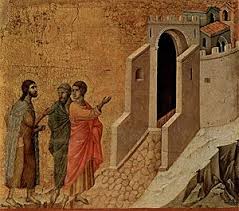 Rev. Rebecca Stelle, Becoming Church
Guest Preacher at New Community Church,
Washington, DC
Sunday April 30, 2017
Luke 24: 13-25
When the anticipation of celebration is upended by grief, people are traumatized. Think of November 9 of last year- Do you remember the emotion which has now largely subsided? On November 8, millions of people were poised to celebrate a win, and the next day, millions were outraged, terrified, offended, bewildered and humiliated. Even if you weren’t one of them, can you viscerally recall the intensity of that expectation gone wrong? Continue reading “Sermon: That’s Just Love Sneakin’ Up On You”
Morally Coherent & Socially Irresistible
 Excerpted from Michael Eric-Dyson’s “Abraham, Isaac and Us,” reposted from OnBeing.org:
The only meaningful interpretation of transcendence we might propose is to strip the term of its philosophical and theological orthodoxy and offer instead a more forceful definition. Truth can be described as transcendent if it illumines the time and place of its emergence as well as other places and periods. Truth’s transcendence is not pegged to its authoritative reflection of an unchanging reality that everyone would agree on if they had access to it. Truth happens when we recognize the expression of a compelling and irrefutable description of reality. Truth is not irrefutable because it appeals to ideals that escape the fingerprints of time and reason. Truth is irrefutable because it is morally coherent and socially irresistible. Continue reading “Morally Coherent & Socially Irresistible”
Place-Based Resurrection
 By Dr. James Perkinson (right), a sermon on Luke 24:13-35
I want to begin with a word of prayer before we jump into the gospel for today, but to facilitate that, first—a story about prayer and some necessary preliminaries. I have a half-Filipino poet friend in Detroit who tells of his first experiences of the Lord’s prayer, while growing up. Whenever he heard “Our Father who art in Heaven,” his five-year-old vernacular ears could not compute “art” as anything other than what happened when you put paint on paper, so his five year-old mind supplied a little slurred “n” in there, and what he actually thought he heard was “Our Father, who aren’t in heaven.” And it rattled him; he couldn’t figure it out; he says he kept thinking, “Well, where is he then?” If not there, then where? But he gradually came to hear it as a positive affirmation: a God who “aren’t” in heaven, because that God’s “place” is really right here, with us. A deep intuition, I would say, for all—what I would call place-based confession. Continue reading “Place-Based Resurrection”
What they need
Give people what they need: food, medicine, clean air, pure water, trees and grass, pleasant homes to live in, some hours of work, more hours of leisure. Don’t ask who deserves it. Every human being deserves it.
― Howard Zinn, Marx in Soho: A Play on History

