A Call to Action

bcm-logoBy Tommy Airey

White people: no one is asking you to apologize for your ancestors. We are asking you to dismantle the systems they built and that you maintain. We have no use for your guilt. What we want from you is action.
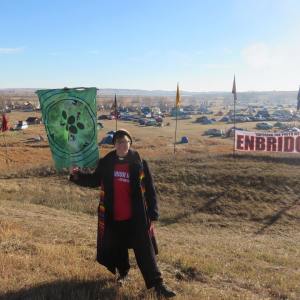
Sylvia McAdam, co-founder of Idle No More

Saskatoon, Saskatchewan

Snow came early this year to the Canadian prairies, but there were some logs of hope burning in the fireplace of the soul last weekend at St. Andrew’s College in Saskatoon as 100 First Nations and white settler leaders convened for the Fall 2016 Bartimaeus Institute entitled The Truth & Reconciliation Commission Calls Churches to Action: Building Capacity for Restorative Solidarity.  The seven residential school survivors in attendance served as elders, guiding participants with both historical memory and spiritual anticipation. Continue reading “A Call to Action”

Praying Ourselves Down From Our Privileged Perch

prayerBy Wes Howard-Brook and Sue Ferguson Johnson

Prayer is central to Luke’s Gospel. The opening scene has the assembly of the people in Jerusalem praying while Zechariah is doing his priestly duty (1.10). The adult Jesus’s first appearance in the gospel is while he is praying (3.21). Luke regularly shows us Jesus at prayer as he discerns the Way (5.16; 6.12; 9.18; 9.28-29). Continue reading “Praying Ourselves Down From Our Privileged Perch”

Remembering his Uncle

jerryDaniel Berrigan Memorial
September 30, 2016
St. Thomas More Parish, Kalamazoo
Jerry Berrigan

It is wonderful to be with you all on this last evening of September.  I need to begin by expressing my gratitude, deep beyond words, for this circle and each individual within it and for many more who couldn’t be here tonight.  You are my community and my family, your lives and the friendships we share undergird everything we do at Peace House and not only make our work possible but make our lives rich beyond any measure.  Thank you, for everything.  Continue reading “Remembering his Uncle”

I Am Being “Unsettled”

perkinsonA excerpt from Dr. James Perkinson’s “Unsettling Whiteness: Refocusing Christian Theology on Its Own Indigenous Roots” in Wrongs to Rights: How Churches Can Engage the U.N. Declaration on the Rights of Indigenous Peoples (2016): 

What is this thing called “Whiteness” as a force of history?  A hidden Power that inhabits institutions, influences policies, whispers in psyches, and colors perceptions without itself appearing, except in shadows and at the edge of vision.  I have only become aware of how profoundly this Power has moved my will, shaped my desire, and birthed my thought, as black and native people in my life have called out its nearly invisible Presence that is so obvious to them.  I am married to a Filipina, from a country colonized by my own for half a century, so the scrutiny is relentless–but also very healing, in the midst of the “trouble” it occasions.  I am, year-by-year, deepening my understanding that I am a Settler on someone else’s land, and enjoy access to unjust amounts of “resources” and goods because of someone else’s labour.  I am being “unsettled.” Or more precisely, what is being unsettled within and around me is White Power (I am actually more than just the Whiteness that “possesses” me).

Lines Written in the Days of Growing Darkness

maxresdefaultby Mary Oliver

Every year we have been
witness to it: how the
world descends
into a rich mash, in order that
it may resume.
And therefore
who would cry out

to the petals on the ground
to stay,
knowing, as we must,
how the vivacity of what was is married

to the vitality of what will be?
I don’t say
it’s easy, but
what else will do

if the love one claims to have for the world
be true?
So let us go on…

Mennonite delegation shows solidarity at Standing Rock encampment

kat
Photo by Maria Thomas

Published on October 10, Indigenous People’s Day at themennonite.org.

Katerina Friesen is a recent graduate of Anabaptist Mennonite Biblical Seminary, Elkhart, Indiana. She is a writer and community builder, and currently serves as the interim pastor of Belmont Neighborhood Fellowship in Elkhart.

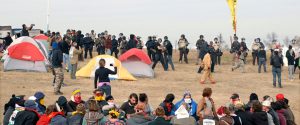
The largest gathering of Native American tribes in over a century is happening near Cannonball, North Dakota, about a mile from the Standing Rock Sioux Reservation. Tribes that were once divided are finding reconciliation and unity in a movement of nonviolent resistance to protect the sacred lands and waters of the Lakota Sioux.

From Sept. 16-23, I traveled there with a delegation of Mennonites from the Dismantling the Doctrine of Discovery Coalition to show support and solidarity with the thousands of people resisting the Dakota Access Pipeline (DAPL), slated to carry over 450,000 barrels of crude oil per day from the Bakken shale of North Dakota to refineries in Illinois, over 1,100 miles. Our delegation included Anita Amstutz, John Stoesz, Ken Gingerich, Maria Thomas, and I, stayed at the Sacred Stone Camp, the first of the three main camps where between 5,000–7,000 people were estimated to have camped during the week we visited. Continue reading “Mennonite delegation shows solidarity at Standing Rock encampment”

Never Give Up: Faith as Tenacious Agitation

By Ched Myers

Note: This post is part of a series of weekly comments on the Lukan gospel readings from the Revised Common Lectionary during Year C, 2016. [Image below: St. Louis Post-Dispatch, J.B. Forbes/Associated Press, found at http://www.thefeministwire.com/2014/10/fergusonfridays-black-freedom-fighters-men-interview-black-women-front-line-ferguson/.]

ferguson

This Sunday’s gospel lesson is the second of two key stories about “determined prayer” in Luke. As is so characteristic of the third evangelist, this vignette about a woman’s unflagging insistence on being heard corresponds to an earlier one about similar importunate behavior by a man (see Luke 11:5-13). That text came up in the middle of the summer (see Wes and Sue’s comments on “shameless audacity” and its relevance to the Black Lives Matter movement here). Each story has two “onstage” characters (a protagonist and antagonist), with the Divine “comparison” well offstage. But while the earlier object lesson took place in a village setting and concerned neighborly hospitality and mutual aid among social equals, our text for October 16 takes place in the city and pits social opposites; it pertains to the public vocation of tenacious advocacy for justice. These twinned stories together articulate how deeply connected the personal and political were for Luke, and should be for us. Continue reading “Never Give Up: Faith as Tenacious Agitation”

To Reconcile and Restore

mertonFrom Gordon Oyer’s paraphrase of how Thomas Merton would answer the question “What and where is this Word of God?:”

The word of God is a breakthrough into our real, human experience, and it speaks not just from the Bible but from deep within us, within each of our neighbors, within all of creation. It offers us the means to tear down the false identities we have constructed to fit in with a society rooted in ego-centric self-interest. If we choose to engage it, this word engages us with questions about who we really are, about what person it is who seeks dialogue with the word. If we continue to engage its questions, the word of God will ultimately reconcile and restore us to our true self, to the human community, and to the great and mysterious ground of all being from which our core essence originated.

Prayers of the People

prayersBy Heather Robertson-Ross, Salal and Cedar

The earth is yours, oh Divine Creator, and everything in it. You have made us stewards of your creation so that it may nourish us, clothe us, shelter us, and heal us. Your wisdom lives in it, and communicates to us if only our ears are open to hear, and are hearts are able to discern. Your wisdom and ever present spirit nourishes us, like the clear stream nourishes the trees at her banks, so that we might produce good fruits of the spirit to nourish other. Continue reading “Prayers of the People”