Magnificat: Poor Women’s Voices Liberated

MyersMagnificatBy Ched Myers, for the 4th Sunday in Advent (Luke 1:39-55)

Note: This is part of a series of Ched’s occasional comments on the Lukan gospel readings from the Revised Common Lectionary during year C, 2015-16.

Luke 1 is the prolegomenon to the nativity story, and is structured around the stories of two women who, for radically different reasons, cannot conceive. In a nutshell, Elizabeth is too old, and Mary is too young. Their stories are narrated in staggered parallel:

  • Annunciation to Elizabeth (1:5-25) Annunciation to Mary (1:26-38)
  • Elizabeth’s Response (1:41-45) Mary’s Response (1:46-55)
  • John’s birth (1:57-66) Jesus’ birth (2:1-20)

Continue reading “Magnificat: Poor Women’s Voices Liberated”

These Long Advent Nights

 By Tommy Airey, an Advent Communion Meditation from Detroit

And maybe this is what heroism looks like nowadays: occasionally high-profile heroism in public but mostly just painstaking mastery of arcane policy, stubborn perseverance year after year for a cause, empathy with those who remain unseen and outrage channeled into dedication.
Rebecca Solnit, Hope in the Dark (2004)

About 40-50 years after the death of Jesus, Luke’s Gospel, the story of Jesus the suffering servant, was read in its entirety in small Christian communities all over the Roman Empire. Out loud. It would take about 90 minutes to two hours. About the length of one of our movies.
Continue reading “These Long Advent Nights”

Learning from Laughter: Sitting in Court- An Advent Story

isaac homrich cait
Photo credit: Cait De Mott Grady

By Lydia Wylie-Kellermann

“It’s not Christmas! It’s Advent!” declares my two-year old son loudly when strangers wish him a Merry Christmas. This kid carries his Grandma Jeanie’s spirit in his bold truth-telling with clear liturgical boundaries.

Advent is one of the things I have most looked forward to as a parent. It is a season of darkness, candles, slowing down, making Christmas gifts, wonder and joy, and learning the stories. Scriptures these days are filled with stories of our faith where the power dynamics are flipped on their head. Moments when after a long list of all those in power, God’s voice comes to John in the wilderness (Luke 3:1-6). Then of course, there is the story where amidst deportation and government counting, Jesus is born in a barn. The voice of God is not ringing from Kings or military warriors or presidents or bankers, it is in the poor, ordinary folk. Continue reading “Learning from Laughter: Sitting in Court- An Advent Story”

For A Country?

Arundhati and EdwardFrom Arundhati Roy’s recent piece in The Guardian on visiting Edward Snowden:

What sort of love is this love that we have for countries? What sort of country is it that will ever live up to our dreams? What sort of dreams were these that have been broken? Isn’t the greatness of great nations directly proportionate to their ability to be ruthless, genocidal? Doesn’t the height of a country’s “success” usually also mark the depths of its moral failure? And what about our failure? Writers, artists, radicals, anti-nationals, mavericks, malcontents – what of the failure of our imaginations? What of our failure to replace the idea of flags and countries with a less lethal Object of Love? Human beings seem unable to live without war, but they are also unable to live without love. So the question is, what shall we love?… Continue reading “For A Country?”

A Continual Lure

Walter WinkFrom Walter Wink in Engaging the Powers (1992):

Without a clear idea of the contrast between God’s domination-free order and the Domination System, the gospel is proclaimed in a sociopolitical vacuum, a timeless, placeless, noncontextual, eternal nowhere. Gospel truths are handled like everlasting principles entirely unrelated to the specificity of any real world. And the Powers are consequently reduced to general structural constants ostensibly prevailing ineluctably everywhere and in every time…The gospel has a very specific context: the Domination System. And the gospel has a specific response to that system: the liberating message of Jesus…The gospel is not an ideal beyond realization. It is rather a continual lure toward the fullest conceivable life for all.

Making The House Ready for the Lord

squirrelBy Mary Oliver

Dear Lord, I have swept and I have washed but
still nothing is as shining as it should be
for you.  Under the sink, for example, is an
uproar of mice—it is the season of their
many children.  What shall I do?  And under the eaves
and through the walls the squirrels
have gnawed their ragged entrances- but it is the season
when they need shelter, so what shall I do?  And
the raccoon limps into the kitchen and opens the cupboard
while the dog snores, the cat hugs the pillow;
what shall I do?  Beautiful is the new snow falling
in the yard and the fox who is staring boldly
up the path, to the door.  And still I believe you will
come, Lord: you will, when I speak to the fox,
the sparrow, the lost dog, the shivering sea goose, I know
that really I am speaking to you whenever I say,
as I do all morning and afternoon:  Come in, Come in.

The Baptist’s Radical Critique of Entitlement: Repentance as Radical Discontinuity

LentzJohntheBaptistBy Ched Myers, the 3rd Sunday in Advent (Luke 3:7-18)

Note: This is one of Ched’s occasional comments on the Lukan gospel readings from the Revised Common Lectionary during year C, 2015-16.

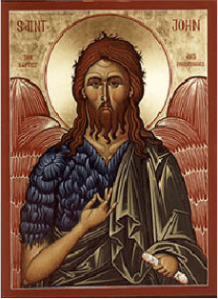
The third week in Advent lingers on Luke’s portrait of John the Baptist, in which we get our most substantive glimpse into this wilderness prophet’s message (right, icon by Robert Lentz, 1984). This reading cuts sharply against the grain of the holiday season, so often defined in corporate-sponsored Christmas culture by commercialization and commodification of all things religious. But the Lectionary’s wisdom seeks to restrain the manic rush into what a young Jewish friend calls “the days of craze,” insisting rather on a sober look at the travails of empire.
Continue reading “The Baptist’s Radical Critique of Entitlement: Repentance as Radical Discontinuity”

The Time is the Time of No Room Raids on the Unspeakable

merton-pbsBy Thomas Merton (+December 10+)

We live in the time of no room, which is the time of the end. The time when everyone is obsessed with lack of time, lack of space, with saving time, conquering space, projecting into time and space the anguish produced within them by the technological furies of size, volume, quantity, speed, number, price, power and acceleration. Continue reading “The Time is the Time of No Room Raids on the Unspeakable”

Introducing: The Feminary

Grace ABy Grace Aheron

This winter, five young women and myself are embarking upon an online adventure of alternative theological education. We’ve been dubbed “the feminary” and will be participating in a study cohort following the Bartimaeus Institute’s five-month online series. The seeds of the feminary were planted by a few voices crying out in the wilderness— crying for a radical feminist space where we could study scripture, history, and bible at a low price point and in community with like-minded people— and Ched and Elaine’s faithful response.
Continue reading “Introducing: The Feminary”

Abundant Community

Scouts_readingThe following is the third post in a series by Kate Foran about exploring an alternative kindergarten education for her daughter Sylvie.

This picture was taken last November at a harvest gathering (note the bowls of squash soup) that I participated in with other children and parents. At the time, I was still wrestling with whether to enroll Sylvie in school or not, and the moment captured in the picture stands out for the way it tipped the balance toward “DIYing” her education instead. It was in some ways a typical preschool group story time (I think we were reading Curious George), but in other ways it was remarkable, because it was not a moment I organized. Instead, a child handed me the book and asked me to read it. And soon the other children crowded around, piling onto my lap and leaning on my shoulders. I was aware at the time of the great privilege of having the trust of these children, and it occurred to me that the spontaneous connection and even the physical closeness was not something that could easily occur in an institutional setting.   Sylvie was a bit ruffled at having to share her mom, but she was satisfied when I explained to her that I got to be a teacher to these other kids the way that their parents got to be a teacher to her. Continue reading “Abundant Community”