Vision in Action at First Mennonite

Mennonite Vision in ActionA Vision in Action story given by Sarah Matsui at First Mennonite.

After the sermon or music is concluded, the Worship Leader and Vision in Action storyteller go to the podium. The Worship Leader introduces the Vision in Action: In the Lord’s Prayer, Jesus invites us to pray: “God, may your kingdom come, on earth as it is in heaven.” In our monthly Vision in Action, we hear stories about how people in our community live this prayer – how they shift, reform, transform, revolutionize, and nudge the world so it becomes more fully the realm of God. Today, Sarah Matsui will share her story with us as we take our morning offering. Please pray with me: Creating God, may Sarah’s story open our imaginations to the many ways in which you partner with us to bring about your realm on earth. Receive these offerings, which are also a part of this great work. We rejoice in what we have been given, and in what is ours to give. Amen.

My first Sunday here at First Mennonite was Pride Sunday. When I can, I’ve been coming back every Sunday since. Continue reading “Vision in Action at First Mennonite”

The “Confessional Crisis”

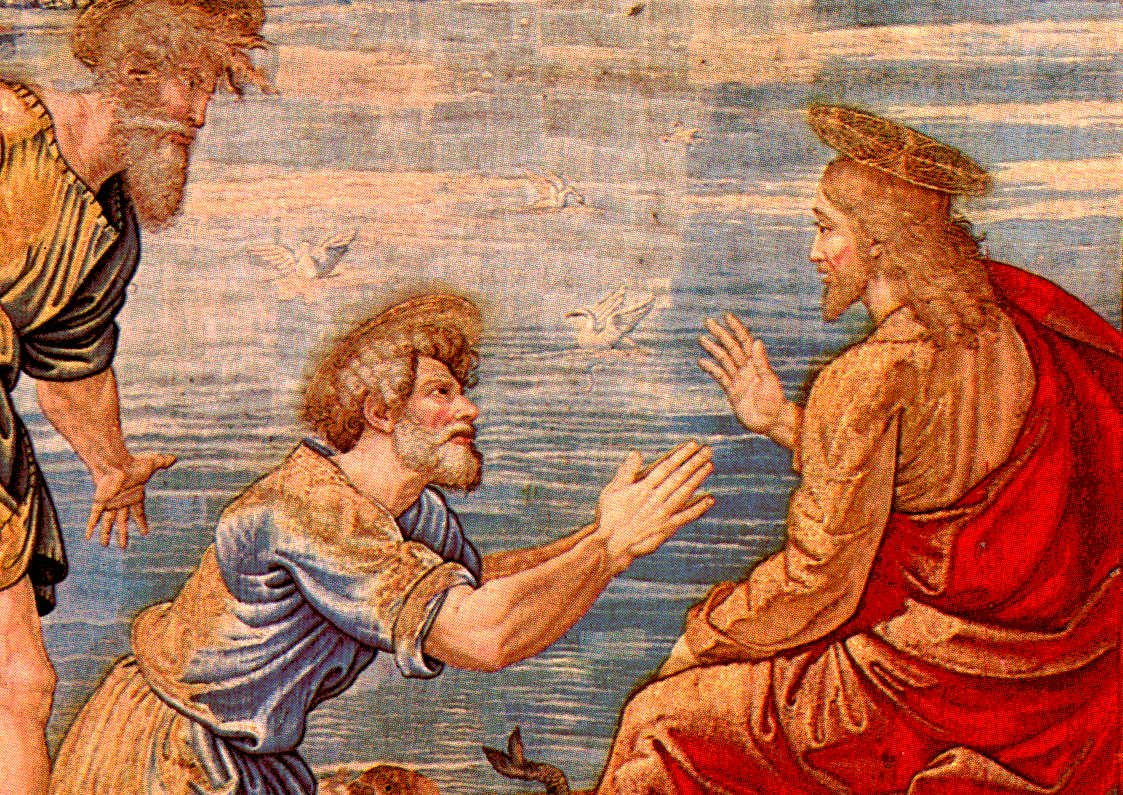
PeterBy Ched Myers, for the 16th Sunday of Pentecost (Mk 8:27-9:1)

Note: This is an ongoing series of Ched’s brief comments on the Markan gospel readings from the Revised Common Lectionary during year B, 2015.

Roughly midway through the season of Ordinary Time, and a week before the Fall Equinox, our lectionary series in Mark’s gospel arrives at the midpoint of the story.

The first half of the narrative began by heralding a “Way” (1:2), and closed with a question addressed to the disciples and the reader: “Do you not yet understand?” (8:21) The second half opens “on the Way” (8:27), with yet another query: “Who do you say that I am?” (8:29a). Do we really know who Jesus is, and what he is about?

It is a shock to discover in this Sunday’s reading that Peter’s “correct” answer (8:29b) is silenced (8:30). This issues in what I call a “confessional crisis” (8:30-33), followed by Jesus’ second call to discipleship (8:34ff). This sequence represent the fulcrum upon which the entire gospel balances. Mark’s thesis is most clearly revealed here: discipleship is not about theological orthodoxy, but about the Way of the cross.

This Way will be explained by three object lessons, both positive and negative. The architecture of the ensuing narrative section consists of three “portents” about Jesus’ impending arrest, which the disciples fail to comprehend, and three teaching cycles. This structure has a catechetical character, representing a “school of the road,” as Jesus and his disciples journey from the far north of Palestine to the outskirts of Jerusalem:

         Geography                   Portent      Incomprehension       Teaching

1) Caesarea-Philippi      8:31                     8:32f                    8:34ff

2) Galilee to Judea        9:31                     9:32-34                9:35ff

3) to Jerusalem             10:32-34              10:35-37              10:39ff

This catechism is neatly framed by two stories in which the blind receive sight: in Bethsaida (8:22-26) and in Jericho (10:45-52). Here we see master story telling indeed.

Since Mark’s first storm episode (4:41), the issue of Jesus’ identity has been lingering in the background; now Mark turns to address it directly (8:27). The public’s perception of Jesus parallels the three misinterpretations reported earlier concerning John (8:28; see 6:14-16). But when the disciples are asked for their opinion, Peter hails Jesus as “Messiah” (8:29).

We meet this politically-loaded term for the first time since the story’s title (1:1). Messiah was understood by many Jews in first century Palestine to be a royal figure who would someday restore the political fortunes of Israel. Based upon Mark’s title and the centrality of this confession in the church, we are likely to approve of Peter’s identification. But to our chagrin, Peter is immediately silenced by Jesus (8:30), as if he were just another demon trying to “name” Jesus (see 1:25; 3:12)!

Since this lection has already come up this year (on the Second Sunday in Lent), I refer to my comments there concerning the crisis of expectation that punctuates Jesus’ exchange with Peter, and the meaning of his teaching on denial and the “Coming of the Human One.”

Lessons in Lament

BreeBy Ric Hudgens, a sermon at Second Baptist Church, Evanston, June 28, 2015

Text: Psalm 30 (Fifth Sunday of Pentecost, Year B)

INTRODUCTION
What does it mean in this Kairos moment that we have a God moved by our lamentations?

The events of recent months are too familiar to need rehearsing. We are living in a kairos moment. The ancient Greeks had two words for time: chronos and kairos. Chronos was chronological or sequential time; the time that we track on our watches and cellphones. Moment by moment time.
Continue reading “Lessons in Lament”

Detroit Spirit and Roots Reflection

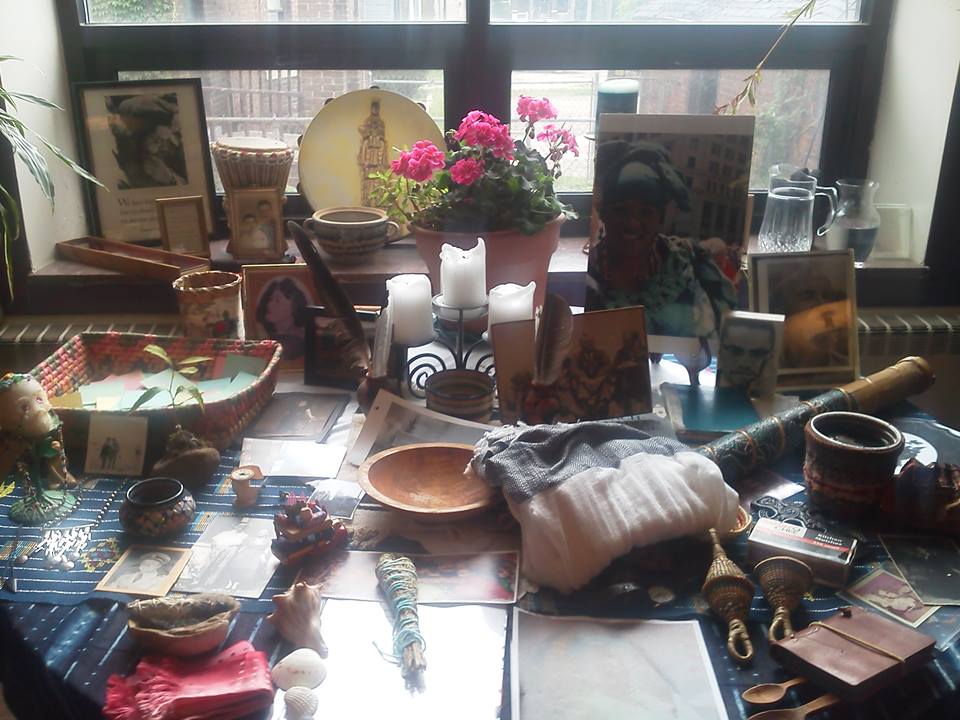
Photo taken by Andrea Ferich. Created by participants bringing with them their ancestors to this place.

Kate Foran reflects on Detroit Spirit and Roots, a project of Word and World and local organizers in Detroit.

An ancestor chose to survive because they saw this—you, us—coming. – A Detroit Spirit and Roots Participant, to the young people of color at the table

Some 11 years ago: my husband Steve and I are interns for Word and World, living in Greensboro, NC and working under one of the founding W&W board members Nelson Johnson. Word and World is struggling (as one way or another most organizations do) with white supremacy culture. We have a diverse board and we have rigorous goals for anti-racism and anti-oppression at our week-long schools. Everyone is making a good faith effort to unpack internalized privilege and internalized oppression, to “do our own work.” Still, as can be expected when you’re organizing so many moving parts, tensions run high and everyone brings their own default cultural assumptions to the table. At the time (and still) Nelson is involved in many organizations nation-wide. Steve and I ask him if he has ever been part of a truly multi-racial organization. He thinks long and hard for a minute and says no. He says the closest he’d ever come was with the Communist Workers Party, where ideology was so strong it trumped other dynamics. He says Word and World is different because at least folks are willing to have some honest conversation about race. But, he said, his experience as an African-American organizer is that white people either take over or they leave. Continue reading “Detroit Spirit and Roots Reflection”

Prayer for the Tortured Earth

KaterinaBy Katerina Friesen

Katerina wrote this for a chapel service on Sept 1, 2015 at AMBS on “Crying out with Creation.” Pope Francis declared Sept. 1 as the World Day of Prayer for the Care of Creation, as the Orthodox Church has done since 1989.

O Lord of mercy,
We pray for Your tortured Earth.
For forests scorched by drought-fueled wildfires out west.
For island nations drowning in rising ocean waters:
Fiji, Palau, Cape Verde, Kiribati, Micronesia.
For the sinking boats of refugees,
fleeing resource wars and famine.
Continue reading “Prayer for the Tortured Earth”

And So It Will Be With You

Terry BurkeFrom Chris Hedges’ eulogy of Rev. Terry Burke (right), who spent 31 years as the pastor of the First Church Jamaica Plain, a Unitarian Universalist church in a working-class neighborhood of Boston:

I want to speak especially to you, his beloved children, Willow, Amelia and Lucy, who were the alpha and omega of his existence, of whom he was so proud and whom he loved so deeply, to tell you this: The awful, gut-wrenching pain you feel will transform into something beautiful. Your father, for the rest of your life, will be your inner witness. His life will illuminate and guide your own. When you stand up for the wretched of the earth, Palestinians in Gaza, single mothers and their children in homeless shelters, those discriminated against because of their race or their sexual orientation, the impoverished and the neglected, those gunned down in the streets by police because they are poor people of color, when you carry out simple acts of kindness, when empathy makes you demand justice, you will feel your father’s spirit. He will be with you. I know this for a fact. I carry my own father’s presence within me. He was a pastor who, too, was good and kind. Every word I utter, every act I make, is done in fealty to my father. It is my voice you hear, but these are his words. And so it will be with you. And one day there will be solace in this.

Wisconsin Walk for Peace and Justice: Nine Arrested at Volk Field

Let-it-Shine-peace-walk-photoBy Joy First, National Campaign for Nonviolent Resistance    August 26, 2015

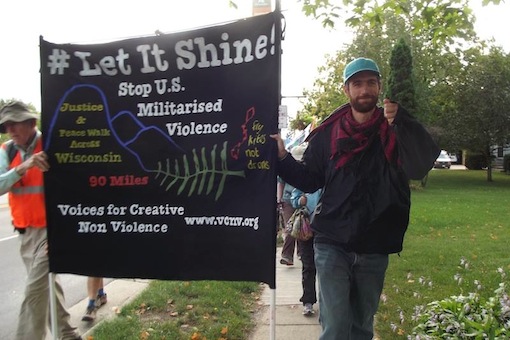
Voices for Creative Nonviolence engaged with a number of Wisconsin peace groups to organize an 8-day 90-mile walk across southwest Wisconsin from August 18-25.  The purpose of the walk was to call attention and make connections between the militarized police violence at home and the military using violence abroad through drone warfare and by other means.  In both cases the victims are people of color, which forces us to reflect on the systemic racism of our society.

The walk began at the City/County/Jail complex in Madison on August 18.  Dane County has one of the highest rates of racial disparity of any county in the country on many issues, including when it comes to incarceration – hence starting the walk at the jail.  In fact, in order to make the prison population match the general population in Dane County, we would need to release 350 Black people.  This is horrific, especially when we understand that so many people of color are in jail for nonviolent crimes and crimes of poverty that could better be solved by more positive interventions.  It is up to all of us to stand up with our brothers and sisters and proclaim that “Black Lives Matter!” Continue reading “Wisconsin Walk for Peace and Justice: Nine Arrested at Volk Field”

Activism: An Irenic, Inclusive & Intentional Vision

MLPBy Tommy Airey

We are not to simply bandage the wounds of victims beneath the wheels of injustice, we are to drive a spike into the wheel itself.
Dietrich Bonhoeffer

Right after Andrew educated me on the elaborate formula he uses to determine his weekly lotto number, Will stared me down intensely, proclaiming “It’s happening and I’m gonna need a ride to the airport.” This was probably the sixth time he’d told me this since arriving in Detroit less than a year ago (so far it hasn’t happened and he hasn’t needed a ride). Eternally glued to his smart phone, he has been taking money out of his monthly SSI check to “invest” in a business that he is utterly convinced will deliver him two planes with $100 million so, as he puts it, he can “get out of this shit hole.”
Continue reading “Activism: An Irenic, Inclusive & Intentional Vision”

Sacrificed: The Story of Jephthah’s Daughter

Girls hold certificates stating their new official names during a renaming ceremony in Satara, India, Saturday, Oct. 22, 2011. Almost 300 Indian girls known officially as "Unwanted" have traded their birth names for a fresh start in life. Given names like "Nakusa" or "Nakushi" _ or "unwanted" in Hindi _ they grew up understanding they were a burden in families that preferred boys in Maharashtra state. (AP Photo)
Girls hold certificates stating their new official names during a renaming ceremony in Satara, India, Saturday, Oct. 22, 2011. Almost 300 Indian girls known officially as “Unwanted” have traded their birth names for a fresh start in life. Given names like “Nakusa” or “Nakushi” _ or “unwanted” in Hindi _ they grew up understanding they were a burden in families that preferred boys in Maharashtra state. (AP Photo)

This month, we are beginning a year long monthly series on biblical women. Women from around Turtle Island will be honoring the women in scripture with poetry, art, storytelling, and love. This month, Joyce Hollyday starts the series with Jephthah’s daughter. If you are interested in contributing to the series, email lydiaiwk@gmail.com.

By Joyce Hollyday

Judges 11:29-40

Her name is lost to us—excised by the male chroniclers of faith history who understood that to name something was to give it power. And she was about as powerless as anyone could be. Jephthah’s daughter. Young, naïve, and female. Defined, possessed, and controlled by a violent and volatile warrior-father who ended her life in a ritual murder.

So, why launch a series on biblical women with such a tragic tale? Because Jephthah’s daughter is with us still. Her story is present among us in every form of male control: in the assumption that those of us who marry men will take their names and those who choose women must be “set straight”; in domestic violence and discriminatory pay; in denial of education and forced child marriages; in genital mutilation, sexual slavery, and female infanticide. Continue reading “Sacrificed: The Story of Jephthah’s Daughter”