The Great Stories

ArundhatiFrom Arundhati Roy in The God of Small Things (2008):

…the secret of the Great Stories is that they have no secrets. The Great Stories are the ones you have heard and want to hear again. The ones you can enter anywhere and inhabit comfortably. They don’t deceive you with thrills and trick endings. They don’t surprise you with the unforeseen. They are as familiar as the house you live in. Or the smell of your lover’s skin. You know how they end, yet you listen as though you don’t. In the way that although you know that one day you will die, you live as though you won’t. In the Great Stories you know who lives, who dies, who finds love, who doesn’t. And yet you want to know again.

That is their mystery and their magic.

Aslan is on the move

lion witch wardrobe“They say Aslan is on the move perhaps has already landed.”

And now a very curious thing happened. None of the children knew who Aslan was any more than you do; but the moment the Beaver had spoken these words everyone felt quite different. Perhaps it has sometimes happened to you in a dream that someone says something which you don’t understand but in the dream it feels as if it had some enormous meaning—either a terrifying one which turns the whole dream into a nightmare or else a lovely meaning too lovely to put into words, which makes the dream so beautiful that you remember it all your life and are always wishing you could get into that dream again. It was like now. At the name of Aslan each one of the children felt something jump in its inside. Edmund felt a sensation of mysterious horror. Peter felt suddenly brave and adventurous. Susan felt as if some delicious smell or some delightful strain of music had just floated by her. And Lucy got the feeling you have when you wake up in the morning and realize that it is the beginning of the holidays or beginning of summer. – C.S. Lewis, The Lion, the Witch, and the Wardrobe.

81 Years Later: The Barmen Declaration

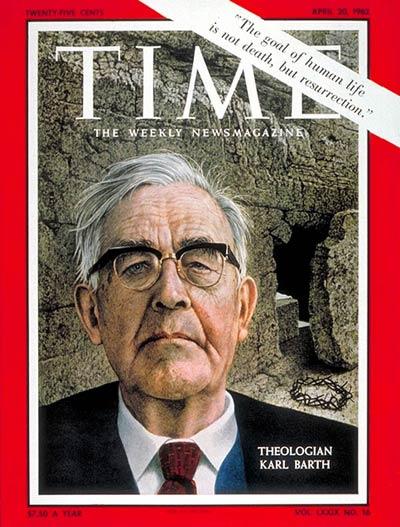
karl barthWe reject the false doctrine that the Church could have permission to hand over the form of its message and of its order to whatever it itself might wish or to the vicissitudes of the prevailing ideological and political convictions of the day.
An Excerpt from the Barmen Declaration, May 29-31, 1934

This weekend, we celebrate the anniversary of the birth of the “confessing church” in Germany, standing up against the idolatry of the State. This is a nice summary from the United Church of Christ “beliefs” page:

The Barmen Declaration, 1934, was a call to resistance against the theological claims of the Nazi state. Almost immediately after Hitler’s seizure of power in 1933, Protestant Christians faced pressure to “aryanize” the Church, expel Jewish Christians from the ordained ministry and adopt the Nazi “Führer Principle” as the organizing principle of church government. In general, the churches succumbed to these pressures, and some Christians embraced them willingly. The pro-Nazi “German Christian” movement became a force in the church. They glorified Adolf Hitler as a “German prophet” and preached that racial consciousness was a source of revelation alongside the Bible. But many Christians in Germany—including Lutheran and Reformed, liberal and neo-orthodox—opposed the encroachment of Nazi ideology on the Church’s proclamation. At Barmen, this emerging “Confessing Church” adopted a declaration drafted by Reformed theologian Karl Barth (above photo) and Lutheran theologian Hans Asmussen, which expressly repudiated the claim that other powers apart from Christ could be sources of God’s revelation. Not all Christians courageously resisted the regime, but many who did—like the Protestant pastor Dietrich Bonhoeffer and the Roman Catholic priest Bernhard Lichtenberg—were arrested and executed in concentration camps. The spirituality of the Barmen Declaration profoundly influenced many of the first generation of pastors and laypeople who formed the United Church of Christ in 1957

Unmothered & In Halves: From The Center of Babaylan Studies Conference

Bearing our rituals: carrying a part of the Ifugao Hut Healing Project. Photo by Jana Lynne Umipig.
By Melissa R. Sipin

*This post is excerpted from a longer piece entitled “Lamuwan Kata: Experiencing Loob at CfBS Conference,” written in the aftermath of The Center of Babaylan Studies Conference, last weekend.

Lamuwan kata means “we are one.” It speaks of the relational connectivity that ties a tribe, a community, a people together. It spoke volumes to me this past weekend at the Center of Babaylan Studies Conference held in Glouster, Ohio, a very small, almost hidden town on the outskirts of Columbus. I came to the conference seeking guidance, hoping to quell a heavy, unmothered heart that burdened me since youth. And I say “unmothered” in so many ways: unmothered by my biological mother who abandoned me a few months after I was born; unmothered by the country I grew up in, America, as if I were an outsider, a pariah, in the city that raised me with its unloving arms; and unmothered by diaspora–unmothered because the land that gave birth to my ancestors was colonized and enslaved, and the caprices of history flung its children to the farthest corners of the earth.
Continue reading “Unmothered & In Halves: From The Center of Babaylan Studies Conference” →

A Post-Evangelical Pilgrimage, Part I

evangelical TimeBy Tommy Airey

*The first in a three-part series exploring more compelling ways to follow Jesus.

…the essence of Christianity is itself an essentially contested concept.
James McClendon, Doctrine (1992)

I was inducted into North American Evangelical Christianity in 1983 while attending the Christian elementary school where my mom got a job teaching 5th grade. I was in the 4th grade and my teacher, whom I loved, rhythmically proclaimed:

God said it, I believe it and that settles it.

This was after daily prayer and Bible readings in class. End of conversation. No debate or diversity. It’s settled. Period. I remember the rush of certainty and triumph that would flood my heart and mind.
Continue reading “A Post-Evangelical Pilgrimage, Part I” →

A Seven-Month Honeymoon Sabbatical: Our Journey with BCM and Spiritus Christi

Sarah and MyraBy Sarah Holst

We got married on August 30, 2014 in a park in Duluth, Minnesota. The sun came out just in time for the service. A butterfly joined us on the altar. A flock of seagulls flew over our heads. We had a mixed gender wedding party, a blessing with Lake Superior water was given by our mothers, friends read from Job and Matthew, John O’Donohue and Rumi, and we printed a special acknowledgment in the program to the indigenous people of the area in regards to use of the Lake Superior Watershed, their home.
Continue reading “A Seven-Month Honeymoon Sabbatical: Our Journey with BCM and Spiritus Christi” →

The War on Drugs Fails

gabor mateFrom Gabor Mate in In The Realm of Hungry Ghosts: Close Encounters with Addiction (2009):

The War on Drugs fails—-and is doomed to perpetual failure—-because it is directed not against the root causes of drug addiction or of the international black market in drugs, but only against some drug producers, traffickers, and users. More fundamentally, the war is doomed because neither the methods of war nor the war metaphor itself is appropriate to a complex social problem that calls for compassion, self-searching insight, and factually researched scientific understanding.

How an 85-Year-Old Nun, Activists Infiltrated Top U.S. Nuclear Site, Exposing Dangers & Urging Peace

Transform NowVideo and report from Democracy Now!

Three peace activists who infiltrated a nuclear weapons site have been freed from prison after their convictions were overturned. In 2012, the self-described Transform Now Plowshares broke into the Y-12 nuclear facility in Oak Ridge, Tennessee. Known as the “Fort Knox of Uranium,” the complex holds enough uranium to make 10,000 nuclear bombs. The activists cut holes in the fence to paint peace slogans and threw blood on the wall, revealing major security flaws at the facility, which processes uranium for hydrogen bombs. The break-in sparked a series of congressional hearings, with The New York Times describing it as “the biggest security breach in the history of the nation’s atomic complex.” The three were convicted of damaging a national defense site. After two years behind bars, a federal appeals court recently vacated their convictions, saying the prosecution failed to prove the three intended to “injure the national defense.” All three were released this weekend until their resentencing on a remaining charge of damaging government property. They have likely already served more time than they are set to receive under their new sentencing.
http://www.democracynow.org/embed/story/2015/5/19/how_an_85_year_old_nun