
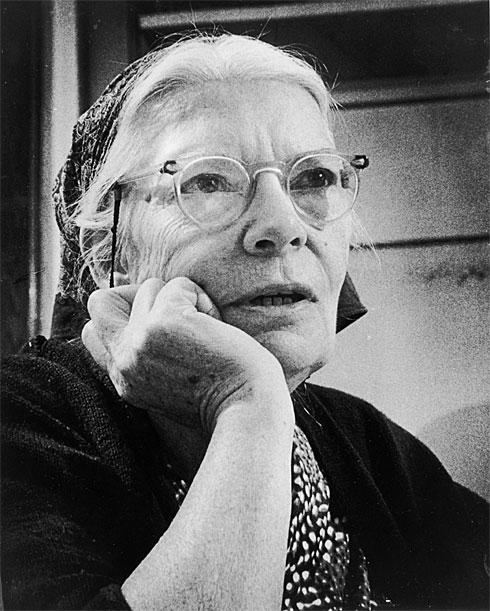
What we would like to do is change the world- make it a little simpler for people to feed, clothe, and shelter themselves as God intended them to do. And, by fighting for better conditions, by crying our unceasingly for the rights of the workers, the poor, of the destitute- the rights of the worthy and the unworthy poor, in other words- we can, to a certain extent change the world; we can work for the oasis, the little cell of joy and peace in a harried world. We can throw our pebble in a pond and be confident that its ever-widening circle will reach around the world. We repeat, there is nothing we can do but love, ad dear God, please enlarge our hearts to love each other, to loveour neighbor, to love our enemy as our friend.”
Dorothy Day
Back from the Crocodile’s Belly: Philippine Babaylan Studies and the Struggle for Indigenous Memory
 S. Lily Mendoza is a native of San Fernando, Pampanga in Central Luzon, Philippines. Lily is especially known in the Philippines and beyond for her pathbreaking work on indigenization and indigenous studies. She is a scholar and associate professor of Culture and Communication at Oakland University in Rochester, Michigan.
RD: What is the crocodile’s belly? Where does the title come from?
LM: I don’t know if I should even dare tell you what our original title was. But it was Towards a Postcolonial Indigeneity: Babaylanism as Critical Pedagogy for Diasporic Struggles (laughter). Continue reading “Back from the Crocodile’s Belly: Philippine Babaylan Studies and the Struggle for Indigenous Memory”
“God is Like a Mountain” (Mk 9:2-9)
By Ched Myers, for Transfiguration Sunday (6. Epiphany)
Note: This is an ongoing occasional series of Ched’s brief comments on the Markan gospel readings from the Revised Common Lectionary during year B.
——————
Without wildness, civilization could not survive. The converse does not hold.
Evan Eisenberg, The Ecology of Eden
The Feast of the Transfiguration probably dates back to the late Roman period. A major feast in the Eastern Church, it was not widely practiced until the 9th century by the Western Church. August 6th was designated as Feast of the Transfiguration for the whole church in 1456. The Roman Catholic Church today also commemorates the Transfiguration on the second Sunday in Lent, but the Revised Common Lectionary puts the story at the last Sunday of Epiphany, just before Lent. This is done in order to recognize the Transfiguration’s close relationship in the synoptic gospel narratives to Jesus’ journey toward Jerusalem and the Cross.
Continue reading ““God is Like a Mountain” (Mk 9:2-9)”
The Real St. Valentine
 From Ken Sehested on his wonderfully illuminating Prayer & Politiks site. Subscribe to his weekly e-newsletter here.
—————–
Every year, prior to Valentine’s Day (celebrated in a surprising number of countries), children in our church create homemade Valentine’s cards to send to inmates, observing St. Valentine’s Day as the occasion to remember those in prison. Here is a little background.
While the existence of St. Valentine is not in doubt—archeologists have unearthed a chapel built in his honor—reliable accounts of his life are scarce. Which is why, in 1969, the Vatican removed St. Valentine from its official list of feasts.
Continue reading “The Real St. Valentine”
Creatively Resisting A Fracked Up California
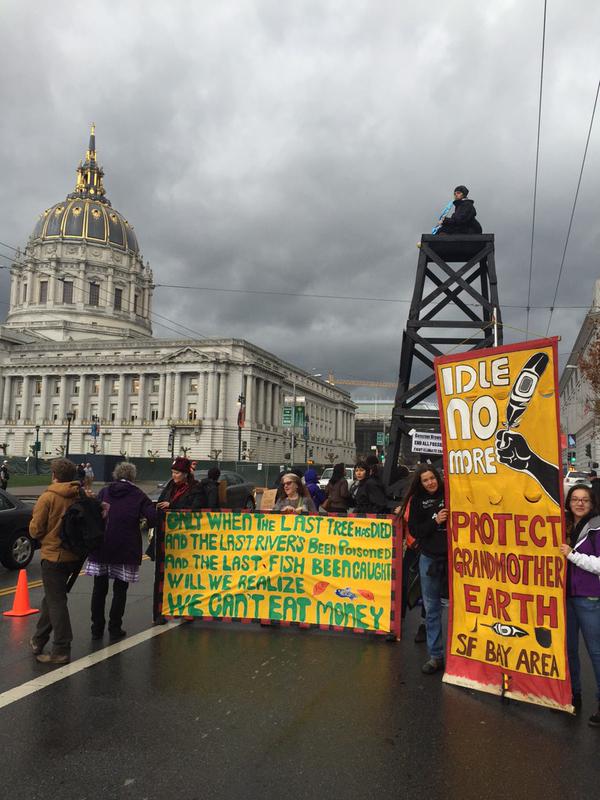 Excerpts from a piece by Sarah Lazare of Commondreams.org, reporting from the big climate justice action in San Francisco this weekend:
More than 150 protesters on Friday blockaded the California State Office Building in downtown San Francisco and erected a 16-foot fracking well in the middle of an intersection to demand Governor Jerry Brown cease all drilling and fossil fuel extraction and respect climate justice (photo right from Steve Rhodes).
Campaigners—who hail from labor, indigenous, student, and community organizations—were awaiting arrest at the time of publication…
Continue reading “Creatively Resisting A Fracked Up California”
A Betrayal of the Disappointed
 From Dorothee Soelle in “Christofascism,” in The Window of Vulnerability: A Political Spirituality (1990):
At a mass meeting a thousand voices shouted: ‘I love Jesus’ and ‘I love America’ — it was impossible to distinguish the two. This kind of religion knows the cross only as a magical symbol of what he has done for us, not as the sign of the poor man who was tortured to death as a political criminal, like thousands today who stand up for his truth in El Salvador. This is a God without justice, a Jesus without a cross, an Easter without a cross — what remains is a metaphysical Easter Bunny in front of the beautiful blue light of the television screen, a betrayal of the disappointed, a miracle weapon in service of the mighty.
Putting your shoulder to the wheel of history
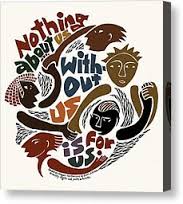
“White people are taught that racism is a personal attribute, an attitude, maybe a set of habits. Anti-racist whites invest too much energy worrying about getting it right; about not slipping up and revealing their racial socialization; about saying the right things and knowing when to say nothing. It’s not about that. It’s about putting your shoulder to the wheel of history; about undermining the structural supports of a system of control that grinds us under, that keeps us divided even against ourselves and that extracts wealth, power and life from our communities like an oil company sucks it from the earth.”
– Ricardo Levins Morales
What Would Happen if Jesus Came to Your Home?
 By Ched Myers, Fifth Sunday in Epiphany (Mk 1:29-39)
Note: This is an ongoing occasional series of Ched’s brief comments on the Markan gospel readings from the Revised Common Lectionary during year B.
———————
In Mark 1:28, Jesus retreats to a home from his confrontation with the “Powers” occupying the synagogue, having created space for change. In Mark’s story, the home seems to be a safe site (5:38; 7:17, 24; 9:33; 10:10; 14:3), in contrast to the synagogue and Temple as places of conflict. Such “politics of space” no doubt reflected the experience of the earliest church—or of any social renewal movement’s relationship with established institutions of control. In this case, we should note that Jesus avails the hospitality of a peasant fisherman, setting the pattern that will continue throughout this story: Jesus abides with the marginalized.
Continue reading “What Would Happen if Jesus Came to Your Home?”
Agents of God’s Invasion
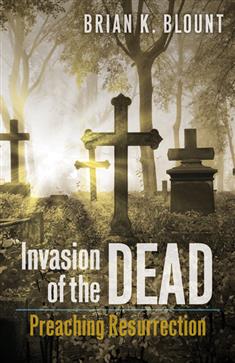 Since 2007, Brian Blount has been the president and professor of New Testament at Union Presbyterian Seminary, Richmond, VA, and Charlotte, NC. Before that, Dr. Blount was the professor of New Testament Interpretation at Princeton Theological Seminary for 15 years. In this interview, we focus on his most recent publication Invasion of the Dead: Preaching Resurrection (2014).
——————–
RD: What led you into researching and writing Invasion of the Dead?
BB: I initially wanted to write about our contemporary understanding and misunderstanding of apocalyptic literature. I was very interested in trying to help the church read apocalyptic literature in the context of the 21st century, particularly in light of the way contemporary popular culture was reading apocalyptic language and imagery. This concern developed because of my sense that popular culture had really taken a liking to material that the church had given up on, even though apocalyptic imagery is a part of Christianity’s birthright. The more I worked on it, the more I realized that there were many persons, like my former teacher, J. Christiaan Beker, already speaking to this issue. What they were not speaking to more specifically was the language of resurrection, which is consummate apocalyptic language. As I focused more and more, my interest went more and more to reading resurrection as an apocalyptic theological reality.
Continue reading “Agents of God’s Invasion”
Prayer
 by tommy airey
Prayer from the heart can achieve what nothing else can in the world.
Gandhi
We do not want to be beginners [at prayer], but let us be convinced of the fact that we will never be anything but beginners, all our life!
Merton
…………………..
Prayer is a pilgrimage into the deepest recesses of our being. It is being attentive to God’s active presence both with us and within us. The 15th century Indian contemplative Kabir wrote that “God is the breath inside the breath.” The Apostle Paul quoted the philosopher Epimenides as he sermonized the Athenians: “For in him we live and move and have our being.” God is that energy and power and inspiration that we draw upon to live and thrive. Continue reading “Prayer”
 Radical Discipleship