This is Not News

A re-post from Shelagh Rogers (Facebook, June 6, 2021), who helped facilitate the Truth and Reconciliation Commission in Canada in 2015.

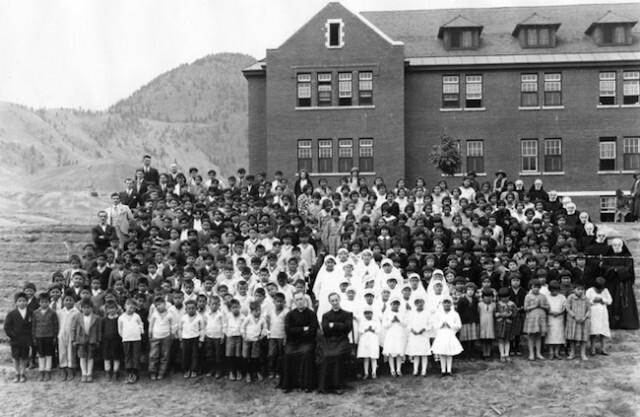
When we learned about the 215 Indigenous children buried on the grounds of Kamloops Indian Residential School while in the care of Catholic clergy who ran the school, the Prime Minister shared this tweet:

“The news that remains were found at the former Kamloops residential school breaks my heart – it is a painful reminder of that dark and shameful chapter of our country’s history. I am thinking about everyone affected by this distressing news. We are here for you.”

I want to parse the tweet out a little.

May I start with “The news”? I don’t understand how could this be news when a whole volume of the TRC report (V.4, 266 pages) is dedicated to children who did not come home? That volume is titled “Canada’s Residential Schools: Missing Children and Unmarked Burials”. Have you read it, Prime Minister? It’s been out for 5 and 1/2 years. Is it required reading for all your ministers? I was there in December of 2015 when the full 6 volume TRC report was presented to you, Prime Minister. I was in the company of fellow TRC honorary witnesses from Coast Salish territory, Andrea Walsh and Chief Bobby Joseph.

Continue reading “This is Not News”

Sowing Hope

By Ched Myers, for the 3rd Sunday after Pentecost (Mark 4:26-34)

Note: This is an ongoing series of re-posts of Ched’s brief comments from 2015 on the Markan gospel readings from the Revised Common Lectionary during year B.

This week the lectionary gives us the last third of Jesus’ parables sermon (hopping over the famous parable of the Sower and its allegorical interpretation, Mk 4:2-23). This section begins with a sober warning:

And he said to them, “Take heed what you hear: ‘The measure you give will be the measure you get, and still more will be given you. For to him who has will more be given; and from him who has not, even what he has will be taken away’.” (Mk 4:24-25)

Mark’s Jesus cautions his audience to “beware” of the anti-Jubilary ideologies they hear from elites, which counsel resignation in the face of injustice (4:23). The assertion that the gulf between haves and have-nots will inevitably grow was the “realism” advanced by wealthy landowners to justify their privilege (4:24). These two verses are omitted by the lectionary portion, but in fact are the point to which the next two parables serve as radical counterpoint, as Jesus repudiates such rationalizations of economic stratification (in the spirit of another parable-spinner, Ezekiel, see Ez 18:1-9).

Continue reading “Sowing Hope”

The Dance with our DNA

Image credit: Angelica Frausto, “My Ancestors Hold Me”, 2020, digital, 13 in x 13 in.

By Naomi Ortiz, published in Geez magazine’s Signs of Dawn

As a mixed person with Indigenous, Latinx, and white heritage, I’ve become practised at acknowledging the historical complexities that live within my own body.

I came to doing ancestral work not because I had access to information through websites or even family stories, but because I felt responsibility to legacies that live on in my body. I am aware that violence got me here as much as love. Ancestral work is an invitation to the in-between.

Sitting on the side of the road at the edge of the desert, I look up into a mountain ridge full of Palo Verdes, Ocotillos, Jojoba bushes, and Saguaros. Intuitively, I know if I could see my ancestors and their numbers, they would stretch like this desert plant life as far as I could see.

Continue reading “The Dance with our DNA”

White Evangelical Racism

An excerpt from an interview with Anthea Butler, the author of the new release White Evangelical Racism. The full interview with Eric Miller at Religion and Politics can be read here.

I chose this title because I wanted to set certain parameters for the book. I specified white evangelicals to show that I’m using the term in the way that it is used colloquially by the media and the political pundits, rather than in some academic sense. That popular understanding of evangelical can be traced to self-identification, to the demographic of white, Christian conservatives who consider themselves evangelical. And I included racism because it is a very particular type of racism that I am discussing. That is, the racism that hides behind “moral” issues.

I address these questions at some length in the book, exploring how the meaning of evangelicalism has changed over time, and recognizing that there are a lot of people out there who don’t realize they’re in this thing because their self-concept leans heavily on theological considerations, allowing them to pretend that they’re not political. But nobody cares about your commitment to the Bebbington Quadrilateral when you’re arguing about the Supreme Court or judges or abortion. They care about how your belief informs your politics, which candidates you vote for, and what they stand for. So I wanted to pull evangelicals out of this safe little realm in which they’ve placed themselves and press them to confront how other people see them.

Binding the Strong Man: Jesus’ Master Metaphor

By Ched Myers, for the 2nd Sunday of Pentecost (Mk 3:20-35)

Note: This is re-posted from a series of Ched’s brief comments in 2015 on the Markan gospel readings from the Revised Common Lectionary during year B.

The first major narrative cycle in Mark’s gospel (1:16-3:6) ends with Jesus’ rejection by the authorities in a Capernaum synagogue. The following episodes serve to regenerate the story by a withdrawal and summary scene (3:7-12) and then by a reconsolidation moment (3:13-19a). The latter mountaintop scene boldly re-contextualizes two of the most revered traditions of Israel: God’s covenant with Moses on Sinai, and Moses’ founding of the free tribal confederacy in the wilderness. Jesus, who has taken the torch from the prophets, prepares to pass it on to twelve disciples he has called, named, and commissioned to proclaim, heal and exorcize (3:14f). Shortly they will be sent out to practice this charge – a second regenerative episode that follows upon another synagogue rejection (6:1-13).

Continue reading “Binding the Strong Man: Jesus’ Master Metaphor”

Transition News from Word and World

From Michael Boucher

When Word and World first began in 2001, the dream was to bring together the seminary, sanctuary, streets and soil in a traveling alternative seminary in order to fill a gap that so many had been noticing.  Word and World stood in the traditions of ‘church as movement’ and movement work as church and sought ways to the bring stories, practices and histories of liberation into deep and meaningful dialogue with our rich faith tradition.

Originally Word and World focused on creating week long (or multi-day) “schools” where participants would create a movement village and learning collaborative at various places across the United States to witness the local stories of struggle, faith and liberation as they were lived out in that context. 

Continue reading “Transition News from Word and World”

The Womanist Theology of Rev. Dr. Katie Geneva Cannon

An excerpt from a reflection on the life of Rev. Dr. Katie Geneva Cannon by Angela D. Sims. Re-posted from Religion and Politics, February 2019.


In every generation, a “remnant” of scholars emerges that challenges status quo perspectives. Their critiques of normative constructs serve as models for subsequent scholars who learn how to work not only to eat but also to work in a manner that enables others to eat. The Rev. Dr. Katie Geneva Cannon was indeed such a person. She loved life, loved people, loved laughter, loved food, loved imagining the not yet, loved calling things into existence. The progenitor of womanist theological ethics, Cannon was a brilliant scholar, a mentor extraordinaire who possessed an ability to discern what was most needed, and generous (almost to a fault) in the sharing of her time and resources…

…Born January 3, 1950, in Kannapolis, North Carolina, Cannon became the first black woman to be ordained in the United Presbyterian Church, a precursor to the Presbyterian Church (U.S.A). After earning her doctorate at Union Theological Seminary in New York City—the first African American woman to do so—Cannon laid the foundation for womanist ethics in her 1985 essay, “The Emergence of Black Feminist Consciousness.” Many black women in theological disciplines, including Cannon, have gravitated to the use of author Alice Walker’s term “womanist” as both a challenge to and a confessional statement for our own work. Womanist, as defined in Walker’s In Search of Our Mothers’ Gardens: Womanist Prose, contains elements of tradition, community, self, and a critique of white feminist thought and provides a fertile ground for religious reflection and practical application.

Continue reading “The Womanist Theology of Rev. Dr. Katie Geneva Cannon”

The Ditch

Combustion, by Marcia Foutch

By Marcia Foutch

I lived in Minneapolis for more than 30 years before I moved to Greensboro five years ago.  Our family home is at 32nd and Columbus which is 6 blocks from where George Floyd was killed. The majority of my family lives in the Minneapolis area (including the now infamous Brooklyn Center). At the beginning of the uprising that started last summer my son, who we call Bubby, asked me,” “Why do white people care about the murder of George Floyd? They’ve been killing us for more than 400 years – so what is so different about this one?”  I struggled trying to figure out an answer to his question. I thought about Grace Lee Boggs and her advice to look at “What time is it on the clock of the world?’.  And I thought of Reverend Nelson Johnson talking about the small streams of justice that flow into a mighty river that cannot be stopped.  And I thought of something that Deacon Bob Foxworth at Faith Community Church told me when I got to Greensboro a few years ago about what it takes to hold a man down in a ditch.  And after months of grappling with this question- this poem is my attempt to answer Bubby’s question.

What
Sparked this
Uprising? What is it
About the killing of
George Floyd that
Made White America care
About the killing of
This Black Mother’s son?

Continue reading “The Ditch”

Geez magazine: Call for Advent pieces

Embracing Darkness
Due June 1, 2021

Credit: Megan Suttman

This year, Geez will offer a second edition of our daily Advent reflection book. While we hope that the pieces are as wild and varied as our community, we also hope to narrow in on the theme of Embracing Darkness. We are looking for reflections, poetry, prayers, and whatever else you can think of that fits in 200 words.

What can the darkness teach us? What gifts or wisdom can only be accessed in the night? What would the moon have to say about the dance between dark and light? Which Biblical or movement ancestors do we turn to as models of embracing darkness? How do we build our courage to stay in the dark? How do we resist the problematic binary of light (good) and darkness (bad)? How does this season offer a spiritual invitation towards racial justice? How does darkness welcome us into the counter-cultural work of rest and slowing down? What does fear of the dark have to do with fear of death? How do we resist the flashing lights of capitalist, consumerist Christmas? How do we learn from seeds that germinate in the dark and creation that is formed in the womb?

As always for Geez, we will be looking for words that shift the structures of power, incite community, make us belly laugh, and illuminate beauty and imagination.

Continue reading “Geez magazine: Call for Advent pieces”