The Subversion of Hierarchical Power

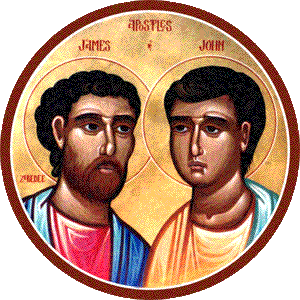
zebedeeBy Ched Myers, for the 21st Sunday in Pentecost (Mark 10:32-45), originally posted in 2015

Note: This is an ongoing series of Ched’s brief comments on the Markan gospel readings from the Revised Common Lectionary during year B, 2015.

The last cycle of the discipleship catechism begins, as did the previous story of the rich man, “on the Way.” Here the journey is finally revealed as headed to Jerusalem, the place of final confrontation with the Powers (10:32a). Jesus “goes before” the discipleship community, who are amazed and afraid (10:32b). This snapshot will be important to remember at the end of the story, where at the empty tomb we are told that Jesus “goes before” disciples who are both afraid and “ecstatic” (16:7f).
Continue reading “The Subversion of Hierarchical Power”

The Call of the Rich Man as a Text of Terror

JesusBy Ched Myers, for the 20th Sunday in Pentecost (Mark 10:17-31), originally posted on October 8, 2015

Note: This is an ongoing series of Ched’s brief comments on the Markan gospel readings from the Revised Common Lectionary during year B, 2015. This post is 2-3 times longer than previous ones because of the importance of this text to our struggle to be disciples within a capitalist culture.
—————
The story of Jesus and the rich man lies at the crossroads of Mark’s narrative. From here Jesus will turn toward Jerusalem, a destination of confrontation with the Powers that evoked dread and denial among his disciples then (10:32) as now. But the encounter between Jesus and this affluent gentleman represents a theological crossroad as well.
Continue reading “The Call of the Rich Man as a Text of Terror”

“Defect-ive” Discipleship: Recovering from Domination Culture

JesusBy Ched Myers, for the 18th Sunday of Pentecost (Mark 9:38-50), originally posted on September 24, 2015

This week continues our journey through the second cycle of Mark’s discipleship catechism. Here John boasts that the disciples shut down the work of an exorcist who was not “following us” (9:38). Under these narrative circumstances, never was the “royal we” more inappropriate! Jesus’ attempt to deconstruct hierarchical power is met with the crudest of assertion of “franchise entitlement.” But is not this a poignant (if sardonic) portrait of how we Christians so often look at our faith traditions as membership clubs? Continue reading ““Defect-ive” Discipleship: Recovering from Domination Culture”

The Cross in Everyday Life: Embracing the “Least”

crucifixionBy Ched Myers, for the 17th Sunday of Pentecost (Mark 9:30-37), re-posted from September 2015

In the wake of the “confessional crisis” (last week’s reading), Mark’s narrative now turns to a triple cycle of object lessons and teaching I call the “discipleship catechism.” This Sunday’s gospel text comes from the second and longest cycle, with its focus of instruction on the less heroic, yet perhaps more difficult, practice of the Way in daily life.

The cross represents more than nonviolent resistance to the Powers; it includes the struggle against patterns of domination in interpersonal and social relationships as well. Thus Mark here addresses several expressions of social power imbalance: greatest and least (9:36f); outsiders and insiders (9:38-41); offenders and victims (9:42-50); male and female (10:2-12); children and adults (10:13-16); and rich and poor (10:17-31). This sequence exhibits certain similarities to catechetical traditions found elsewhere in the New Testament relating to family and community life such as the so-called “House-tables” (e.g. Col 3:12-4:6). Continue reading “The Cross in Everyday Life: Embracing the “Least””

Learning from the Other

lentzBy Ched Myers, for the 15th Sunday of Pentecost (Mk 7:24-37)

Note: This is a re-post of Ched’s brief comments on the Markan gospel readings from the Revised Common Lectionary during year B, 2015. The original piece was posted on September 3, 2015.

In a doublet I called a “tale of two women” (5:21-43; see my blog on the gospel for 5 Pentecost) Mark presented two linked healings in “Jewish” symbolic territory. He now narrates a corresponding doublet in clearly marked “Gentile” space (7:24). Tyre and Sidon were coastal cities not only well outside Palestinian Jewish society, but historic centers of the Phoenician naval empire, a legendary adversary of Israel (see e.g. Ezekiel 26-28), though now part of the Roman province of Syria. These healings of a woman and man are thus surprising, and serve as object lessons in the inclusivity just advocated in the previous Markan episode. Continue reading “Learning from the Other”

The Crossings

TabghaBy Ched Myers, for the 8th Sunday of Pentecost (Mk 6:30-34, 45-56)

Note: This is an ongoing series of Ched’s brief comments on the Markan gospel readings from the Revised Common Lectionary re-posted from year B, 2015.

The lectionary melts down a little this week. On one hand, it inexplicably avoids the wilderness feeding (6:35-44), such that we get neither of Mark’s two versions of this tradition in Year B. Continue reading “The Crossings”

The Tale of Two Women: The Priority of the Marginalized

By Ched Myers, for the 5th Sunday of Pentecost (Mk 5:21-43) 

Note: This is an ongoing series of Ched’s brief comments on the Markan gospel readings from the Revised Common Lectionary during year B, 2015. 

In Mark’s tale of the Gerasene Demoniac (Mk 5:1-20), Jesus brings dramatic liberation to a man “occupied” by the spirit of Legion (i.e. Roman imperialism) on the Gentile side of the Sea of Galilee. Frustratingly, this powerful story is again deftly avoided by the Revised Common Lectionary (but you can read my comments on it here in “Sea-Changes: Re-Imagining Exodus Liberation as an ‘Exorcism’ of Imperial Militarism” in Challenging Empire: God, Faithfulness and Resistance, edited by Naim Ateek et al, Sabeel Ecumenical Liberation Theology Center)Jesus then returns across the sea to “Jewish” territory (5:21), where the next episode dramatizes how the poor were given priority in the ministry of Jesus. Mark 5:22-43 is yet another example of “sandwich-construction,” which wraps a story within a story in order to compel the reader to interrelate the two. The setting of the first half of this narrative sequence seems to be the “crowd” itself (5:21,24,27,31). Jesus is approached by a synagogue ruler who appeals on behalf of his daughter, who he believes to be “at the point of death” (5:23). Jesus departs with him on this mission, and we fully expect this transaction will be completed. On his way, however, Jesus is hemmed in by the crowds (5:24).

Continue reading “The Tale of Two Women: The Priority of the Marginalized”

A Storm Blowing From Paradise…

By Ched Myers (4 Pentecost: MK 4:35-41)

Note: This is an ongoing series, re-posting Ched’s brief comments from 2015 on the Markan gospel readings from the Revised Common Lectionary during year B.

This Sunday’s gospel text is the poignant story of Jesus and his disciples caught in a storm at sea, which threatens to drown them. It is a profound, archetypal scenario that Mark narrates twice (again in 6:45-52). Because today is the day that Pope Francis’ historic encyclical on climate crisis is being published, I will focus on how this appeal addresses the storm that is Climate Catastrophe. A month from now I will return to Mark’s sea stories for Pentecost 8 (on which day the Lectionary inexplicably hops over the second boat journey in its piecemeal gospel selection, which we’ll rectify!).

Continue reading “A Storm Blowing From Paradise…”

Sowing Hope

By Ched Myers, for the 3rd Sunday after Pentecost (Mark 4:26-34)

Note: This is an ongoing series of re-posts of Ched’s brief comments from 2015 on the Markan gospel readings from the Revised Common Lectionary during year B.

This week the lectionary gives us the last third of Jesus’ parables sermon (hopping over the famous parable of the Sower and its allegorical interpretation, Mk 4:2-23). This section begins with a sober warning:

And he said to them, “Take heed what you hear: ‘The measure you give will be the measure you get, and still more will be given you. For to him who has will more be given; and from him who has not, even what he has will be taken away’.” (Mk 4:24-25)

Mark’s Jesus cautions his audience to “beware” of the anti-Jubilary ideologies they hear from elites, which counsel resignation in the face of injustice (4:23). The assertion that the gulf between haves and have-nots will inevitably grow was the “realism” advanced by wealthy landowners to justify their privilege (4:24). These two verses are omitted by the lectionary portion, but in fact are the point to which the next two parables serve as radical counterpoint, as Jesus repudiates such rationalizations of economic stratification (in the spirit of another parable-spinner, Ezekiel, see Ez 18:1-9).

Continue reading “Sowing Hope”

Binding the Strong Man: Jesus’ Master Metaphor

By Ched Myers, for the 2nd Sunday of Pentecost (Mk 3:20-35)

Note: This is re-posted from a series of Ched’s brief comments in 2015 on the Markan gospel readings from the Revised Common Lectionary during year B.

The first major narrative cycle in Mark’s gospel (1:16-3:6) ends with Jesus’ rejection by the authorities in a Capernaum synagogue. The following episodes serve to regenerate the story by a withdrawal and summary scene (3:7-12) and then by a reconsolidation moment (3:13-19a). The latter mountaintop scene boldly re-contextualizes two of the most revered traditions of Israel: God’s covenant with Moses on Sinai, and Moses’ founding of the free tribal confederacy in the wilderness. Jesus, who has taken the torch from the prophets, prepares to pass it on to twelve disciples he has called, named, and commissioned to proclaim, heal and exorcize (3:14f). Shortly they will be sent out to practice this charge – a second regenerative episode that follows upon another synagogue rejection (6:1-13).

Continue reading “Binding the Strong Man: Jesus’ Master Metaphor”