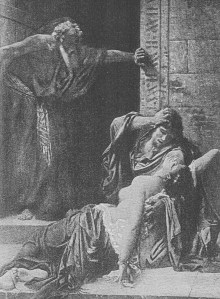
Sermon: She was not: The Bible’s most vividly brutal story, and why we must read and remember it


concubine in Judges 19Ken Sehested, Circle of Mercy, 9.19.05
Judges 19:1-30

There have been two special occasions in my life when I have become agonizingly aware of the special fear women feel over the threat of sexual assault.

The first happened when Nancy and I were counting the days before our wedding in 1973. Every couple weeks she came in from where she went to school in New Jersey to meet me in a chaplain’s office in New York City. We were doing a series of premarital counseling sessions. Continue reading “Sermon: She was not: The Bible’s most vividly brutal story, and why we must read and remember it”
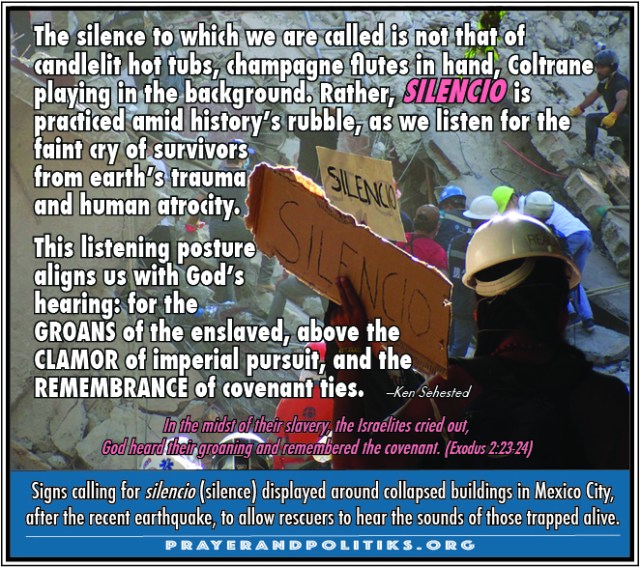
Another Word is in the Wind: A Psalm of Complaint and Avowal

prayer and politiksBy Ken Sehested, the curator of Prayer & Politiks

Have mercy upon us, O Lord.
Our soul has had more than its fill
of the scorn of those who are at ease,
of the contempt of the proud.
—Psalm 123:3-4

In the end, if we are left to our own devices—to our
own amalgam of brains and brawn, of ingenuity and
charisma, sleight of hand and strength of arm, in
mobilizing sufficient force to bend the will of others
to our own, in accordance to self-ordained vision
masquerading as fate’s foreordained history—then
nothing is forbidden. All authority is subsumed in
the will to power. Continue reading “Another Word is in the Wind: A Psalm of Complaint and Avowal”

Sermon: Religious liberty, or social mischief? Understanding the “wall of separation” between church and state

indexBy Ken Sehested, 9 July 2017, Circle of Mercy Congregation, Asheville, NC

Text: Psalm 72

(The text below has been expanded from the original sermon.)

Not so long ago a sermon on religious liberty would likely provoke yawns. The widespread and diverse claims of “religious freedom” are so common and unquestioned in our culture, they mostly go without notice. (Which, if anything, may be testimony to how tamed our assumptions have become.) Continue reading “Sermon: Religious liberty, or social mischief? Understanding the “wall of separation” between church and state”

Conflicting Memorials: The Lord’s Table of Remembrance vs. The Nation’s Vow of Preeminence

Ken SehestedBy Ken Sehested

My earliest memory of Memorial Day is of my Dad, puttering in his garage shop (he was a mechanic and jack-of-all-trades fixer-upper) on a rare day off from work, listing to the Indianapolis 500 car race on a portable radio. On one of those occasions I remember using a hammer, and the concrete garage floor, helping him straighten nails for reuse.

Both my parents were children of the Depression. Thrift was a primal virtue even when it was no longer a necessity.

I have no doubt Dad would silently recall some of his war-time experience while enduring the monotony of listening to race cars doing 200 laps around an oval track at speeds in excess of 200 mph. He managed to survive being in the first wave of troops landing at Omaha Beach in the 1944 D-Day invasion of Europe, though I can remember only once in my life when he talked about those days. I was an adult before I knew he carried a bit of 88mm German artillery shrapnel, bone-embedded, behind his right ear.
Continue reading “Conflicting Memorials: The Lord’s Table of Remembrance vs. The Nation’s Vow of Preeminence”

Pacem in terris: Easter, Earth Day, and Pentecost’s promise

prayer-politiks-logo-1x.pngBy Ken Sehested

Pacem, pacem, pacem in terris

Easter’s focus is always sharper when allied with Earth Day. We sing, properly, of being wayfaring strangers. “A wandering Aramean was my ancestor” (Deuteronomy 26:5) is among the oldest testimonies of fate and faith. An alternate translation—“A Syrian ready to perish was my ancestor”—brings added poignancy to the text

We are indeed strangers; but not foreigners. In common usage these two words seem similar. Biblically speaking, though, the theological difference could not be greater. Continue reading “Pacem in terris: Easter, Earth Day, and Pentecost’s promise”

Easter’s Aftermath

ResurrectionBy Ken Sehested, the editor and author of prayerandpolitiks.org, an online journal at the intersection of spiritual formation and prophetic action

Easter resurrection is never as assured
as the arrival of Easter bunnies.

Clothiers and chocolate-makers alike yearn
for the season no less than every cleric.

And yet, in my experience, the Spirit
rarely blows according to the calendar,
much less on demand. Continue reading “Easter’s Aftermath”

Lamentations’ call to arms

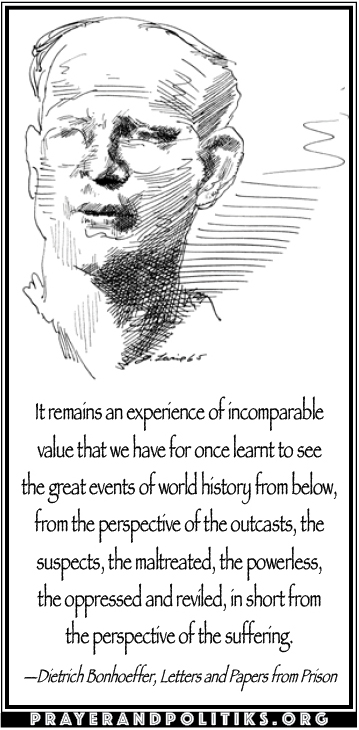
kenA poem inspired by the book of Lamentations (especially chapter three)

by Ken Sehested

Turn off (what passes for) the news.
Boycott the season’s electoral charades.
Don’t give in to Pokémon’s promise of
“augmented reality.” Attend instead to
unmitigated reality: bloodied, stricken
and strewn. Offer grief the hearing it
demands, the voice it obliges, and
the risk it assumes. Continue reading “Lamentations’ call to arms”

The Labor of Lament

TearsBy Ken Sehested, of Prayer & Politiks, written for an ecumenical “Service of Lament and Healing” following the August 2014 killing of Michael Brown by police in Ferguson, MO. Inspired by Ps 6:6; 42:3; 80:5; 102:9; Luke 7:38

Who among you believe that
grieving and lamentation
are symptoms of despair.
Not so!
Only the hopeless are silent
in the face of calamity—
silenced because they no
longer aspire even to be heard,
much less heeded. The labor
of lament, on the other hand,
is premised on the expectation
that grief’s rule will be bound
by the Advent of Another. Continue reading “The Labor of Lament”