A God Who is Very Different from the Almighty

AugsburgerFrom the conclusion of David Augsburger’s recent piece “Lent: Is God Like Jesus?” originally posted on The Mennonite blog. Read the entire Lenten reflection here.
“Christ is not only God-like, but God is Christ-like,” Martin Luther King Jr. wrote in Strength to Love (1963). The Christian gospel proclaims a God who is very different from “the Almighty,” the historic God among all the gods who is, by trusted definition, an omnipotent paragon of ultimate invincible irresistible power. The God of Jesus Christ, in Leonardo Boff’s phrase, is “weak in power but strong in love” (Cry of the Earth; Cry of the Poor, 1978).

God is like this gentle good gracious guest at Mary, Martha and Lazarus’ home, at Zacheus’ table, at Simon’s banquet, at Cleophas and spouse’s supper. Continue reading “A God Who is Very Different from the Almighty”

Wild Lectionary: Roots and Stories

7491435002_e9fed382f8_o
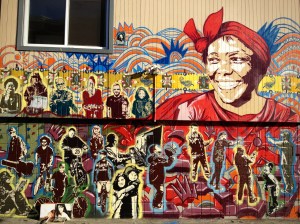
Wangari Maathai mural in the Lower Haight. Photo by Phil Dokas.

Lent 1

Deuteronomy 26:1-11
Psalm 91:1-2, 9-16
Romans 10:8b-13
Luke 4:1-13

By Rev. Dr. Victoria Marie

As I reflected on today’s readings, the theme they seemed to weave together is to begin Lent by reviewing our stories. With the First Reading, in which the writers of Deuteronomy are giving the reader a sort of Last Will and Testament of Moses, God’s people are reminded of their history and God’s presence in it. They are told to recount that history in ritual and celebration. We are also being reminded to reflect on our personal intergenerational stories. Who were our ancestors? How was God with them as they journeyed? How do their stories impact your story? How has God’s presence in all of our stories led us to where we are today: physically, socially, emotionally and spiritually? The First Reading reminds us to ponder these questions as we reflect on our stories. Continue reading “Wild Lectionary: Roots and Stories”

Wild Lectionary: Leafy Branches Sunday – Domingo de Ramos

imagejpeg_0-5Palm Sunday, Year B
Mark 11:1-11

By Carmen Retzlaff

The Palm Sunday story in the Gospel of Mark says that

Many people spread their cloaks on the road, and others spread leafy branches that they had cut in the fields. (Mark 11:8)

The Greek (from Thayer’s Greek Dictionary) is:

stiba¿ß; stibas, stibados; a. a spread or layer of leaves, reeds, rushes, soft leafy twigs, straw, etc., serving for a bed; b. that which is used in making a bed of this sort, a branch full of leaves, soft faliage Continue reading “Wild Lectionary: Leafy Branches Sunday – Domingo de Ramos”

Bright Sadness

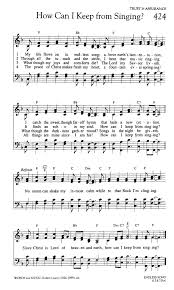
indexA litany for Lent, to be read while “How Can I Keep From Singing” is played in the background, after which the congregation sings one or more verse of the song

by Ken Sehested

In the Eastern Orthodox tradition, the season of Lent is described as a “bright sadness.”

In the sadness that surrounds our lives, our community, our world, we give thanks, nevertheless. More is at work than we can see. Continue reading “Bright Sadness”

What Resurrection Means

LyniceOur Last day of the Lenten Journey.  [S]he is risen indeed.  From Rev. Lynice Pinkard of Oakland’s Seminary of the Street, in an interview with Sun Magazine in 2014.

We’re not going to do this work — of bringing people together, of stemming the tide of ecological abuse, of dealing with income inequality — without having something inside us change. Before I even get to my interaction with you, I need to examine my own self-interest. That’s what resurrection means to me: being able to rise above self-interest and the interests of your group. For me resurrection is about laying down our weapons and getting up off our assets. Resurrection is not merely about whether Jesus is dead or alive, in the tomb or not. In Romans, the Bible says the same spirit that raised Jesus from the dead can quicken our mortal bodies to life. We can leave our cemeteries, abandon the deadness and the death-dealing nature of our lives. We can rise above the life-limiting forces that hold us down. For me, that’s resurrection: crossing over from self-interest to true solidarity.

A Struggle of Interpretation

ElsaDay 46 of our Lenten Journey beyond “Beyond Vietnam.”  From Costa Rican biblical scholar Elsa Tamez, an excerpt from an article entitled “The Bible and Five Hundred Years of Conquest” (2005).
We see that for five hundred years we have been involved in a struggle of interpretation: some from a liberating perspective and others from a legitimating perspective of oppression. The struggle for a liberating reading of the Bible is good, nevertheless, it seems to me. After taking a look at history and seeing ourselves there as in a mirror, we need to go beyond the hermeneutical struggle. We should revise the discourse of our written canon and the logic of Christian thought; maybe there is a deeper problem that facilitates the rapid inversion of values. I am referring to aspects such as the biblical conception of time, that is, infinite progression toward the final victory (the Day of the Lord, the battle of Armageddon, the crushing of the enemy). These can be a double-edged sword—or the idea of a universalist, tolerant, egalitarian God, which is projected in the following scheme: “God is good for all; for that reason, all are good for God.” There is no distinguishing the difference. The sacrificial discourse, principally christological, sometimes degenerates into demands of unnecessary sacrifices or into the logic of crucifying the crucifiers; others such as the Elect of God, the Holy War, and so on need to be reworked. This is a matter not just of intellectual concern but of honesty before unjust practices that are easily legitimated with the Bible and theology. All of this leads us to rethink popular hermeneutics and to rework in great depth the significance of biblical authority.

The Fourth Word

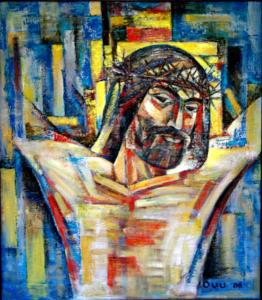
Hovsep MesropianBy Ric Hudgens, for Good Friday (art by Hovsep Mesropian)

He was hanging there trying to remember,
the weight of his body weighing on his mind.
What was the first line of that song we used to sing?
His head was perplexed with pain, his muscles
aching in place, his body stretched out along this beam,
no way to find rest that didn’t increase the sting.

Continue reading “The Fourth Word”

Those Most Othered

KBDDay 45 of our Lenten Journey beyond “Beyond Vietnam.”  A Good Friday meditation from theologian Kelly Brown-Douglas, excerpted from a post on the Feminism and Religion blog.

In Jesus’ first century Roman world crucifixion was reserved for slaves, enemy soldiers and those held in the highest contempt and with lowest regard in society. To be crucified was, for the most part, an indication of how worthless and devalued by established power an individual was.  It also indicated how much of a threat that person was believed to be to the order of things. There was a decided crucified class of people. These were essentially the castigated and demonized as well as the ones who defied the status quo of power. It is in this respect that I believe Jesus’ crucifixion affirms his identification with the marginalized and outcasts. Indeed, on the cross Jesus fully divests himself of all pretensions to power and anything that would compromise his bond with those most othered in the world. The reality of the cross further affirms the profundity of god’s bond with put-upon bodies.. Continue reading “Those Most Othered”