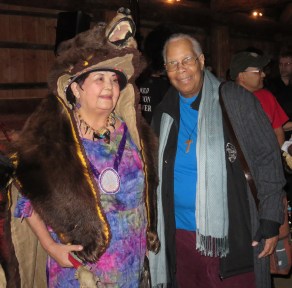
Vikki Marie and a St’at’imc Bear Dancer praying for healing and protecting wild salmon.
Easter 3(B)
Acts 3:1-21
By The Rev. Dr. Victoria Marie
The liturgical season of Easter is the only time that our readings are all from the New Testament. During this season the first readings are from the Acts of the Apostles. Today’s reading from Acts is another occasion where our Roman Catholic Lectionary differs from the Revised Common Lectionary and omits scripture verses. This textual omission significantly changes the meaning and therefore our understanding of the scriptural message.
Tanker in the Burrard Inlet near the proposed end of the Kinder Morgan Transmountain pipeline
This liturgical resource was assembled by members of Salal + Cedar (www.salalandcedar.com) and Earthkeepers (www.theearthkeepers.org) two Christian environmental groups on Coast Salish Territory, lower mainland British Columbia who host an Ecological Stations of the Cross each year during Holy Week. Stations of the Cross are a Good Friday tradition of prayer and contemplation on images depicting the events from the time that Jesus is sentenced to death to his burial. We walk outdoors at a site slated for the expansion of a tar-sands bearing pipeline and draw connections between Jesus’ suffering and the suffering and betrayal of creation. The traditional passion narrative from John (18:1-19:42) moves from the betrayal and arrest in the garden to Jesus’ burial. Our stations include action, poetry, song and contemplation when we read from John we use the word Judeans (a more accurate and less anti-semetic translation) instead of “the Jews.” Themes include: repentance, culpability, betrayal, complicity, empire, suffering, compassion, power/powerlessness, death, lament, longing despair, hope and hopelessness, outrage.
Coast Salish Territory Water Station (overlook)
Come all you who are thirsty, come to the waters. Isaiah 55:1
And Jesus, knowing that all was now finished said, “I thirst.” John 19:28
Here where Fraser River, the Sto:lo, flows into the Salish Sea, where parts of our region are temperate rainforest, our reservoirs are full and we consign gallons of clean drinking water to the sewers with every flush –we can forget, or even ignore, those who thirst. Continue reading “Ecological Stations of the Cross”→
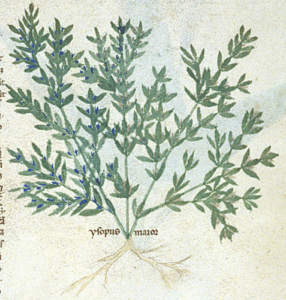
The psalmist says “purge me with hyssop” –clean me with a scrubby aromatic plant.
Mediterranean Hyssop— Hyssopus officinalis is a pungent-leafed bush with blue flowers that is used medicinally, mostly in teas as an expectorant, antiseptic and for cough relief. But the qualities that the bible ascribes to Hyssop: it grows in walls, can hold moisture, has a long, stiff stalk, has a purgative effect, appear in no one plant. Other suggested candidates for biblical Hyssop include caper, Syrian oregano, and za’atar a word which Palestinians use for a family of aromatic herbs (and the ubiquitous condiment made from their dried leaves). Continue reading “Wild Lectionary: Purge Me with Hyssop”→
Today’s gospel reading contains perhaps the best-known verse in the bible, certainly the New Testament passage that is known best in modern North America.
I recently moved from southern Ontario near Toronto to a north-ish rural community near Bancroft, Ontario – north-ish because we are really at the southern end of the north. My partner and I live most of the time in the manse in town, where she is the minister, and the rest of the time in the cabin on a 64-acre piece of mostly forested Land which has been deemed “marginal agriculture” by those who are supposed to know these things. I left my congregational ministry position to move here to live and labour on the Land and in this community. It has never been my dream to be a farmer, but I keep reminding myself that the Spirit moves in mysterious ways and that I may just bloom where I am planted. Continue reading “Wild Lectionary: Thoughts from a reluctant farmer”→
A little over a year ago as I entered the season of lent, I was feeling close to Jesus in a way I never had before. I was attending Catechism classes at my parish while preparing for my impending baptism- a time in my life that would mark a significant transition. At least that was the transition that I was preparing for publicly. Privately I was preparing for a different kind of transition. I knew that shortly I would be showing my whole self to people for the first time ever. This was the season I spent preparing to be honest with others (and honest with myself) about my gender identity as a trans person. Continue reading “Wild Lectionary: Meeting Myself in the Mountains”→
Water flows through our ancient Judeo-Christian texts. Righteousness pours down like a mighty stream (Amos 5:24), and Jesus offers relief to those who thirst (John 4:13–15). Before whales or eagles or humans did, God dwelt among the waters (Gen 1). The creation of heaven and earth commenced through a parting of the seas. Rains fell, destroying all creatures except those aboard an ark, awaiting a rainbow covenant that promised an end to the waters of judgment (Gen 9:11–17). The Israelites flee from their oppressors to freedom through the miracle of a parting sea that offered safe passage from empire into the wilderness (Exod 14). In the Gospels, Jesus was baptized into the wildness of the river Jordan (Mark 1:9f), became living water at the well (John 4), and shed tears over Jerusalem (Luke 19:41). From the beginning, water has offered a call to discipleship. Continue reading “Wild Lectionary: God’s Gonna Trouble the Waters”→
“Six days later, Jesus took with him Peter and James and John, and led them up a high mountain apart, by themselves.” (Mk 9.2)
It has been a long, wet, grey, dark winter so far here in the Issaquah Creek watershed. While we have been spared the intense cold and massive snowfalls visited upon our sisters and brothers to the east, the relentless “parade of storms” from the Pacific Ocean (as local weatherfolk like to call it) can wear away at even the most committed pluviophile. Continue reading “Wild Lectionary: Transfiguration”→
Sometimes I am asked why the Bible, especially the Hebrew Bible, says that we should “fear” God, who is love. Psalm 111:10 The fear of the Lord is the beginning of wisdom; all those who practice it have a good understanding.
“Have you not known, have you not heard?” says God in Isaiah this week. It is God who sits above the circle of the earth. We, the inhabitants of this planet, are like grasshoppers. God stretches a curtain of heaven for us, as a tent. God is reassuring here: this defeat, this moment in history, this war is not the big story. The story is so much bigger. God brings princes to naught and makes rulers of the earth like dead plants blown in the wind. Continue reading “Wild Lectionary: Awe”→
As to the eating of food offered to idols, we know that “no idol in the world really exists,” and that “there is no God but one.” Indeed, even though there may be so-called gods in heaven or on earth–as in fact there are many gods and many lords– yet for us there is one God, the Father, from whom are all things and for whom we exist, and one Lord, Jesus Christ, through whom are all things and through whom we exist.
“Food will not bring us close to God.” We are no worse off if we do not eat, and no better off if we do.
By David Pritchett
Fireflies and Feathers: Two Kinds of Farming
The summer of 2012 was hot in the Midwest. By the fourth week of temperatures over 90 degrees, and over two months without rain, the grass was brown and our crops in Northeastern Indiana were not faring any better. Continue reading “Wild Lectionary: What We Do with Our Bodies”→


 Lent 5B
 Lent 3B
 Lent 1B

 Epiphany 4B
 Radical Discipleship