Towards a Spirituality of Activism

Just JesusBy Tommy Airey

God, help me to refuse ever to accept evil; by your Spirit empower me to work for change precisely where and how you call me; and free me from thinking I have to do everything.
Walter Wink, Engaging the Powers (1992)

On the day we met Bill Wylie-Kellermann back in the summer of ’13, we naively asked him how many times he’d been arrested for acts of civil disobedience: “I stopped counting at 50,” he muttered matter-of-factly. Between sermons and sacraments, Pastor Bill is committed to hitting the streets, participating in what he calls “liturgical direct action.”
Continue reading “Towards a Spirituality of Activism”

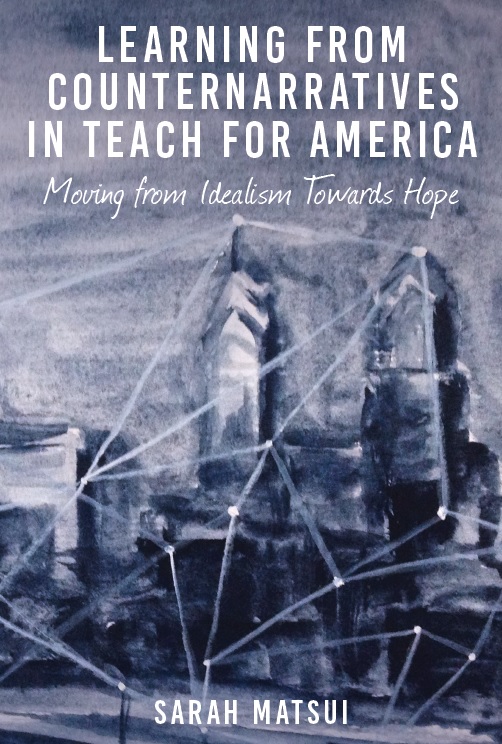
Learning From Counternarratives

LearningThe “achievement gap” is often presented as an isolated phenomenon, and it has become a misleading euphemism for the workings and product of historic oppression, structural injustice, and institutional racism.
Sarah Matsui, Learning From Counternarratives in Teach for America: Moving from Idealism Towards Hope (2015)

True generosity consists precisely in fighting to destroy the causes that nourish false charity.
Paolo Freire, The Pedagogy of the Oppressed (1972)

When Sarah Matsui graduated from Penn, she was accepted to the competitive Teach For America (TFA) program, a two-year teaching odyssey in urban and rural schools all over North America. More than $300 million strong and heralding education reform through meritocratic slogans like “Work Hard, Get Smart,“ Data-Driven” and “Closing the Achievement Gap,” for the past 25 years TFA has successfully recruited the highest caliber graduates from top U.S. schools to heroically stride into the nation’s most under-resourced classrooms. Continue reading “Learning From Counternarratives”

Activism: An Irenic, Inclusive & Intentional Vision

MLPBy Tommy Airey

We are not to simply bandage the wounds of victims beneath the wheels of injustice, we are to drive a spike into the wheel itself.
Dietrich Bonhoeffer

Right after Andrew educated me on the elaborate formula he uses to determine his weekly lotto number, Will stared me down intensely, proclaiming “It’s happening and I’m gonna need a ride to the airport.” This was probably the sixth time he’d told me this since arriving in Detroit less than a year ago (so far it hasn’t happened and he hasn’t needed a ride). Eternally glued to his smart phone, he has been taking money out of his monthly SSI check to “invest” in a business that he is utterly convinced will deliver him two planes with $100 million so, as he puts it, he can “get out of this shit hole.”
Continue reading “Activism: An Irenic, Inclusive & Intentional Vision”

Cape Blanco

DSC01515By Tommy Airey

For Dianne, my soft-spoken spiritual director who calmly and confidently predicted, “I imagine that your trip to Oregon will be even more enlightening that you expect.” And for Peter, an artist, pilgrim and guide whose seven-space opened up for us one vista after another.

He calmly announced that
gratitude unlocks
the fullness of life.
Continue reading “Cape Blanco”

White Supremacy: The Air We Breathe

An alley just off 23rd & Butternut in Detroit.

By Tommy Airey
—————–
The Confederacy is a southern thing, but white supremacy is not.
Bree Newsome

Economist Paul Krugman came out with a piece last week in The New York Times lambasting the South for its ongoing racist drama, while proclaiming “we really have become much less racist, and in general a much more tolerant society on many fronts.”

He scaffolded his arguments with two key economic studies: one that studied the massive white working class exodus away from the Democratic Party in the 70s and 80s (the Southern Strategy) and another that pegged the downsizing of the U.S. welfare state to racial discrimination. Krugman argues that, unfortunately, these forces are still very powerful in the U.S., beckoning readers to take a quick glance at the states that have denied Medicaid expansion to its residents. Surprise, surprise: almost of them are in the South.
Continue reading “White Supremacy: The Air We Breathe”

The Good News on Masculinity: There is Another Way

jim harbaughIn patriarchal culture males are not allowed simply to be who they are and to glory in their unique identity. Their value is always determined by what they do. In an anti-patriarchal culture males do not have to prove their value and worth. They know from birth that simply being gives them value, the right to be cherished and loved.
bell hooks, The Will to Change: Men, Masculinity, and Love (2004)
—————–
Lydia Wylie-Kellermann and Tommy Airey, co-editors of RadicalDiscipleship.Net & “backdoor neighbors” in Detroit, are both white and both come up solid INFJs on the Myers-Briggs personality test. When it comes to the Enneagram, Lydia is a 2 with a 3 wing. Tommy is a 3 with a 2 wing. But the similarities may end there. Lydia grew up in Detroit, is in a traditional same-sex marriage, the mother of a 2-year-old, a disciple of the Harry Potter series, an avid gardener and knitter. Tommy grew up in suburban Southern California, is scandalously married to a former student, an avid distance runner and starts every morning sipping on home-roasted coffee, journaling and reading the sports page and academic theology. Below is the transcript of an eDialogue we recently had on the current state of North American masculinity.
——————
TA: I’m not sure if you are familiar with Jim Harbaugh (photo above: in a recent game of shirts and skins). He might be the most popular white guy in Michigan right now. The University of Michigan recently signed him to a $7 million per year contract to be their football coach. He’s coaching football clinics all over North America to try to recruit the best players to play in your native Michigan. I came across this quote last week: Continue reading “The Good News on Masculinity: There is Another Way”

A Post Evangelical Pilgrimage, Part III

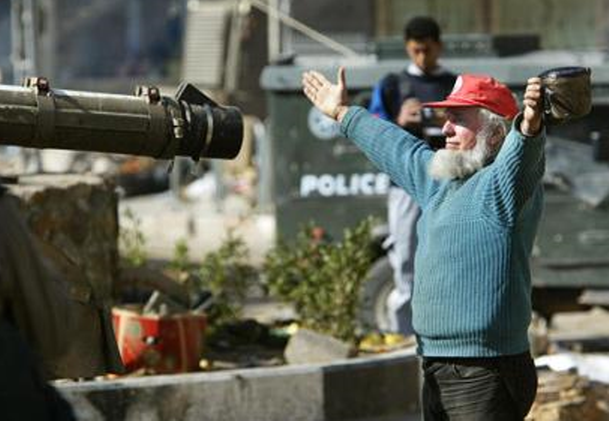
Christian Peacemaker Teammate Art Gish in Hebron in 2003 standing in front of an Israeli tank to try to stop it destroying a market in the Old City (AP Photo).
We mislead ourselves and others when we try to play down the extremity of the Christian vocation and the total demands it makes.
John Main

*This is the final post in a three-part series exploring more compelling ways to follow Jesus.

During the summer of 2013, Lindsay and I took a 75-day, 12,000-mile road trip. We simply wanted to meet people whose lives of faith were compelling. We wanted to get a taste test of what some might call “Movement Christianity” or “Radical Discipleship” (radical in Latin means “roots”), a particular strand of faith and action that goes all the way back to the roots of Judeo-Christian faith: Moses’ contemplative meeting with the Divine at the burning bush and his ensuing confrontation with the beastly bastards of Egyptian Empire, calling the underdogs out of enslavement and into a whole new Way of being.
Continue reading “A Post Evangelical Pilgrimage, Part III”

A Post-Evangelical Pilgrimage, Part II

MLKBy Tommy Airey

*This is the second post in a three-part series exploring more compelling ways to follow Jesus.

On the one hand we are called to play the good Samaritan on life’s roadside; but that will be only an initial act. One day we must come to see that the whole Jericho road must be transformed so that men and women will not be constantly beaten and robbed as they make their journey on life’s highway.
Martin Luther King, April 4, 1967

In a conversation we were having on a prairie highway about 30 kilometers north of Saskatoon, Ched Myers, predictably, got pedagogical. “When we become jaded or wounded, one of three things happens,” he exhorted.

1. We blame others and stay in denial, inflicting our pathologies on to others.
2. We bail out or burn out, escaping into a myriad of copings.
3. We traverse the road-less-traveled: we do the hard work of personal inventory.

Over the course of the past decade, as my Evangelical categories crumbled in the face of experience, theological reading, deep dialogue, prayer and social analysis, I’ve struggled through all three of these phases.
Continue reading “A Post-Evangelical Pilgrimage, Part II”

A Post-Evangelical Pilgrimage, Part I

evangelical TimeBy Tommy Airey

*The first in a three-part series exploring more compelling ways to follow Jesus.

…the essence of Christianity is itself an essentially contested concept.
James McClendon, Doctrine (1992)

I was inducted into North American Evangelical Christianity in 1983 while attending the Christian elementary school where my mom got a job teaching 5th grade. I was in the 4th grade and my teacher, whom I loved, rhythmically proclaimed:

God said it, I believe it and that settles it.

This was after daily prayer and Bible readings in class. End of conversation. No debate or diversity. It’s settled. Period. I remember the rush of certainty and triumph that would flood my heart and mind.
Continue reading “A Post-Evangelical Pilgrimage, Part I”